
Author
Anđela Mićanović
Published on: Jun 3rd 2026
Publication
For two decades, the European Union has approached the Western Balkans as if democracy and stability were competing goods – as if a degree of democratic erosion were a price worth paying for a quiet neighbourhood. At the annual conference of the Montenegrin Political Science Association (MoPSA), held in cooperation with the Faculty of Political Science of the University of Montenegro, ESILUX researcher Dr. Anđela Mićanović challenged that assumption. Her central argument was straightforward: democratic backsliding in Southeast Europe is not a normative cost the Union can choose to tolerate. It is a strategic liability that ultimately undermines European security itself.
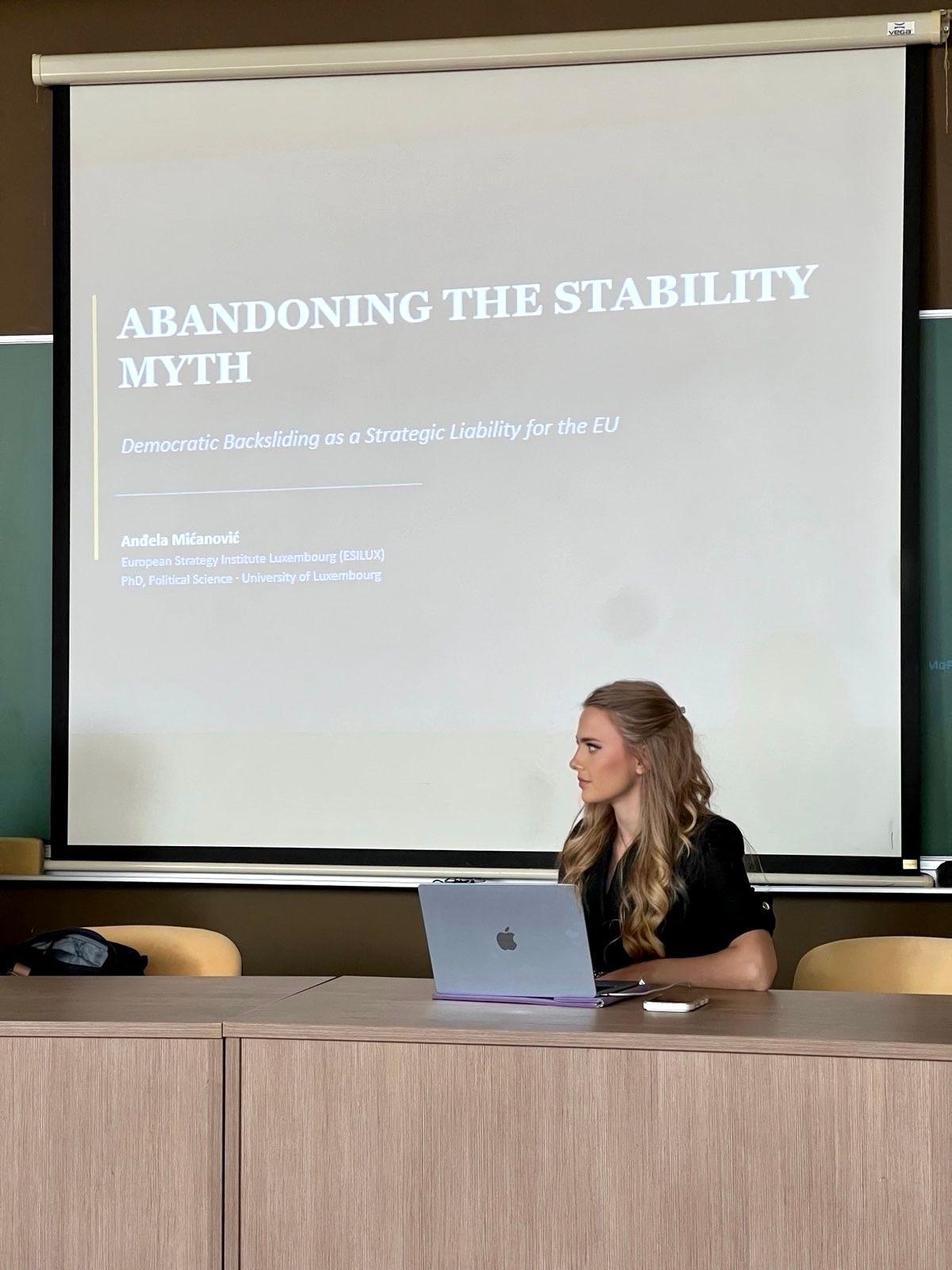
On 25-26 May, ESILUX Research Fellow Dr. Anđela Mićanović attended an annual conference organised by the Montenegrin Political Science Association (MoPSA), where she presented her study on the democratic backsliding in Southeast Europe.
The conference held in Budva (Montenegro) took place against the backdrop of a broader debate about the future of democracy in what many scholars now describe as a postliberal international order. Discussions throughout the opening panel questioned assumptions that had long guided European and transatlantic policy: that liberal democracy would continue to expand, that democratic consolidation would prove largely irreversible, and that the United States would remain the principal guarantor of the European security order. Among the keynote interventions, Daniel Serwer of Johns Hopkins SAIS argued that Europe can no longer take American security guarantees for granted and must increasingly rely on its own political and strategic capacities. Montenegro, he cautioned, should not assume sustained U.S. support for its European trajectory as Washington's foreign policy becomes more transactional and inward-looking.
From Stability to Risk: Democratic Backsliding as an EU Security Challenge
Dr. Mićanović’s paper “Abandoning the Stability Myth: Democratic Backsliding as a Strategic Liability for the EU” took this diagnosis as its starting point and asked a related question: if Europe must increasingly provide for its own security, how well is the EU serving its strategic interests through the policies it pursues in its immediate neighborhood? Her analysis focused on a persistent tension at the heart of the EU's approach to the Western Balkans. While enlargement policy formally prioritizes democracy, rule of law, and institutional reform, implementation has often rewarded short-term stability, cooperation with incumbent elites, and crisis management. The reason, she argued, lies in what the Union has chosen to treat as genuinely threatening. Drawing on securitization theory, which examines how political actors define and prioritize existential threats, the paper tends to show how the EU gradually securitized migration, geopolitical competition, and regional instability, while treating democratic erosion as a largely domestic issue that could be addressed later. As a result, state capture, institutional weakening, and democratic backsliding increasingly fell outside the sphere of urgent political concern.
The consequences followed almost mechanically. Once instability becomes the primary threat and democratic quality a secondary consideration, incentives shift toward supporting actors capable of maintaining short-term order regardless of how they govern. This dynamic has become a defining feature of what scholars describe as stabilitocracy: political systems in which governments receive external support for delivering stability while democratic standards gradually deteriorate. The paper argues that this logic ultimately produces the opposite of its intended effect. A Union that allows institutional fragility to take root on its own periphery is not purchasing stability; it is accumulating exposure. Weak institutions generate governance crises, undermine resilience, increase susceptibility to external influence, and reduce the capacity of states to manage future shocks. What appears as stability in the short term often masks vulnerabilities that emerge later at significantly higher political cost.
EU Enlargement as a Strategic Security Asset
The argument builds on Dr. Mićanović’s broader research on EU enlargement policy and its strategic dimensions. Her previous work “Operational Enlargement: Why Montenegro Matters Beyond Montenegro” has emphasized that the credibility of enlargement is itself a strategic asset and that accession policy is most effective when treated as a genuine political project rather than primarily as a tool of crisis management. The MoPSA paper explored the reverse side of this proposition. If credibility is an asset, then the accommodation of democratic backsliding is precisely what depletes it. From this perspective, enlargement policy extends beyond the question of integration alone. It increasingly represents a matter of European security. A credible accession process strengthens institutional capacity, enhances democratic resilience, and reduces the governance vulnerabilities that external actors can exploit for geopolitical influence. Conversely, when the credibility of enlargement erodes, the consequences are not limited to stalled democratization. The result is a weakening of institutional resilience, greater exposure to external leverage, and a gradual deterioration of the Union’s long-term strategic position in its immediate neighborhood.
For ESILUX, engagement in debates of this kind reflects the Institute’s commitment to evidence-based analysis of Europe’s strategic and institutional future. As the external environment grows less forgiving and the guarantees of an earlier era can no longer be assumed, Dr Mićanović’s paper offers European policymakers a constructive proposition: that the surest route to a stable neighbourhood runs through, not around, the democratic standards the Union already claims as its own.
Photo credit: Pexels.com.