Strategic Notes
Oleksiy Kandyuk
Published on: Jul 14th 2026
This Policy Analysis examines the emergence of “armed integration”: Ukraine’s accelerating incorporation into Europe’s defence-industrial, security, and economic architecture ahead of full EU or NATO membership. It argues that this pattern reflects both strategic necessity and institutional blockage. While defence procurement, industrial cooperation, and single-market alignment can advance through flexible EU instruments, formal accession remains constrained by unanimity, budgetary politics, and enlargement fatigue. The analysis maps four possible trajectories: pragmatic drift into EEA-plus armed non-alignment; a “Helsinki Path” toward EU membership with a strong national army; defence-first integration without accession; and a fragmented bilateral-security model. It concludes that armed integration can serve Europe and Ukraine only if designed as a transitional bridge, not a permanent substitute for membership. To avoid a “Turkey trap” of indefinite intermediate status, the EU should make EEA-plus explicitly time-bound, secure long-term defence financing, and operationalise Article 42(7) TEU.
Download PDFRussia’s war and Ukraine’s June 2022 candidate status turned European integration from a hypothetical into an operational task. Four years on, the result is an uncomfortable asymmetry that the European Union has built largely by accident: Ukraine is being integrated into Europe’s defence-industrial and economic architecture far faster than into its political institutions. Joint defence procurement, single-market alignment and security-sector cooperation advance through channels that do not require unanimity, while the formal accession track – which does – moves only in fits and starts.
This creates a real strategic opportunity. Europe can lock in the security and economic substance of integration with Ukraine now, without waiting for the political stars to align for full membership. But it also creates a serious risk. The instruments that make partial integration so attractive in the short term – they dissolve the binding constraints of accession – are precisely the ones that make exit from it costly later. An arrangement designed as an interim step can quietly become a permanent one. A bridge can become a waiting room without anyone ever deciding that it should.
That is the dilemma for decision-makers in Brussels and Kyiv. The question is no longer whether this new mode of integration exists – it manifestly does – but whether the EU and Ukraine will steer it as a transition toward membership or let it settle as a substitute for it. The difference will not be decided by declarations. It will be decided in real time, through the design of specific instruments, the wording of negotiating mandates, the structure of financing, and the terms of any eventual peace. This analysis labels the emerging arrangement armed integration, sets out why it has arisen, maps the four shapes it can take, weighs their costs and benefits for both sides, and ends with concrete steps to keep it transitional and accession-oriented, rather than permanent.
Armed integration is the integration of Ukraine into the European security and economic order ahead of – and partly in place of – full EU and NATO membership, on a defence-first track. It builds on the classical logic of European integration. That logic assumed NATO would supply security while economic and political accession followed reform. Here the sequence is similar, though with important differences due to the geopolitical context. Security is built first under the pressure of armed conflict; and it is built largely separately from political and economic integration. In other words, the political and economic integration which played a huge role in solving the security problem of Eastern Europe after the Cold War takes a back seat.
The architecture of armed integration rests on a simple triangle. The first pillar is a rapidly expanding Ukrainian defence-industrial base, moving toward partial operational self-reliance while still dependent on continued European financing, procurement and political support. The second is deep economic integration through an EEA-plus framework – single-market access and regulatory alignment that delivers most of the gains of membership while leaving formal accession on a slower technical track. The third is defence-industrial partnership through the EU’s common instruments: PESCO, the SAFE procurement facility, the European Defence Industry Programme (EDIP) and the European Defence Fund.
Each of these three pillars is clearly observable today. The point that matters for European policy makers – in Kyiv, Brussels and throughout the continent – however, is this: under wartime conditions the EU may be creating a new form of partial membership, and that form can either prepare Ukraine for full accession or trap it outside the Union’s political institutions. Which of these two scenarios ends up materializing is not predetermined, but depends on the choices being made moving forward.
Armed integration is nobody’s grand design. It is the path of least resistance produced by five pressures pushing in the same direction. Each of these pressures is independently visible; together they make this the route the system takes when the direct route is blocked.
1. War and an expanding Ukrainian defence industry. The war has forced Ukraine to build a defence industry at extraordinary speed. Output valued at roughly one billion dollars before 2022 is projected by Kyiv’s own count at fifty to sixty billion dollars in 2026 – tens of times the pre-war level. Drone production has scaled toward a seven-million-unit annual target, and overall capacity rose by about three-quarters across 2024–25.[1] This is a movement toward greater military self-reliance under continued European support, but it does not mean self-sufficiency: Ukraine remains heavily dependent on external financing and procurement. Nevertheless, the scale of the country’s defence industry is already large enough to turn Ukraine into a capability supplier to Europe. For instance, in early 2026 Kyiv announced defence-export centres across the continent, giving European partners a direct industrial stake.
2. US uncertainty. The reliability of the American security guarantee can no longer be assumed. Continued US disengagement from European security has removed the background certainty on which the old division of labour rested – NATO for defence, the EU for prosperity. With that certainty gone, Europe must supply more of its own deterrence, and Ukraine’s armed forces and defence industry have become part of the answer rather than a problem to be parked until after accession.
3. EU unanimity constraints. Accession requires unanimity at almost every step, which hands any single member state a veto. The Hungarian government blocked the opening of accession clusters and the adoption of the December 2025 enlargement conclusions. Although the change of government in Budapest removed this obstacle, it did not instantly reverse the effects of earlier obstructions.[2] Defence-industrial and economic cooperation, by contrast, can advance through co-decision and qualified-majority channels that no single capital can halt. Faced with one track that can be blocked and another that cannot, Brussels has routed as much progress as possible through the latter – integration by instrument rather than by treaty.
4. Defence-industrial needs. Europe’s own rearmament has created instruments into which Ukraine fits naturally. The SAFE facility opened joint procurement under a €150 billion envelope; of the nineteen national plans submitted by late 2025, fifteen included projects with Ukrainian industry.[3] EDIP’s work programme made Ukrainian companies fully eligible applicants for an EU defence funding instrument for the first time,[4] and the European Defence Fund committed over a billion euros to dozens of projects with Ukraine-relevant priorities.[5] The NATO Hague targets of June 2025 – 3.5% of GDP for core defence and a further 1.5% for resilience by 2035 – locked in a spending trajectory that Ukrainian capacity helps fill.[6]
5. The slow accession track. Finally, the political appetite for enlargement is constrained. EU-wide support for further enlargement stood at 56% in spring 2025 but only 43–45% in Austria, France and Czechia.[7] Furthermore, current estimates indicate that a Ukrainian accession could require €15–20 billion per year in additional EU spending, requiring budget reforms the Union has not yet undertaken.[8] The Commission’s practical answer has been a “frontloading” strategy: advancing technical preparation bilaterally with Ukraine without waiting for unanimous agreement on the opening of accession cluster.[9] The asymmetry between the fast defence track and the slow political track therefore cannot be seen as anything else but the equilibrium the system settles into under these five pressures.
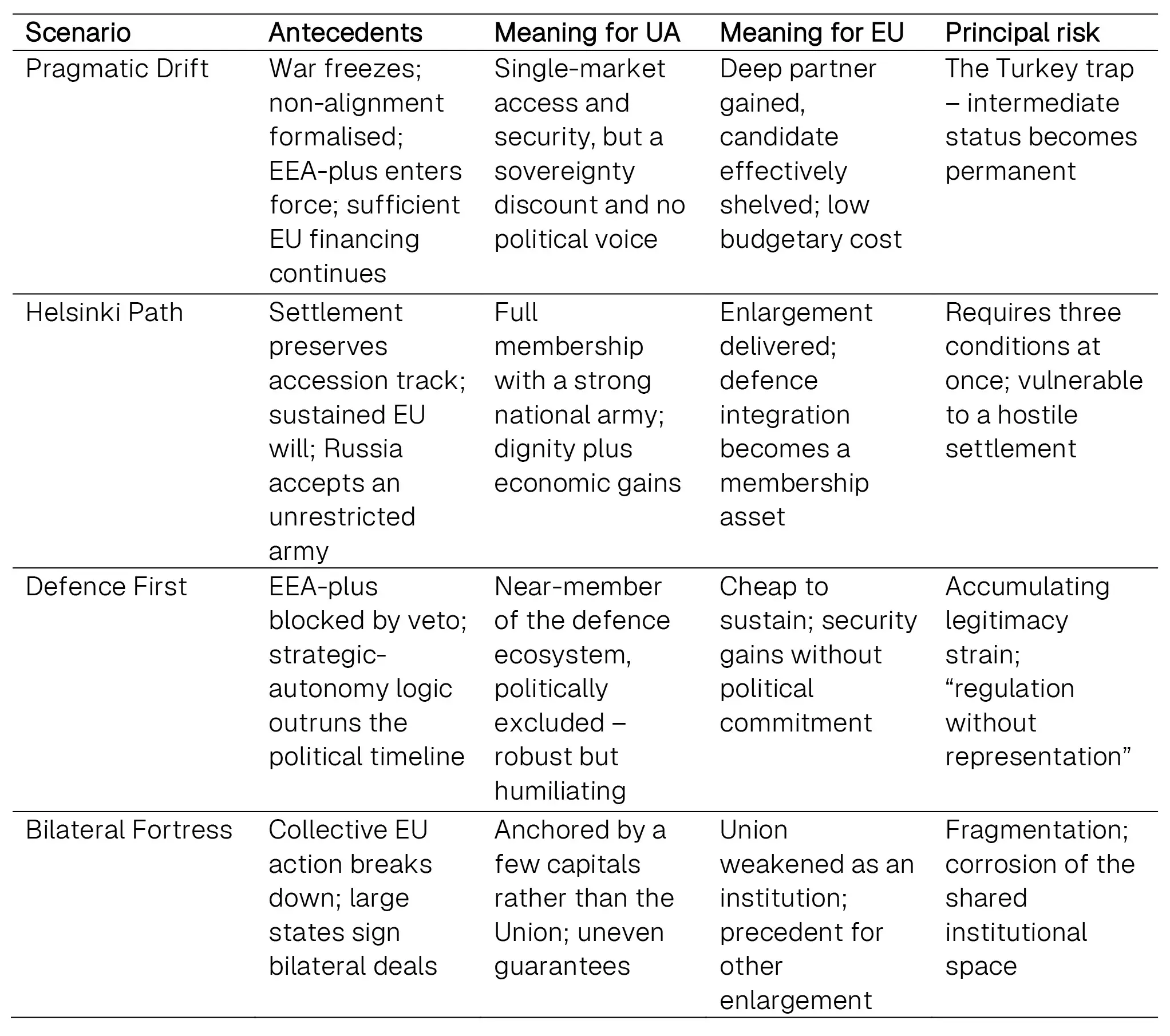
Within this armed-integration frame, four scenarios for near-term development are visible. They are not mutually exclusive forecasts but plausible end-states between which the actual trajectory is likely to oscillate. They are decisively determined by the interaction of two variables that, by 2026, move together. The first is the shape of any future peace settlement: whether it preserves Ukraine’s accession track and an unrestricted national army or imposes capability caps and constitutional neutrality. And the second is the character of the EU’s institutional response: collective action through SAFE, EDIP and the accession framework, or fragmented action through bilateral coalitions of the willing. Because the peace process and the integration process have effectively fused, movement on one variable constrains the other – the terms on which the war ends set the limits of what armed integration can be, and the Union’s institutional choices are partly a hedge against the settlements that are plausible. Here we label those four scenarios as: 1) the pragmatic drift, 2) the Helsinki path, 3) defence first, and 4) the bilateral fortress.
If the war freezes along the current contact line – a ceasefire without a formal political settlement – and Kyiv's posture remains one of de facto non-alignment (not by choice, but because no alliance framework has admitted it and no settlement has resolved its status), sustaining its armed forces at current levels under that posture the most likely outcome is armed non-alignment paired with EEA-plus.[10] Ukraine would be expected to become largely self-reliant by around 2030; an EEA-plus arrangement would likely have entered into force a year or two earlier, opening the single market and aligning Ukrainian regulators with EU rules; and participation in PESCO and the European Defence Fund would continue on a non-member basis.
This is analytically the purest expression of the Armed Integration concept and the most comfortable outcome from the perspective of Brussels’ political economy: deep integration without budgetary restructuring, without the redistributive conflicts of full accession over agriculture and cohesion funds, and without confronting the unanimity-bound politics of the European Council. The EU loses a candidate but gains a deep partner; Ukraine gains the single market but pays a sovereignty discount.
Its cost is the “Turkey trap”: deep economic and security integration without political membership tends to stabilise as a permanent intermediate status. The Turkish precedent – a customs union since 1995, accession talks frozen since 2016 – shows the configuration can persist for decades. Throughout any EEA-plus phase, Ukraine would also face a structural “regulation without representation” problem, adopting EU rules in whose formation it has no formal vote.[11] Whether the sovereignty discount is acceptable depends entirely on one thing: whether the transition to the Helsinki Path remains a live, credible option rather than a receding promise.
The most desirable variant short of accelerated accession is a settlement that does not foreclose the EU path. Ukraine would keep its accession track and join the Union within a 2033–2035 horizon. Article 42(7) TEU codifies the EU’s collective-defence commitment alongside Ukraine’s national capability. The historical analogue is Finland after 1995: an EU membership with a strong army that joined NATOonly later in 2023.[12] For Ukraine, this would eliminate the Turkey trap, deliver the political dignity of membership, lock in the economic gains, and build on the defence-industrial integration already built up under SAFE and EDIP. It is the outcome the EU should be engineering.
It also has demanding preconditions. It requires sustained EU political will and, above all, a Russian decision not to insist on any settlement on constitutional neutrality – the very condition the November 2025 draft peace plan sought to impose.[13] The institutional design challenge is therefore not whether to permit a graded, transitional status to EU membership but how to make the move to the next grade automatic under specified conditions, with explicit triggers for upward movement rather than open-ended discretion. It is the only configuration in which the costs of integration are jointly borne by both parties while full membership is preserved.
A more inverted variant runs the sequence backwards: defence integration precedes accession, propelled by the logic of European strategic autonomy and continued American retrenchment.[14] If a future enlargement-sceptical veto emerges to replace the now-diminished Hungarian one, Ukraine could nonetheless be brought into PESCO and EDF programmes without formal EU membership. The result would be a Ukraine that is operationally and industrially a near-member of the European defence ecosystem while remaining politically excluded from the Union’s institutions. Strategically robust, but politically humiliating.
This pathway is institutionally cheap for the Union and politically costly for Ukraine – the mirror image of the cost distribution under the Pragmatic Drift, where the EU takes on a larger institutional commitment. Its durability depends on the Union’s willingness to fund the security pillar without recognising the political one, a configuration that is sustainable in the short term but accumulates legitimacy strain over an electoral cycle or two. It is the variant most corrosive for the idea that integration and representation belong together.
In the most fragmented scenario, the EU collective framework cannot overcome internal vetoes at all. France, Germany, the United Kingdom and Poland – already the principal donors and procurers under SAFE-aligned national plans – are then likely to conclude bilateral security and economic agreements with Ukraine and become its de facto European anchors. The arrangement could work, but it would weaken the Union as an institution and set a precedent that the Western Balkans and Moldova would surely note. The Union would persist as a legal entity while its substantive integration politics is conducted through ad hoc partnerships – a geopolitical coalition in place of a geopolitical Union.
It is the hardest outcome to govern and the easiest to slide into, because it requires no positive decision at all, only the continued failure of collective action. It is also the variant most likely to spill over to other enlargement files, inviting Tirana, Pristina, Podgorica and Chisinau to read the EU’s handling of Ukraine as the new template.
These scenarios should be seen as heuristics. Their probabilities cannot be easily calculated, though they can be rank ordered. The Pragmatic Drift currently appears the most likely: it requires only the persistence of the military stalemate, the absence of a positive political shock at EU level, and continued sufficient financing. The Helsinki Path is the most desirable but needs three conditions at once – a settlement that preserves the accession track, sustained EU political will, and Russian acceptance of an unrestricted Ukrainian army. Defence First becomes more likely if the strategic-autonomy imperative outruns the political timeline or if a member state blocks EEA-plus. The Bilateral Fortress is the residual default if any EU integration of membership path breaks down entirely. Crucially, movement between scenarios is path-dependent: a year inside one configuration generates commitments that constrain the next move, which is why early choices about EEA-plus design and the framing of a SAFE successor will disproportionately shape the eventual outcome.
Whichever scenario prevails, armed integration is institutionally attractive to the Union in the short term for a number of reasons. Seen clearly, these are also the reasons the comfortable version is so tempting – and therefore so dangerous.
1. Strategic resilience. Armed integration requires only an increasingly self-reliant Ukraine and continuous EU financing. The security pillar is thus largely independent of EU institutional decisions, of Russian behaviour, and of multi-cycle US commitments. This makes it uniquely robust under the layered geopolitical uncertainty of 2026–2030, when US elections and electoral cycles in Germany and France will repeatedly reshuffle the political board.
2. Decoupling security from Council voting. The security question is resolved through Ukrainian capability and defence-industrial integration delivered via qualified-majority CSDP instruments, so no single member state can unilaterally undo it. With enlargement support below half in several member states, that decoupling is the difference between a track that moves and a track that does not.
3. Acceleration of European strategic autonomy. EU–Ukraine defence-industrial cooperation generates domestic interest groups in favour of further autonomy. The Commission’s April 2026 commitment of €1.07 billion to 57 EDF projects, SAFE’s €150 billion envelope drawn down under the first-wave plans, and EDIP’s €1.5 billion programme – including a €300 million Ukraine Support Instrument – together build a constituency for deeper integration that is hard to reverse.[15]
4. Preservation of optionality. EEA-plus does not foreclose future accession; it builds an acquis baseline from which membership can proceed quickly when political conditions allow. The frontloading logic captures exactly this: technical reforms can advance bilaterally with Ukraine without waiting for unanimous cluster openings, keeping the membership option alive at low political cost.
5. Security without escalation. Armed non-alignment, formally outside collective military-political alliances, is legally and politically distinct from classical neutrality: it permits defence cooperation with third states without formal mutual-defence obligations. In principle this is a compromise format more acceptable in any future negotiation than full NATO membership – and one that may reduce, rather than inflame, Russian threat perceptions in a settlement.
6. Institutional economy. Armed integration does not require accession-related budgetary restructuring, does not trigger CAP redistributive conflicts, and does not demand QMV reform or expansion of the own-resources system. The EU obtains most of the strategic gains of integration with Ukraine at a fraction of the political cost of full membership – avoiding the €15–20 billion-a-year transfer burden that accession would imply.[16]
Together these advantages explain why the armed integration is so attractive in the short term: it dissolves the most binding constraints of full accession while preserving the option of something more ambitious later. The same logic, however, generates the principal long-term danger – the conditions that make armed integration comfortable also make exit from it politically costly.
1. The Turkey trap. The most significant risk is the institutional stabilisation of intermediate status – deep integration without membership becoming comfortable for both sides, after which the political momentum for accession dissipates. The Turkish precedent shows this configuration can persist for decades, and nothing about armed integration is automatically self-terminating.
2. Dependence on external defence financing. Armed non-alignment requires sustaining Ukraine’s armed forces at roughly 5–6% of GDP – some €25–30 billion a year, of which Kyiv can cover no more than €10–15 billion from its own budget. There is a five-year build-out window during which sustained European financing is critical;[17] any major shortfall erodes the security foundation before formal membership can supply an institutional anchor, and tips the whole architecture toward the Bilateral Fortress.
3. Russian opportunism. Moscow’s position is fundamentally ambivalent. Any peace acceptable to the Kremlin is likely to demand limits on Ukrainian capability – caps on long-range missiles and ceilings on the size of the armed forces. The November 2025 draft plan circulated a 600,000-personnel ceiling and territorial cessions.[18] Any agreement of that shape would compromise the very foundation of armed integration. The design must therefore preserve enough institutional ambiguity to absorb such demands without surrendering the integration substance.
4. Internal political fracture in Ukraine. A population that expected full membership and paid a high price for it could turn against a leadership seen to accept EEA-plus as a final destination, especially if opponents weaponise the memory of war losses. Support for EU accession was around 90% in 2025, but confidence in the NATO timeline is already collapsing;[19] absent a visible accession trajectory, the domestic consensus that underwrites the European choice could erode.
5. EU strategic complacency. If the intermediate status becomes comfortable, the impulse to complete the transition to membership can simply fade – particularly as competing enlargement demands from the Western Balkans and Moldova absorb institutional bandwidth. Frontloading carries its own paradox: technical preparation can reduce the sense of political urgency it was meant to serve.
6. Institutional (in)adequacy of EEA-plus. The original EEA was designed for three small states whose combined population is smaller than an average EU member. Extending it to a Ukraine of over 35 million people, with a major defence industry and significant agriculture, requires institutional innovation that has not yet been delivered. Its legal nature is also uncertain: as an association treaty or a mixed agreement it would require national ratifications – reproducing the very unanimity problem the doctrine is designed to circumvent.
Taken together, these risks do not invalidate armed integration. They define the active management agenda required to keep it on track: the Turkey trap demands explicit transition criteria; financing dependence demands a multi-annual SAFE successor; the Russian threat demands a coordinated red-line policy on demilitarisation; and EEA-plus must be designed for Ukraine rather than copied from the Norwegian template.
Armed integration is a working architecture, but it should not be allowed to become a destination. While it has its own institutional, financial and geopolitical foundations, it can only succeed as a transitional regime that keeps the horizon of full membership both visible and actionable. Four interventions would keep the track oriented toward accession rather than indefinite suspension, and each has a concrete institutional address.
1. Make EEA-plus explicitly transitional, not terminal — institutionally and politically. Any EEA-plus arrangement should be designed from the outset as a bridge, with built-in automatic review mechanisms: sunset clauses, transition criteria, and explicit linkage to accession-cluster benchmarks. This will ensure that the default is movement toward membership rather than comfortable stasis. Such provisions must be agreed at Council level and reflected in the Commission's negotiating mandate. The legal safeguards need to be matched by an equally explicit political framing in Kyiv: EEA-plus and related arrangements must be described publicly as an interim status rather than a substitute for membership, to forestall the erosion of high but already-fragile public support for European integration. The procedural mechanisms make transitional status enforceable; the honest framing makes it credible. Together they are the cheapest and most important safeguard against the Turkey trap.
2. Put SAFE on a permanent footing. The SAFE facility should be extended beyond its current 2035 horizon and embedded in the next Multiannual Financial Framework as a standing instrument, aligned with the NATO Hague spending trajectory. A multi-annual successor would lock in defence-industrial commitments across political cycles and remove the financing fragility that would otherwise collapse armed integration into the Bilateral Fortress within a single electoral term.
3. Operationalise Article 42(7) of the TEU. The mutual-assistance clause must be equipped with operational infrastructure – typified response plans, integrated command arrangements, synchronised procedures – to convert a treaty provision into a credible deterrent. This is the natural agenda of the next Strategic Compass review and can draw directly on machinery already developed under PESCO and the EDF.
4. Communicate honestly that interim is not final. Political communication in Kyiv must describe EEA-plus and related arrangements as an interim status, not a substitute for membership, to forestall the erosion of very high but already-fragile public support for European integration. Honest framing is the cheapest and most important safeguard against the Turkey trap.
Armed integration should not become a “second-best” option or a mere fallback in case full integration fails. Its durability will depend on whether it is embedded in a credible political narrative that keeps membership in sight. If it stays attached to that horizon, it can anchor Ukraine inside the Union’s core structures before formal entry and make eventual accession almost a formality. If it is decoupled from that horizon, the same architecture will harden into a substitute and quietly redefine the outer limit of enlargement. Success, in the end, will not be measured by the stability of the intermediate framework but by its capacity to remain deliberately incomplete – robust enough to function, yet explicitly built to be outgrown. Armed integration is architecture, in service of the destination.
Oleksiy Kandyuk is a Gerda Henkel Fellow at the University of Konstanz, where he leads the project Democracy Under Siege: Ukraine’s Wartime Integration and European Identity Resilience. He was also a DFG Walter Benjamin Visiting Professor at the University of Konstanz, leading the project EUkraine: Mapping European Scenarios for Ukraine. His research focuses on EU enlargement, Ukraine’s wartime accession, and democratic resilience. He held fellowships at the Hamburg Institute for Advanced Study, Université libre de Bruxelles, University of Padova, the SCRIPTS Cluster of Excellence in Berlin, and Indiana University. He is the Founder and Chairman of ERGOSUM, an expert platform supporting Ukraine’s EU accession.
Photo credit: Leon Aschemann, Pexels; Office of the President of Ukraine.
[1] Illia Kabachynskyi, “Ukraine Built a $50B Defense Industry in Four Years: Here’s Why Exports Matter,” United24 Media, February 24, 2026; Asami Terajima “Ukraine Estimates Its Defense Production Potential to Reach $60 Billion in 2026,” Kyiv Independent, November 7, 2025; Vadim Kushnikov, “Production Capacity of Ukrainian Defense Industry Increased by 75%,” Militarnyi, February 26, 2025.
[2] Jorge Liboreiro, “After Orbán’s Defeat, the EU Faces Tough Questions about Ukraine’s Accession,” Euronews, May 1, 2026.
[3] Emanuele Bonini, “Defence: EU Receives 19 National SAFE Plans; 15 Include Support for Ukraine,” Eunews, December 1, 2025.
[4] Directorate-General for Defence Industry and Space of the European Commission, “EDIP: Commission Adopts €1.5 Billion Work Programme to Boost European and Ukrainian Defence Industry,” press release, March 30, 2026.
[5] Directorate-General for Defence Industry and Space of the European Commission, “Commission to Invest €1.07 Billion in 57 Defence Projects Supporting European Readiness Flagships,” press release, April 15, 2026.
[6] NATO, “The Hague Summit Declaration,” June 25, 2025; Nan Tian, Lorenzo Scarazzato and Jade Guiberteau Ricard, “NATO’s New Spending Target: Challenges and Risks Associated with a Political Signal,” SIPRI, June 27, 2025.
[7] Gregoire Lory, “56% of Citizens Support EU Enlargement, New Eurobarometer Poll Shows,” Euronews, October 28, 2025.
[8] Zsolt Darvas, Marek Dabrowski, Heather Grabbe, Luca Léry Moffat, André Sapir and Georg Zachmann, “The Impact on the European Union of Ukraine’s Potential Future Accession,” Bruegel Report, 02/2024.
[9] Reinhold Brender, “Legitimacy Under Fire: How Ukraine Governs Without Elections,” Egmont Policy Brief 400, February 2026.
[10] Jennifer Kavanagh, “An Armed Nonalignment Model for Ukraine’s Postwar Security,” Defense Priorities, December 2025.
[11] Erik O. Eriksen and John Erik Fossum, eds., The European Union’s Non-Members: Independence under Hegemony? (London: Routledge, 2015).
[12] Anna Maria Josefiina Savolainen, “Mechanisms of Threat: How Finland and Sweden Abandoned Non-Alignment,” Comparative Strategy 43, no. 2 (2024): 87–103.
[13] Mark F. Cancian and Maria Snegovaya, “The Unfinished Plan for Peace in Ukraine: Provision by Provision,” CSIS, November 2025.
[14] Sven Biscop, This Is Not a New World Order: Europe Rediscovers Geopolitics, from Ukraine to Taiwan (Owl Press, 2024); Erik Jones, “Europe Resolved: The Drumbeat of Strategic Autonomy,” Survival 67, no. 5 (2025): 7–38; Erik Jones, “Transatlantic Rupture: Legitimacy, Integration and Security,” Survival 67, no. 2 (2025): 69–84.
[15] Directorate-General for Defence Industry and Space of the European Commission, “Commission to Invest”; Directorate-General for Defence Industry and Space of the European Commission, “Commission Approves First Wave of Defence Funding for Eight Member States under SAFE,” press release, January 15, 2026,; Directorate-General for Defence Industry and Space of the European Commission, “EDIP.”
[16] Darvas, et al. “The Impact on the European Union.”
[17] Jennifer Kavanagh, “Armed Nonalignment Model.”
[18] Bronwen Maddox, “Trump’s 28-Point ‘Peace Plan’ Marks Europe’s Last Chance to Stand Up for Ukraine,” Chatham House, November 24, 2025.
[19] International Republican Institute, “Ukraine: Public Opinion Wave, July 2025,” August 18, 2025; Alex Stezhensky, “Gallup: Record 33% of Ukrainians Believe NATO Membership Will Never Happen,” New Voice of Ukraine, August 7, 2025.