Author
Josip Glaurdić
Published on: Nov 3rd 2026
Publication
What do citizens of divided societies actually want from their political institutions? At a UN event in New York, ESILUX President Josip Glaurdić presented new research from Bosnia and Herzegovina challenging conventional assumptions about ethnic divisions and constitutional preferences. The discussion highlighted the importance of bringing citizens' voices into peacebuilding and political reform, with lessons extending well beyond Bosnia and Herzegovina.
Table of Contents
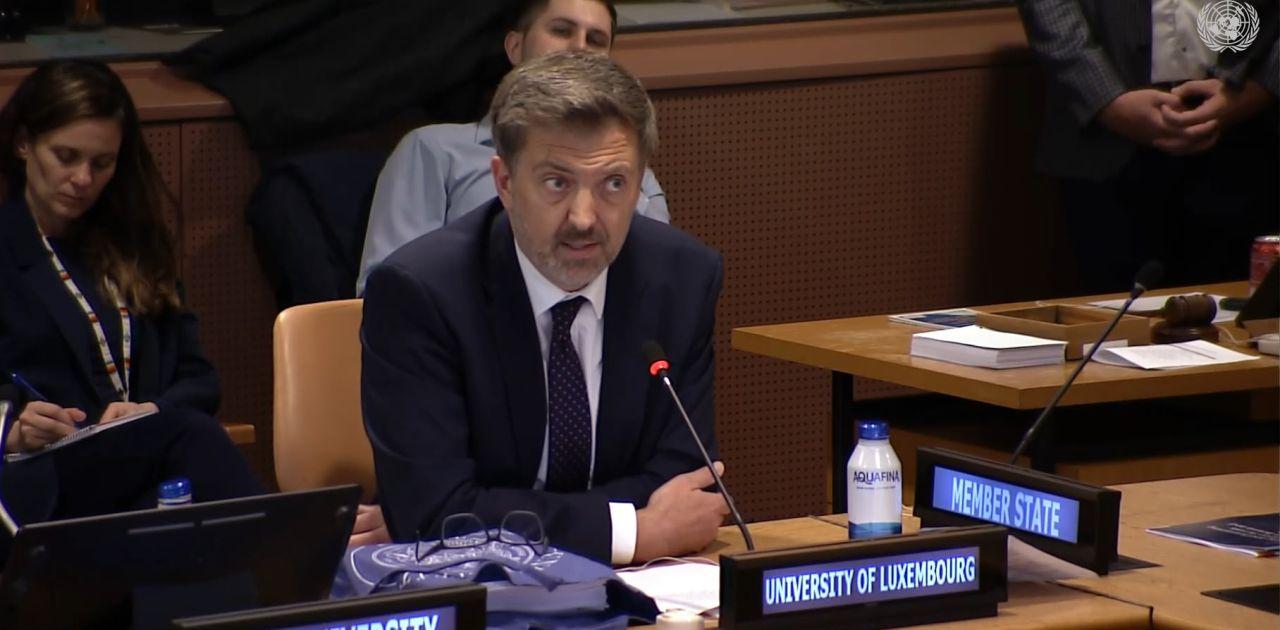
What happens when we stop asking political leaders what their communities want and start asking citizens themselves? This question was at the heart of a United Nations roundtable in New York on 26 October, where Professor Josip Glaurdić, President of the European Strategy Institute Luxembourg (ESILUX) and Professor of Political Science at the University of Luxembourg, presented new findings on constitutional preferences in Bosnia and Herzegovina.
The event, “Recentering Citizens in Peace and Political Progress,” was co-organized by the Permanent Missions of Luxembourg and Bosnia and Herzegovina and the Delegation of the European Union to the UN, in collaboration with the United States–Bosnia and Herzegovina Exchange Council. It brought together senior UN officials, diplomats, researchers, and representatives of civil society to discuss how citizens can contribute more meaningfully to peacebuilding and political progress.
Among the participants were Luxembourg's Ambassador to the UN Véronique Dockendorf, Bosnia and Herzegovina's Ambassador Zlatko Lagumdžija, UN Assistant Secretary-General for Peacebuilding and Peace Support Elizabeth Spehar, and UN Special Adviser on the Responsibility to Protect Mô Bleeker.
What do citizens actually want?
More than thirty years after the Dayton Peace Agreement ended the Bosnian War, Bosnia and Herzegovina remains trapped in constitutional disputes and political disagreements often presented as conflicts between three ethnically defined communities.
But do ordinary citizens see things in quite the same way?
Drawing on the University of Luxembourg's CONSENT BiH research project, Glaurdić presented findings from interviews, focus groups, and a nationally representative survey of more than 2,000 citizens.
The results challenge some conventional assumptions about the country's divisions. Across ethnic communities, citizens display remarkably similar broader ideological orientations and share important expectations of their political institutions.
When asked what their constitution should protect, 52% prioritized peace and stability, 49% equal rights, and only 17% the rights of ethnic groups. Judicial independence emerged as the most important constitutional issue across all four ethnic communities.
This does not mean that ethnic divisions have disappeared. They remain substantial on questions involving territorial organization, collective representation, and the distribution of political power.
Yet the research also reveals considerable diversity within ethnic communities. Even on contentious constitutional questions, citizens do not necessarily share the positions of the political leaders claiming to represent them.
As Glaurdić argued, ethnic identity can constrain political preferences without determining a single preferred constitutional solution.
Lessons beyond Bosnia and Herzegovina
The discussion also featured research by Catherine Panter-Brick and David Simon of Yale University, examining how cooperation across ethnic and political divisions already works in practice, and why it so often fails to translate into lasting institutional change. Imran Pašalić of the University of Sarajevo presented the Students' Peace Declaration, highlighting the role of younger generations in building a more peaceful future.
Together, the contributions pointed toward a broader lesson: international peacebuilding cannot rely exclusively on negotiations between political elites. It must also take seriously the preferences, experiences, and capacities of ordinary citizens.
For Luxembourg, the event illustrated how research conducted at its university can contribute to international policy debates and support the country's engagement with multilateral peacebuilding.
The CONSENT BiH project now moves toward testing which combinations of constitutional arrangements citizens might actually accept, including the difficult compromises that meaningful political reform requires.
As Glaurdić concluded: “Recentering citizens does not mean pretending that political divisions have disappeared. It means refusing to let those divisions define the entirety of what is politically possible.”