
Strategic Notes
Josip Glaurdić
Published on: Jul 1st 2026
ESILUX President Josip Glaurdić spoke to Revue about the crisis of American democracy, Trump’s challenge to constitutional norms, and the institutional reforms the US now needs. He warned that Europe cannot simply wait for American recovery, but must build greater digital, political, and defence resilience.
No sections found.
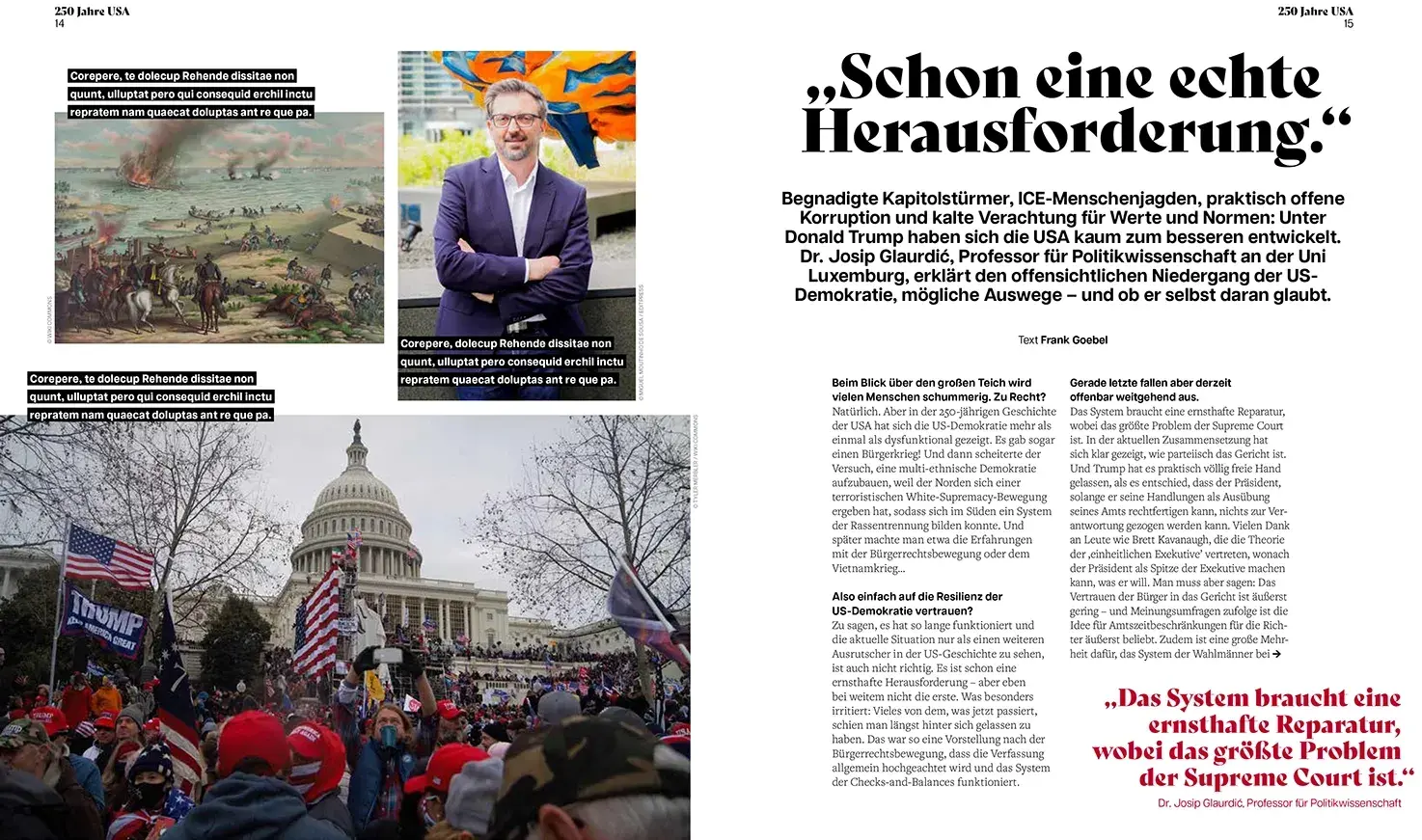
ESILUX President and University of Luxembourg political scientist Josip Glaurdić was interviewed by Revue for a feature marking 250 years of the United States. The conversation examined the condition of American democracy under Donald Trump, the deeper institutional weaknesses of the US political system, and the implications for Europe.
Glaurdić’s central point is that the United States is not facing its first democratic crisis. American democracy has repeatedly shown profound dysfunction: the Civil War, the collapse of Reconstruction, racial segregation in the South, the struggles of the civil rights era, and the Vietnam War all revealed deep conflicts within the American political order. Yet the present moment cannot simply be dismissed as another temporary deviation. What makes the current crisis especially disturbing is that many of the norms once thought to be consolidated after the civil rights era now appear vulnerable again: respect for constitutional restraint, democratic accountability, and the system of checks and balances.
The interview pays particular attention to the Supreme Court. Glaurdić argues that the Court has become one of the central problems of the US constitutional order, especially because of its partisan composition and its expansive view of presidential power. He points to the theory of the “unitary executive,” which gives the president sweeping authority over the executive branch, and notes that recent decisions have given Trump extraordinary room for manoeuvre. At the same time, he stresses that public trust in the Court is low and that reforms such as term limits for justices enjoy broad popular support.
The discussion also addresses the social roots of democratic erosion. Glaurdić identifies a combination of economic anxiety, demographic change, and media fragmentation as key drivers of radicalisation. In the 1990s, the dominant assumption was that America’s two-party system and first-past-the-post electoral rules encouraged moderation by pushing candidates toward the median voter. That world has largely disappeared. Instead of one broad political bell curve, the US increasingly has two separate political publics, living in different media ecosystems and responding to different versions of reality.
For Glaurdić, this also explains why appeals to “democracy” alone are insufficient. In the 2024 election, Kamala Harris emphasised democracy and abortion rights, while Trump focused on inflation, prices, and economic grievance. The lesson is uncomfortable but important: voters first want their basic material concerns addressed. When people feel economically insecure or believe their children’s future is slipping away, many become willing to tolerate institutional abuses they would otherwise reject.
The interview also considers possible ways out. Glaurdić argues that Democrats should act as a broad “big tent” party, selecting candidates suited to different constituencies while combining institutional reform with economic competence. If they regain Congress and the presidency, they should move quickly on reforms to the Supreme Court, the Electoral College, campaign finance, and democratic representation, while seeking broad support where possible.
For Europe, however, the immediate lesson is not to wait passively for American recovery. Even if a strong transatlantic alliance remains desirable, Europe must become less dependent on US-controlled digital platforms, software, cloud infrastructure, intelligence systems, and military capabilities. Glaurdić argues that Europe must strengthen itself so that transatlantic partnership becomes more equal and less vulnerable to American political instability.
Asked whether the United States will still be a real democracy in ten years, Glaurdić describes the outcome as a coin toss. Analytically, he sees equal chances of recovery and catastrophe. Emotionally, he still bets on recovery, both because of his long personal connection to the United States and because history has often shown the dangers of betting against America.
Photo credit: Thuan Vo, Pexels.