Strategic Notes
Christophe Lesschaeve
Mia Džepina
Anđela Mićanović
Published on: Jun 17th 2026
This policy analysis examines the social foundations of defence in Europe by analysing willingness to fight for one's country among more than 126,000 respondents across 30 European countries between 1981 and 2022. Using data from the European Values Study and World Values Survey, it explores how demographic characteristics, migration background, religion, political attitudes, institutional trust, and national context shape citizens' willingness to defend their country. The findings reveal substantial differences by gender, generation, and region, with men and older generations generally expressing greater willingness to fight. Citizens with foreign roots are no less willing to defend their country than native citizens, while Muslim respondents often report equal or higher levels of willingness. Confidence in the armed forces emerges as one of the strongest and most consistent predictors of willingness to fight across Europe, whereas geographic proximity to Russia is not significantly associated with willingness to fight once other factors are taken into account.
Download PDFDefence has returned to the centre of European politics. Across the continent, governments are increasing military spending, expanding defence-industrial capacity, modernising armed forces, and reconsidering long-standing assumptions about security and deterrence. Russia's invasion of Ukraine has accelerated this shift, but the broader trend extends beyond the war itself. Growing geopolitical competition, uncertainty about the future of transatlantic security guarantees, and a more volatile international environment have all contributed to a renewed focus on Europe's ability to defend itself.
Much of this debate has centred on military capabilities: defence budgets, weapons systems, and ammunition stockpiles. While undoubtedly essential, military power equally depends on people. The public`s willingness to fight shapes the pool from which armed forces recruit personnel, mobilise reserves, and sustain military operations during prolonged crises. Even where governments retain the ability to conscript citizens, military mobilisation is easier, faster, and politically more viable when it relies on broad public support rather than coercion.
This then raises a fundamental question for European policymakers: who is willing to fight for their country, and what factors shape that willingness? At a time when many European states face demographic ageing, increasing diversity, and declining trust in institutions, understanding the social foundations of defence has become increasingly important. If Europe is to strengthen its military capabilities, it must also understand the societal conditions that make military capabilities possible.
This report examines the willingness to fight across Europe using data from more than 126,000 respondents surveyed between 1981 and 2022. It analyses how demographic characteristics, migration background, religion, political attitudes, institutional trust, economic conditions, and national context shape citizens' willingness to defend their country. In doing so, it contributes to the debate in three ways. First, it provides one of the broadest comparative assessments of willingness to fight currently available. Existing studies often focus on individual countries, specific regions, or particular conflicts. By contrast, this report examines willingness to fight across 30 European countries over more than four decades. This broader perspective makes it possible to distinguish between region-specific experiences and patterns that appear consistently across Europe.
Second, the report sheds light on the relationship between diversity and national defence. Public debate frequently assumes that increasing diversity weakens citizens' willingness to defend their country. Yet comparative evidence on this question remains limited. By examining both migration background and religious denomination, the analysis provides a more encompassing assessment of whether diversity is associated with willingness to fight across Europe.
Third, the report distinguishes between confidence or trust in political institutions and in the armed forces. While trust is frequently viewed as an important component of national resilience, comparatively little attention has been paid to whether trust in government and trust in the military play similar roles. Examining these relationships separately helps identify which institutions are most closely associated with citizens’ willingness to contribute to national defence.
If Europe seeks to strengthen its defence capabilities, military spending is only part of the equation. Governments can purchase equipment and expand force structures, but they cannot instantly create citizens willing to serve, mobilise, or accept the costs of national defence. Understanding willingness to fight therefore requires understanding the social foundations of military mobilisation. Existing research points to three broad sets of factors: demographic characteristics, political attitudes and institutional trust, and the wider national environment in which citizens live.
One of the most important questions facing European armed forces is whether all parts of society are equally willing to contribute to national defence, and gender has consistently emerged as one of the strongest predictors of willingness to defend one's country. Explanations for these differences can be found in both social and biological accounts of human behaviour. Warfare has long been associated with culturally constructed ideals of masculinity centred on protection, sacrifice, and combat, while women have more often been linked to caregiving and reproductive roles.[1] Although women increasingly serve in European armed forces, military service remains strongly associated with masculine identity and citizenship. At the same time, scholars have argued that sex differences in physical strength, risk-taking, aggression, and coalition formation may also contribute to differences in attitudes towards conflict and defence.[2] Regardless of the precise mechanisms involved, decades of survey research consequently document a persistent gender gap in attitudes toward military force and national defence, with women consistently expressing lower support for the use of force across countries and historical periods.[3] Feminist scholarship similarly argues that these differences continue to be reproduced through social norms and institutions that assign different expectations and obligations to men and women.[4] The expectation is therefore straightforward: men should display higher willingness to fight than women across European societies.
Europe's future defence capabilities will depend not only on the size of future generations, but also on their willingness to serve and defend their countries. As older generations leave the labour force and military reserve structures, younger cohorts will increasingly determine Europe's long-term mobilisation potential. Research on intergenerational value change argues that cohorts socialised during periods of relative prosperity and security may place less emphasis on survival-oriented values and collective obligations, and greater emphasis on autonomy and self-expression.[5] Applied to defence, this suggests that younger Europeans should place less emphasis on military obligation than older generations. This expectation is reinforced by the decline of conscription across much of Europe, which weakened the historical link between citizenship and military service.[6] Decades of relative peace have further reduced the salience of national defence for younger cohorts. At the same time, recent evidence suggests that Russia’s invasion of Ukraine has partly slowed or reversed this trend in some countries, particularly those located closer to the conflict, reminding citizens that interstate war remains a realistic possibility.[7] Willingness to fight therefore remains responsive to the security environment. Nevertheless, existing research generally leads one to expect lower willingness among younger generations.
Education presents a distinct challenge for modern armed forces. While military organisations continue to rely on large numbers of personnel, they also increasingly depend on highly skilled and highly educated individuals to operate advanced technologies, manage complex logistics, and perform specialised tasks. Understanding how education relates to willingness to fight is therefore important for assessing the long-term sustainability of military recruitment. Education partly overlaps with generational change, as younger cohorts are also more highly educated, but it introduces a distinct mechanism of its own. Higher levels of education are often associated with cosmopolitan and post-materialist values, as well as more critical attitudes toward state and military authority.[8] Education may also increase the opportunity costs of military service, as individuals with stronger career prospects and higher expected incomes have more to lose from mobilisation and armed conflict.
As Europe becomes increasingly diverse through migration and demographic change, an important question is whether diversity strengthens or weakens the social foundations of national defence. One line of argument suggests that ethnic heterogeneity can weaken social trust and everyday solidarity, reducing the willingness to engage in collective action.[9] Applied to defence, this perspective suggests that citizens born abroad, or with foreign-born parents, identify less strongly with the national community – whether because attachment is thinner or because experiences of exclusion corrode any felt obligation – so that diversification erodes the aggregate willingness to fight. Evidence for this mechanism is strongest at the local level, where diversity is associated with lower interpersonal trust and weaker social cohesion.[10] However, these patterns do not necessarily translate to national-level attachment, which is shaped more by political membership than by local social interaction.
An alternative perspective emphasises civic rather than ethnic forms of national belonging. National belonging need not rest on shared ethnicity but can instead be civic, grounded in citizenship, institutions, and political membership. From this perspective, military service has historically functioned not only as a duty but also as a means of integration and recognition within the nation-state.[11] Migrants and their descendants may develop strong identification with the state, particularly where citizenship provides inclusion and opportunity, and may even express higher willingness to demonstrate loyalty where their belonging is contested. As a result, the relationship between ethnic diversity and willingness to fight is theoretically ambiguous. Whether diversity ultimately strengthens or weakens willingness to fight therefore remains an open question, making it important to examine how migration background and religious denomination relate to support for national defence across Europe.
Partisanship influences how citizens understand the nation and its place in the world. Political parties differ considerably in their views on national sovereignty, international cooperation, military power, and national identity, making partisan affiliation an important predictor of attitudes toward national defence. Across European societies, citizens on the political right tend to place greater emphasis on national sovereignty, territorial integrity, and patriotic attachment, orientations consistently associated with stronger support for military institutions and national defence. Existing research suggests that willingness to fight is linked less to ideology in the abstract than to the intensity of national identification and attachment to the state itself.[12] Since these orientations remain more prevalent on the political right, right-leaning citizens should be more likely to express willingness to defend their country than those on the left.
Another set of explanations focuses not on partisanship but on the relationship between citizens and the institutions that govern them. Confidence or trust in political institutions works through a different logic. Citizens are more likely to accept the burdens associated with national defence when they view political institutions as legitimate and believe that the obligations and sacrifices required by the state are shared fairly across society.[13] Those who see governments as unrepresentative or self-serving have weaker grounds to accept the burden. The expectation is bounded, though: citizens routinely separate the government of the day from the state as an enduring community, so dissatisfaction with elected officials need not become a refusal to defend the country itself. Citizens may distrust a particular government while remaining deeply attached to their country and willing to defend it. Trust in government should thus exert a positive but modest influence.
Finally, of all political and institutional attitudes, confidence in the armed forces may be the one most directly linked to willingness to fight. Confidence in the armed forces is expected to matter more, and more directly. The military is the institution through which any defence is actually carried out, which makes public belief in its competence, integrity, and legitimacy central to mobilisation. Where citizens regard their armed forces as professional and trustworthy, accepting the burdens of service is far easier to justify; where confidence has been eroded by scandal, politicisation, or visible failure, willingness to serve under that institution erodes with it. For policymakers, this implies that military readiness depends not only on equipment, budgets, and force structure, but also on maintaining public confidence in the institution responsible for national defence. Of the institutional variables, confidence in the armed forces is anticipated to be the single strongest predictor of willingness to fight.
Beyond individual characteristics and political attitudes, willingness to fight is also shaped by the broader environment in which citizens live. One of the most important aspects of this environment is a country's level of economic development, which influences both the material costs of war and the values citizens hold regarding security, sacrifice, and collective obligation. Rather than strengthening readiness for collective sacrifice, rising prosperity is generally associated with post-materialist value change: as societies become wealthier and more secure, priorities shift away from survival, discipline, and collective obligation toward autonomy and self-expression.[14] In practical terms, citizens in affluent societies also face higher opportunity costs from mobilisation, having more to lose in income, career prospects, and quality of life. Both mechanisms point toward the same expectation: wealthier societies should, on average, display lower willingness to fight.
If prosperity shapes what citizens stand to lose, corruption shapes how they view the state they are being asked to defend. Perceived corruption works on the legitimacy of the collective itself. Willingness to defend a country presupposes that the country is worth defending – that it is a genuine political community rather than an apparatus captured by private interests. Citizens are generally more willing to contribute to collective goals when they believe that public institutions operate fairly and that the burdens associated with those goals are shared equitably across society.[15] Where corruption is perceived to be widespread, this trust erodes and the state can come to be seen as serving private interests rather than the public good. While confidence in government reflects citizens' evaluations of current political authorities, corruption captures perceptions of the broader functioning and fairness of the political system. Citizens may distrust a particular government while continuing to believe that state institutions are fundamentally legitimate. Perceptions of corruption, by contrast, speak to whether the state itself is viewed as serving the public interest or private elites. The armed forces are not insulated from this judgement: in states seen as deeply corrupt, the military is liable to be read as an agent or beneficiary of the same capture, compounding the effect. Higher perceived corruption should therefore predict lower willingness to fight.
To identify the factors associated with willingness to fight, this analysis draws on data from the European Values Study (EVS) and the World Values Survey (WVS), two of the largest and most comprehensive cross-national survey programmes available. Together, they provide extensive coverage of European societies over four decades, making it possible to examine both long-term trends and contemporary patterns. The central outcome of interest is whether respondents indicate that they would be willing to fight for their country in the event of war.
Rather than relying on formal membership of organisations such as NATO or the European Union, country selection was guided by relevance to Europe's contemporary security environment. The sample therefore includes countries that are directly connected to current debates on European defence, military preparedness, and collective security. This approach includes Ukraine, whose security has become central to Europe's defence architecture, while excluding countries such as Turkey, whose strategic orientation and security priorities have increasingly diverged from the European defence debates.
Demographic characteristics are measured as follows. Gender distinguishes between male and female respondents. Generational change is captured through six birth cohorts: 1950-1959, 1960-1969, 1970-1979, 1980-1989, 1990-1999, and 2000 or later. Educational attainment is based on respondents' highest completed level of education and is grouped into lower, middle, and higher educational categories.
Migration background is measured in two ways. The first distinguishes respondents with and without foreign roots. Respondents are classified as having foreign roots if they were born abroad themselves or have at least one parent with a migration background. This definition captures both first-generation immigrants and the children of immigrants. The second measure is religious denomination. In many European countries, religious affiliation, particularly Muslim affiliation, is closely associated with migration background and minority status. Respondents are classified as having no religious denomination, being Roman Catholic, Protestant, Orthodox Christian, Muslim, or belonging to another religious denomination. Smaller religious groups are combined into the latter category because their numbers are insufficient for separate analysis.
Regarding the political variables, partisanship is measured through respondents' self-placement on a left-right ideological scale ranging from 1 to 10, and confidence in government and confidence in the armed forces are measured using four-category scales ranging from "no confidence at all" to "a great deal of confidence".
Three contextual variables are included at the country level: corruption, economic prosperity, and geographic proximity to Russia. Measures of corruption are derived from the World Bank's Worldwide Governance Indicators, while economic prosperity is measured using GDP per capita. Geographic proximity to Russia is included as an indicator of exposure to Europe's contemporary security environment.[16]
The analysis also includes several control variables. At the individual level, these consist of income and parenthood. At the country level, the analysis controls for the legacy of compulsory military service. This is measured as the number of years since conscription was abolished. Countries that continue to maintain compulsory military service are assigned a value of 0, while countries that have never operated a system of conscription, such as Iceland and Ireland, are assigned a value of 99. Finally, the analysis controls for whether respondents were surveyed before or after Russia's full-scale invasion of Ukraine in February 2022.[17]
All analyses are restricted to citizens between the ages of 18 and 60, as the objective of the study is to examine the demographic foundations of Europe's potential recruitment base. The descriptive analyses presented in the next section draw on 126,275 respondents from 30 European countries surveyed between 1981 and 2022. The multivariate analyses are based on a more focused dataset containing 25,971 respondents from 28 countries surveyed between 2011 and 2022. The restriction to the more recent period is due to the availability of several demographic and attitudinal variables that were not consistently collected in earlier waves of the European Values Study and World Values Survey.
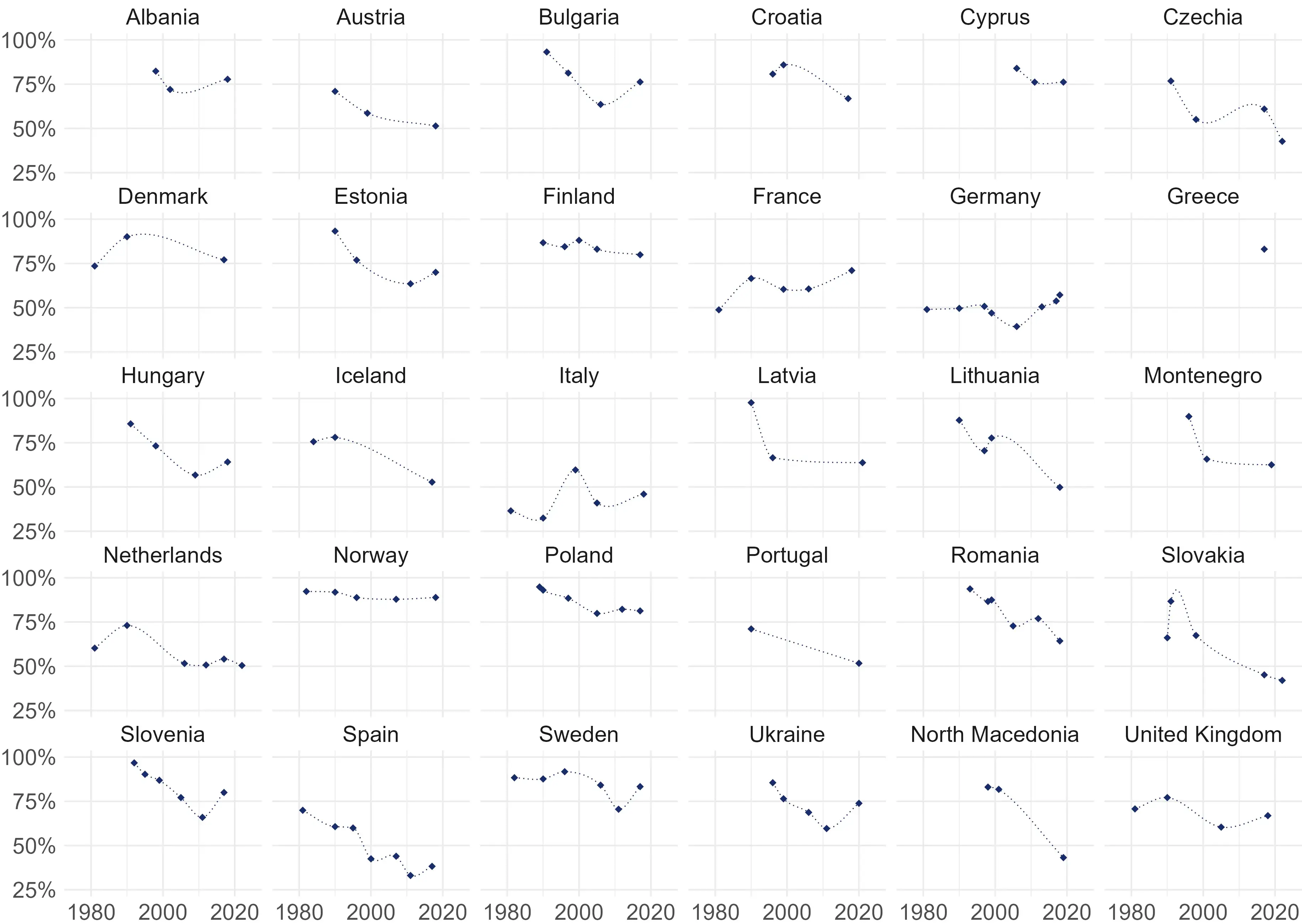
Before turning to the multivariate analyses, it is useful to examine how willingness to fight has evolved across European countries over time. Figure 1 presents the share of respondents indicating that they would be willing to fight for their country in the event of war between 1981 and 2022. Several broad patterns emerge.
First, the willingness to fight has generally declined across much of Europe.. This trend is particularly pronounced among countries in Central, Eastern, and Southeastern Europe that underwent profound political change during the late 1980s and 1990s. The collapse of communist regimes, the dissolution of the Soviet Union and Yugoslavia, and the creation of new states generated periods of intense national mobilisation that were often accompanied by exceptionally high levels of willingness to fight.. However, this willingness declined over the following decades.
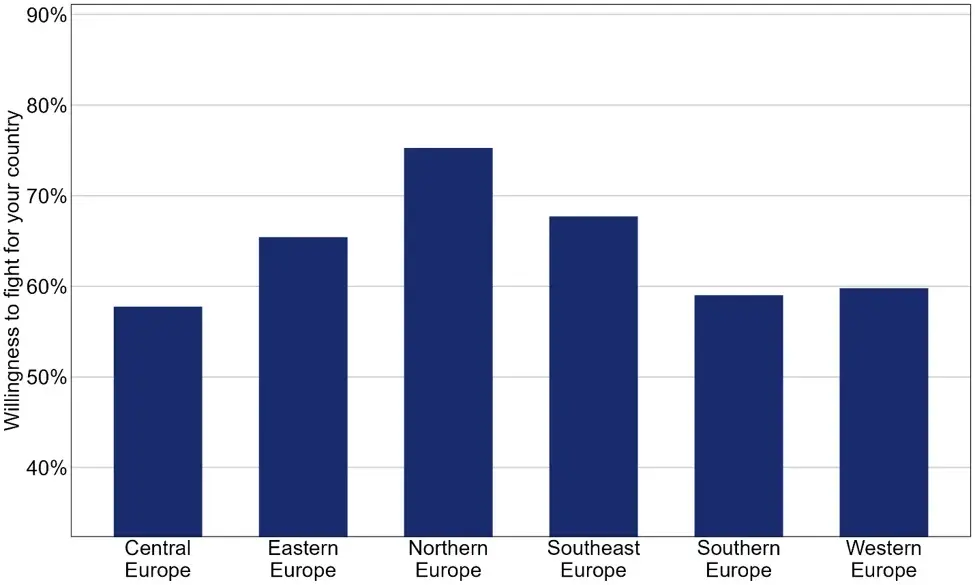
Willingness to fight has generally declined across much of Europe, as shown in Figure 2. Western and Central Europe display the lowest levels of willingness to fight, generally clustering in the low to mid-60s. Countries such as Germany, Austria, Italy, the Netherlands, Spain, Czechia, and Slovakia consistently rank near the bottom of the distribution. Several common features may contribute to these lower levels, such as high economic prosperity, professional volunteer armies, and the limited role that defence occupies in everyday life. In some cases, additional historical factors may also be relevant, such as Germany's post-war Nie-wieder-Krieg tradition and Austria's constitutional neutrality.
Northern Europe records the highest regional level of willingness to fight, at approximately 81%. Norway, Finland, and Sweden maintain consistently high levels throughout the period. These countries combine strong traditions of national defence with high levels of social trust, low levels of corruption. Eastern Europe occupies an intermediate but highly diverse position. Poland, for instance, has maintained comparatively high levels of willingness to fight, whereas in Ukraine willingness to fight declined throughout the 1990s and 2000s before rebounding following Russia's annexation of Crimea and the outbreak of armed conflict in Eastern Ukraine in 2014. Southeast Europe records the second-highest regional average, at approximately 77%, despite generally lower levels of economic prosperity. The region's experience of violent state-building conflicts during the 1990s, combined with the persistence of unresolved territorial and sovereignty disputes, may help explain these comparatively high levels of willingness to fight.
We now turn to the multivariate analyses, examining how factors such as gender, generation, educational attainment, migration background, confidence in institutions, and geographic proximity to Russia are related to willingness to fight once these various influences are considered simultaneously. The full models are reported in the Appendix in Table A1, but the main significant effects are shown in Figure 3-6.[18]
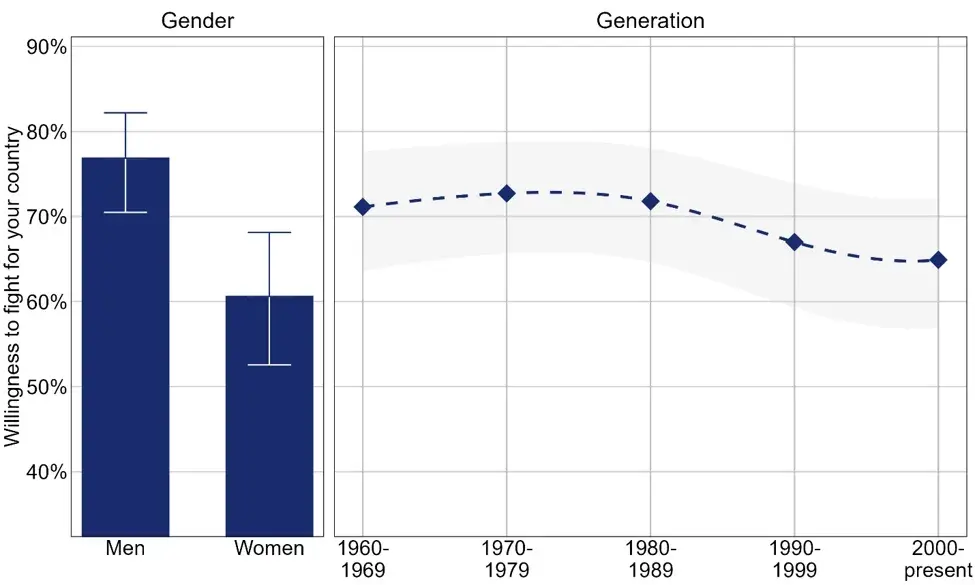
Gender emerges as one of the strongest predictors of willingness to fight. As shown in Figure 3, approximately 77% of men indicate that they would be willing to fight for their country, compared to 61% of women, a gap of nearly 16 percentage points. The magnitude of this difference is substantial and carries important implications for the composition of Europe's potential recruitment base. A possible explanation is that national defence continues to be viewed through a gendered lens across much of Europe. Traditional notions of masculinity have historically emphasised the role of men as protectors and defenders of the community, while women have more often been associated with caregiving roles. Regardless, any assessment of Europe's potential recruitment base must account for the fact that willingness to fight remains significantly higher among men than among women.
Generational differences are also evident. Figure 3 indicates a gradual but consistent decline in willingness to fight across successive generations. Those born in the 1960s and 1970s report a willingness to fight of about 73%, while for those born in the 1990s, it drops to around 67%, and for those born in the 2000s and onwards, it decreases to 65%. While willingness to fight remains high across all generations, younger Europeans are clearly less likely to express a willingness to fight for their country than older cohorts.[19]
What about diversity? As shown in Figure 4, citizens with foreign roots are indistinguishable from native citizens in their willingness to fight for their country. The implication is clear: our findings show that the notion that demographic diversification erodes national defence commitment is not supported by the data. When we examine the relationship between willingness to fight and religious denomination, two conclusions emerge. First, Muslim respondents exhibit higher levels of willingness to fight than respondents in the other religious categories. This finding suggests that increasing religious diversity in Europe, and the growing size of Muslim communities in particular, is not associated with lower willingness to fight. If anything, the relationship appears to run in the opposite direction.
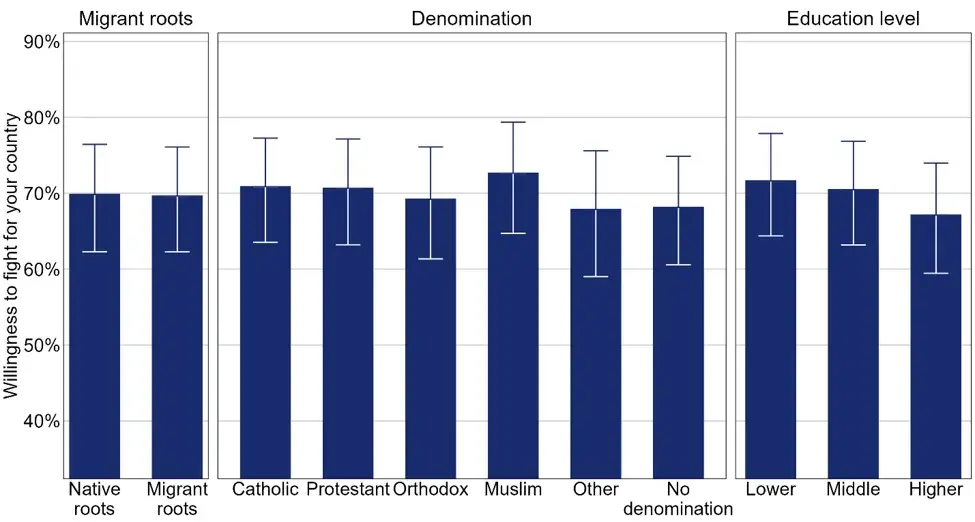
Second, a closer look reveals a broader pattern. Respondents who identify with one of the major religious denominations in Europe generally report higher levels of willingness to fight than those who do not identify with a religion or who belong to a smaller religious denomination. This relationship is particularly evident among Roman Catholics, Protestants, and Muslims, all of whom are significantly more willing to fight than respondents with no religious affiliation. Orthodox Christians also exhibit higher willingness to fight levels, although the difference is not statistically significant once other factors are taken into account.
Education adds an additional layer. Figure 4 show that, when other factors are controlled for, those with higher levels of education are somewhat less willing to fight for their country than those with lower and intermediate levels of education. Although the magnitude of this relationship is modest, it remains statistically significant. Higher educational attainment has been linked to more cosmopolitan political orientations and weaker attachment to exclusively national forms of identity. In addition, highly educated individuals may face different opportunity costs associated with military service and mobilisation.
Demographics reveal who Europeans are, but how is their attitude towards fighting shaped by their political attitudes? As Figure 5 shows, respondents who place themselves further to the right on the ideological spectrum are generally more willing to fight for their country. The magnitude of this relationship is substantial. While approximately 62% of respondents on the left indicate that they would be willing to fight for their country, this rises to roughly 76% among those on the right, a difference of around 14 percentage points. The likely explanation is that right-wing ideological orientations in contemporary Europe tend to be associated with stronger national identification, patriotism, and attachment to the nation-state.
In Figure 5, we also see that more confidence in the government is associated with a greater willingness of individuals to fight for their country. Respondents with the lowest levels of confidence in government report a willingness to fight of approximately 68%, compared to around 72% among those with the highest levels of confidence. Individuals who express greater confidence in government may also exhibit higher levels of trust in the broader political system and the institutions responsible for governing society. Although the relationship is modest in magnitude, it nevertheless suggests that confidence in government is associated with a somewhat greater willingness to defend one's country.
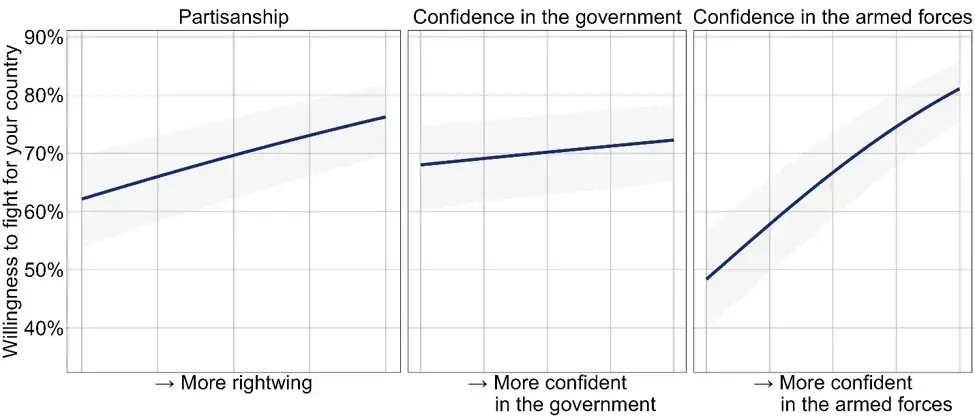
As expected, confidence in the armed forces shows a clear, positive association with higher willingness to fight. As Figure 5 illustrates, respondents with the highest levels of confidence in the military report a willingness to fight of approximately 81%, compared to just 49% among those with the lowest levels of confidence, a difference of more than 30 percentage points. This makes confidence in the armed forces one of the strongest individual-level factors associated with willingness to fight for one’s country. Citizens appear substantially more willing to accept the burdens and risks associated with national defence when they have confidence in the institution that would ultimately be responsible for carrying it out. From a policy perspective, the implication is straightforward: armed forces must maintain public trust and institutional credibility. Scandals, politicisation, or perceptions of military incompetence reduce citizens' willingness to contribute to national defence.
According to results of our analyses, shown in Figure 6, a country's economic prosperity is associated with lower levels of willingness to fight. Specifically, it declines by approximately 34 percentage points across the observed range of GDP per capita. The most plausible interpretation is a straightforward opportunity-cost argument. Citizens in wealthier European societies simply have more to lose, both personally and materially, from the disruption and sacrifices associated with fighting for your country.
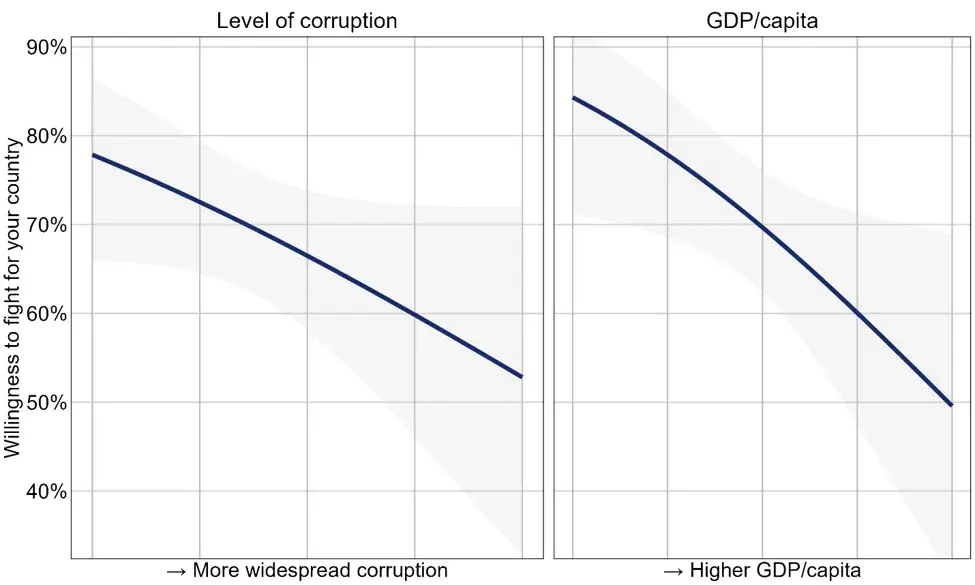
This finding is broadly consistent with Inglehart's theory of value change, which argues that societies that reach higher levels of economic security gradually shift from survival-oriented values, where collective duty and physical security are prioritised, towards self-expression values that place greater emphasis on individual autonomy, personal fulfilment, and quality of life. As a result, willingness to make extraordinary collective sacrifices for the nation may become less common. While notable exceptions exist, particularly among the Nordic countries, the overall European pattern remains one in which higher levels of economic prosperity are associated with lower willingness to fight.
A similar pattern emerges when examining corruption in the second panel in Figure 6. Citizens living in countries with higher levels of corruption are less willing to fight for their country. This willingness declines by approximately 25 percentage points across the observed range. One possible explanation is that willingness to fight depends, at least in part, on whether citizens view the state as worthy of their loyalty and sacrifice. Where corruption is widespread, public institutions may be perceived as serving particular interests rather than the broader public good. Under such circumstances, citizens may be less inclined to accept the risks associated with defending the political system.
While the regional patterns shown in Figure 2 suggest higher levels of willingness to fight in regions closer to Russia, geographic proximity to Russia in our multivariate model is not significantly associated with willingness to fight once other individual- and country-level characteristics are taken into account. This suggests that the higher willingness to fight observed in these regions is shaped less by geographic proximity itself than by the historical, political, and security dynamics associated with it. One possible explanation is that proximity to Russia may be associated with multiple and potentially offsetting mechanisms. While geographic proximity can increase threat perceptions and the salience of national defence, it may also expose countries to greater Russian political, economic, or cultural influence.
The analyses presented so far are based on a pooled sample covering Europe as a whole. While this provides a useful overview of the factors associated with willingness to fight, it also raises an important question: do these relationships hold across Europe, or are some of them driven by the experiences of particular regions? As Figure 1 showed, willingness to fight has not developed in the same way everywhere. In many countries in Central, Eastern, and Southeast Europe, willingness to fight reached very high levels during the 1990s, often in the context of independence, state-building, or violent conflict. In many cases, these levels then declined over time. This means that some of the relationships identified in the pooled analyses may partly reflect these regional historical experiences. For example, the lower willingness to fight observed among younger generations could potentially be influenced by the fact that younger cohorts in these countries grew up after the period of independence and national mobilisation had passed.
A second reason for conducting regional robustness checks is that the meaning of some characteristics differs across Europe. Religious denomination provides a good example. In the pooled analyses, Muslim respondents were generally more willing to fight for their country than respondents with no religious denomination. However, being Muslim does not represent the same social reality everywhere. In much of Western and Northern Europe, Muslim populations are often associated with more recent immigration, whereas in countries such as Albania, Muslim identity is largely unrelated to migration background and instead reflects the country's historical population composition.
The regional analyses are reported in Figure 7 and provide strong support for the main findings reported earlier. Most importantly, the gender gap remains visible across all regions of Europe. In every region, men are substantially more willing to fight for their country than women. The size of the difference varies somewhat, with the largest gaps observed in Central, Eastern, and Southern Europe. The generational findings also largely hold. In most regions, those born after 1990 are less willing to fight than those born during the 1970s, suggesting that the decline observed in the pooled analyses reflects a broader European trend rather than the experiences of a handful of countries. The main exception is Southern Europe, where respondents born in the 1990s and after 2000 do not differ significantly from those born in the 1970s. Educational attainment shows less consistency. While higher educated respondents are generally less willing to fight, this relationship is primarily visible in Central and Northern Europe and is absent in most other regions.
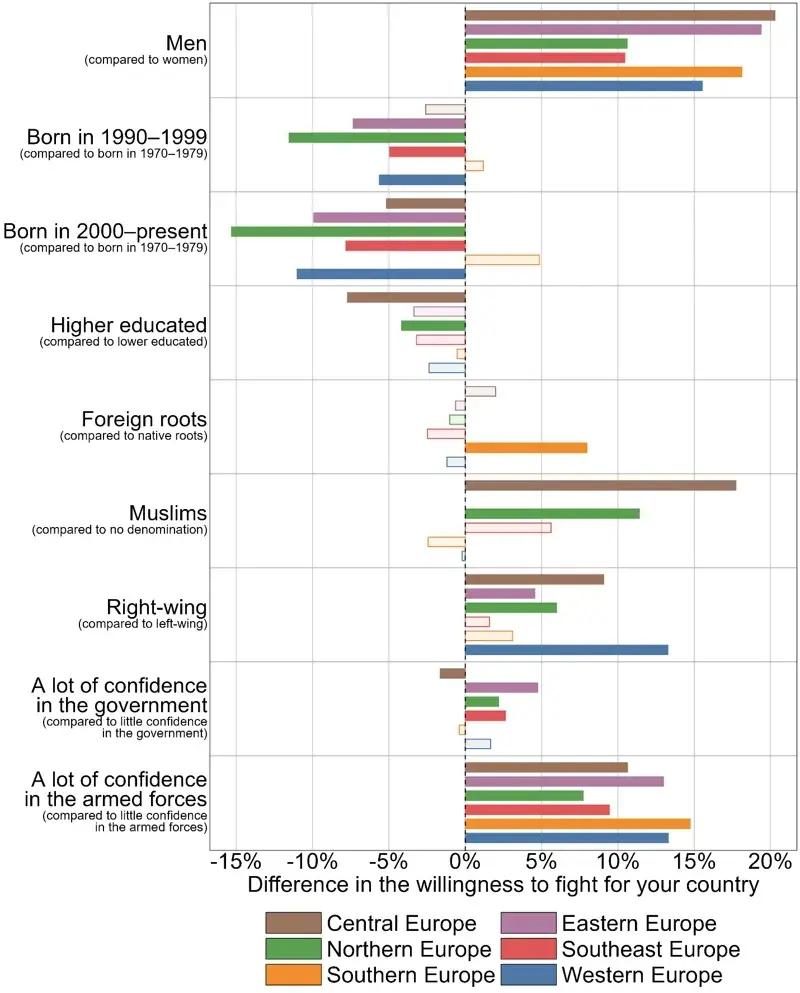
Note: Bars represent the difference in predicted willingness to fight associated with each characteristic relative to the indicated reference category. Dark bars indicate statistically significant effects (p < 0.05), whereas lighter bars indicate effects that are not statistically significant. Predicted probabilities are derived from separate regional logistic regression models, with all other variables held constant at their mean values. No coefficient is shown for Muslims in Eastern Europe because the number of Muslim respondents in that regional subsample was insufficient to produce a reliable estimate.
The findings concerning diversity also prove largely robust. As in the pooled analyses, respondents with foreign roots are generally no less willing to fight for their country than respondents without a migration background. This result holds across almost all regions. The only exception is Southern Europe, where respondents with foreign roots are significantly more willing to fight than native respondents. The results for religious denomination are equally noteworthy. Rather than being driven by Southeast Europe, where Muslim populations often form part of the native population, the positive relationship between Muslim denomination and willingness to fight is strongest in Central and Northern Europe. Muslims in these regions are significantly more willing to fight for their country than respondents without a religious denomination. These findings should nevertheless be interpreted with some caution, as the number of Muslim respondents is considerably smaller in these regions than in Southern and Southeast Europe.
The attitudinal variables likewise show a high degree of consistency across regions. Right-wing respondents are generally more willing to fight for their country than left-wing respondents, although this relationship is not statistically significant in Southeast and Southern Europe. Confidence in government produces a more mixed picture. Positive effects are visible in Eastern, Northern, and Southeast Europe, where greater trust in government is associated with a higher willingness to fight. In Western Europe, however, confidence in government appears largely unrelated to willingness to fight, while in Central Europe the relationship is unexpectedly negative. Finally, confidence in the armed forces emerges as one of the most consistent findings in the analysis. Across every region of Europe, respondents with greater confidence in the military are significantly more willing to fight for their country.
The findings presented in this report paint a more nuanced picture of Europe's willingness to fight than is often suggested in public debate. Across much of Europe, a majority of citizens indicate that they would be willing to defend their country in the event of war. At the same time, willingness to fight is not evenly distributed across society. Men are substantially more willing to fight than women, younger generations are somewhat less willing to fight than older cohorts, and important differences exist between European regions. While these patterns are not uniform across Europe, the regional robustness checks suggest that many of the relationships identified in the pooled analyses extend well beyond the specific experiences of individual countries or regions.
Several findings carry particular relevance for policymakers. Most notably, the results provide little support for the notion that increasing diversity necessarily weakens national defence commitment. Citizens with foreign roots are generally no less willing to fight for their country than native citizens, while Muslim respondents often report equal or higher levels of willingness to fight than other groups. At the same time, confidence in the armed forces emerges as one of the strongest and most consistent predictors of willingness to fight across Europe, considerably stronger than confidence in government. This suggests that defence readiness depends not only on military spending and force structure, but also on maintaining public confidence in the institutions responsible for national defence. Armed forces that enjoy high levels of public trust appear better positioned to draw upon the willingness of citizens to contribute to national defence.
While the findings presented here provide important insights into the social foundations of defence, the willingness to fight question alone leaves out many important aspects of citizens' attitudes towards defence. Respondents are not asked what type of conflict they have in mind, whether they are thinking of territorial defence, alliance obligations, peacekeeping operations, or other military missions. Nor does the question distinguish between voluntary military service and conscription, or between combat and non-combat roles. As a result, willingness to fight should be understood as only one indicator of defence attitudes, and how citizens understand their obligations towards the state. Future research should also explore how these attitudes translate into concrete behaviour, such as actual participation in military service, reserve structures, civil defence, and mobilisation during crises.
Ultimately, understanding who is willing to defend their country, and why, is not merely a question of public opinion. It is a question about the long-term resilience of European societies themselves. In the end, defence is not only about weapons and budgets. It is also about whether citizens believe their country is worth defending. While governments can strengthen their armed forces through higher spending and new equipment within a few years, the civic commitment on which defence ultimately rests is built over generations.
Photo credit: Pixabay
[1] Joshua S. Goldstein, War and Gender: How Gender Shapes the War System and Vice Versa (Cambridge university press, 2001).
[2] Aaron Sell et al., “Physically Strong Men Are More Militant: A Test across Four Countries,” Evolution and Human Behavior 38, no. 3 (2017): 334–40, https://doi.org/10.1016/j.evolhumbehav.2016.11.002; Melissa M. McDonald et al., “Evolution and the Psychology of Intergroup Conflict: The Male Warrior Hypothesis,” Philosophical Transactions of the Royal Society B: Biological Sciences 367, no. 1589 (2012): 670–79, https://doi.org/10.1098/rstb.2011.0301.
[3] Pamela Johnston Conover and Virginia Sapiro, “Gender, Feminist Consciousness, and War,” American Journal of Political Science 37, no. 4 (1993): 1079–99, https://doi.org/10.2307/2111544; Richard C. Eichenberg, “Gender Differences in Public Attitudes toward the Use of Force by the United States, 1990-2003,” International Security 28, no. 1 (2003): 110–41.
[4] Cynthia Enloe, Maneuvers: The International Politics of Militarizing Women’s Lives (University of California Press, 2000).
[5] Ronald Inglehart and Christian Welzel, Modernization, Cultural Change, and Democracy: The Human Development Sequence (Cambridge University Press, 2012), https://doi.org/10.1017/CBO9780511790881.
[6] Ronald R. Krebs, Fighting for Rights: Military Service and the Politics of Citizenship (Cornell University Press, 2006).
[7] Alexander Sorg et al., “Fighting for Their Country: How Proximate Conflict Shapes Citizens’ Attitudes,” European Journal of International Security 11, no. 2 (2026): 228–46, https://doi.org/10.1017/eis.2025.12.
[8] Pippa Norris and Ronald Inglehart, Cultural Backlash: Trump, Brexit, and Authoritarian Populism (Cambridge University Press, 2019).
[9] Robert D. Putnam, “E Pluribus Unum : Diversity and Community in the Twenty‐first Century The 2006 Johan Skytte Prize Lecture,” Scandinavian Political Studies 30, no. 2 (2007): 137–74, https://doi.org/10.1111/j.1467-9477.2007.00176.x.
[10] Peter Thisted Dinesen et al., “Ethnic Diversity and Social Trust: A Narrative and Meta-Analytical Review,” Annual Review of Political Science 23, no. Volume 23, 2020 (2020): 441–65, https://doi.org/10.1146/annurev-polisci-052918-020708.
[11] Krebs, Fighting for Rights.
[12] Rick Kosterman and Seymour Feshbach, “Toward a Measure of Patriotic and Nationalistic Attitudes,” Political Psychology 10, no. 2 (1989): 257–74, https://doi.org/10.2307/3791647.
[13] Margaret Levi, Consent, Dissent, and Patriotism, Political Economy of Institutions and Decisions (Cambridge University Press, 2009), https://doi.org/10.1017/CBO9780511609336.
[14] Inglehart and Welzel, Modernization, Cultural Change, and Democracy; Ronald F. Inglehart et al., “Declining Willingness to Fight for One’s Country: The Individual-Level Basis of the Long Peace,” Journal of Peace Research 52, no. 4 (2015): 418–34, https://doi.org/10.1177/0022343314565756.
[15] Levi, Consent, Dissent, and Patriotism.
[16] Geographic proximity to Russia is measured as the logarithm of the distance between a country's capital and Moscow, based on the assumption that distance has diminishing marginal effects on willingness to fight for your country. Alternative operationalisations, including indicators for countries bordering Russia and countries belonging to the former Soviet sphere of influence, produced substantively similar results.
[17] Only a small share of the multivariate sample was surveyed after Russia's full-scale invasion of Ukraine, consisting almost entirely of approximately 600 respondents from Czechia. While it is therefore important to control for potential effects of the invasion, the available data do not allow for a robust assessment of its independent impact on willingness to fight.
[18] Figures 3–6 display predicted probabilities derived from the multilevel logistic regression model reported in Table A1. When calculating predicted probabilities, all other variables included in the model were held constant at their mean values.
[19] Because the analysis relies on survey data collected between 2011 and 2022, it is not possible to distinguish conclusively between generational and life-cycle effects. The available time span is too short to follow cohorts as they age and observe whether willingness to fight changes over the life course. As a result, the observed differences between generations may reflect enduring cohort differences, age-related effects, or a combination of both.