
Strategic Notes
Josip Glaurdić
Mia Džepina
Christophe Lesschaeve
Ensar Muharemović
Published on: May 2nd 2026
ESILUX researchers presented their CONSENT BiH project at the Yale Peacebuilding Initiative Colloquium, hosted by the Jackson School of Global Affairs. The project examines how citizen preferences can inform constitutional design in post-conflict societies. Drawing on fieldwork in Bosnia and Herzegovina, the team explores pathways from “peace imposed” to “peace owned,” emphasizing the role of empirical evidence in reconstructing political legitimacy.
Researchers, practitioners, and policymakers gathered at the Yale Peacebuilding Initiative Colloquium in April 2026 to advance the central question in contemporary international politics: how can peace settlements be translated into durable and legitimate political orders? Hosted by the Jackson School of Global Affairs, the Colloquium brought together leading voices from academia, diplomacy, and peace practice to bridge the gap between research and real-world negotiation processes.
The discussions reflected a growing recognition in the field: ending violence, while essential, is only the beginning. The more difficult challenge lies in building institutions that are not only stable, but also recognized as legitimate by the societies they govern.
The Yale Peacebuilding Initiative has positioned itself at the forefront of efforts to connect scholarly research with policy-relevant insights. The Colloquium featured contributions from scholars and practitioners working on peace negotiations, mediation, and post-conflict governance across multiple regions.
Participants engaged with questions that cut across cases and disciplines: How do peace agreements shape long-term political trajectories? What role do international actors play in institutional design? And how can societies move beyond elite-driven settlements toward more inclusive and participatory forms of governance?
These themes resonate strongly with recent debates in the study of peacebuilding, where scholars have increasingly questioned the limits of externally driven or technocratic approaches to institutional design.
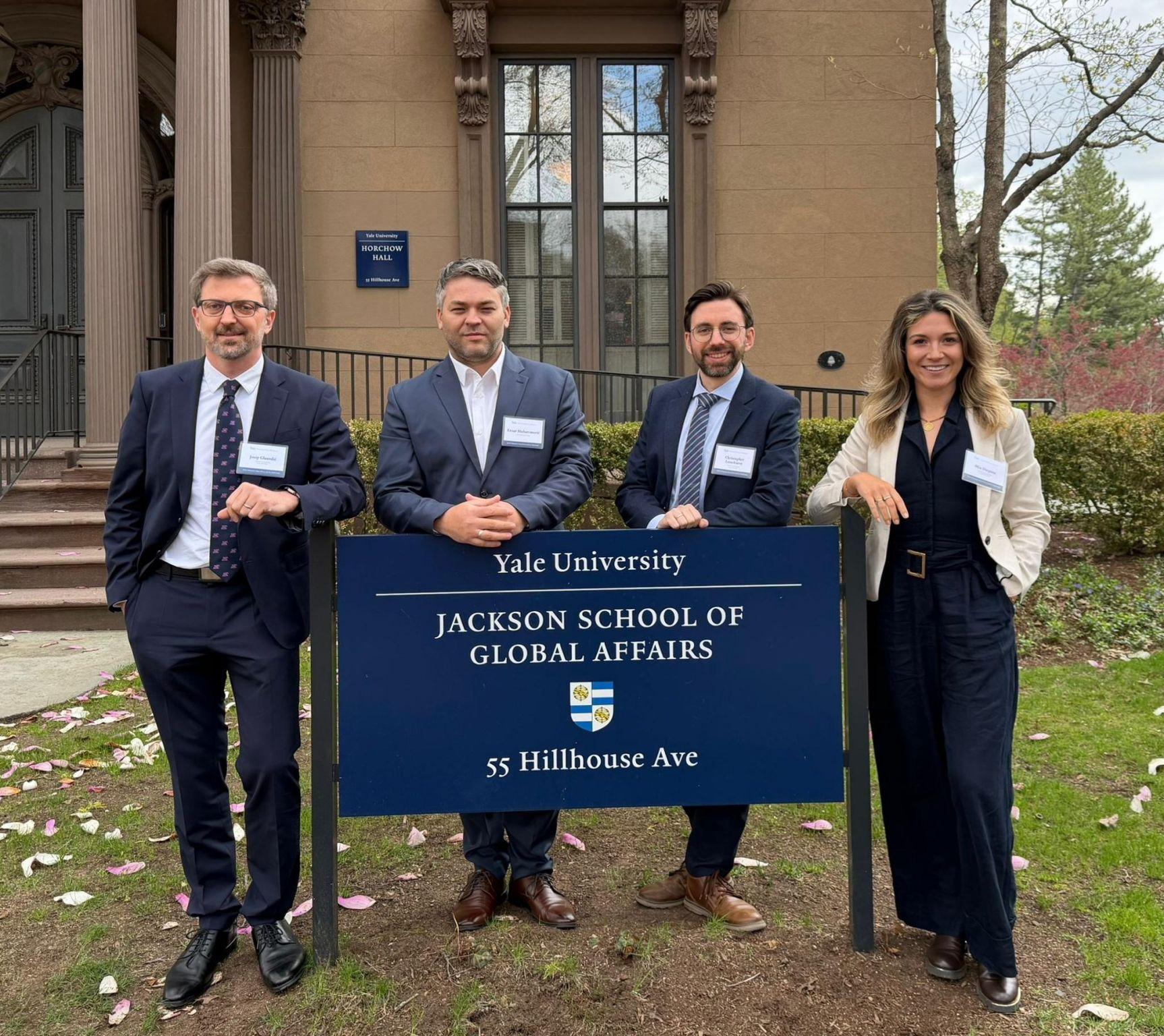
Among the participants was a delegation from the European Strategy Institute Luxembourg (ESILUX): Josip Glaurdić, Ensar Muharemović, Mia Džepina, and Christophe Lesschaeve. Their presentation introduced the ongoing project CONSENT BiH (Constitutional Engagement for the Transformation of Bosnia and Herzegovina), which seeks to rethink how constitutional reform is approached in post-conflict societies.
At its core, the project addresses a gap in both scholarship and practice. While existing frameworks—from consociational power-sharing to the broader liberal peace paradigm—have generated important insights into how to stabilize divided societies, they have often treated citizens as passive recipients of institutional arrangements. Legitimacy, in turn, has typically been inferred indirectly—from stability, compliance, or the endurance of institutions.
The ESILUX team proposed a different approach: to treat legitimacy as an empirical question grounded in citizen preferences. Rather than asking what institutional arrangements political elites or external actors might accept, CONSENT BiH asks what arrangements citizens themselves would be willing to endorse if presented with meaningful choices.
The empirical focus of the project is Bosnia and Herzegovina, a country whose constitutional framework emerged from the 1995 Dayton Peace Agreement. While Dayton marked the end of a devastating war, it also embedded the logic of wartime conflict into the structure of the state.
Three decades later, Bosnia and Herzegovina presents a striking paradox: a political system that is simultaneously stable and deeply contested. As the ESILUX team emphasized, this tension is further shaped by generational change. A majority of citizens today were either children during the war or were born after the violence had ended, yet continue to operate within institutions designed under the constraints of the conflict.
This raises a fundamental question: to what extent are contemporary political preferences still anchored in the legacies of conflict—and to what extent have they evolved beyond them?
By combining qualitative fieldwork (interviews, focus groups, and expert consultations) with forthcoming large-scale survey research and conjoint experiments, CONSENT BiH aims to map what the researchers describe as the “space of possible agreement” among citizens. In doing so, the project seeks to identify not only where divisions persist, but also where unexpected areas of convergence may exist.
A distinctive feature of the approach employed by the ESILUX scholars is its emphasis on closing the loop between research and political practice. In addition to measuring citizen preferences, the project includes a final stage of field engagement in which findings are reintroduced into public and expert debates.
This phase is designed to observe how empirical results are interpreted, contested, and potentially mobilized by different actors. In this sense, the project moves beyond measuring attitudes to studying how political meaning—and ultimately legitimacy—is constructed.
This emphasis aligns closely with the broader mission of the Yale Peacebuilding Initiative, which seeks to bring research “into the rooms where peace gets made.” By grounding discussions of constitutional reform in systematic evidence about citizen preferences, the
ESILUX team contributes to a growing effort to make peacebuilding both more empirically informed and more democratically grounded.
For ESILUX co-founder Josip Glaurdić, the Colloquium also marked a personal return to Yale, where he began his graduate studies more than two decades ago. Presenting new research on post-conflict governance in that setting offered a moment of reflection on how the field itself has evolved—from a primary focus on conflict onset and resolution to a deeper engagement with the long-term challenges of political reconstruction.
The participation of ESILUX scholars in the Yale Peacebuilding Initiative Colloquium reflects the Institute’s broader ambition to contribute to key debates at the intersection of political science, international relations, and public policy. By advancing a research agenda centered on citizen agency, institutional legitimacy, and empirical methods, the Institute aims to help reshape how scholars and practitioners think about the transition from conflict to sustainable governance.
As discussions at Yale made clear, the central challenge facing post-conflict societies today is not only how to end wars, but how to build political orders that citizens recognize as their own. Bridging that gap—from peace imposed to peace owned—remains one of the defining tasks of contemporary peacebuilding.
Photo credit: Michael Marsland, Yale University.