Strategic Notes
Josip Glaurdić
Published on: Apr 20th 2026
As Europe confronts mounting geopolitical uncertainty, democratic fragmentation, and growing strategic pressures, the European Strategy Institute Luxembourg (ESILUX) was created to foster longer-term thinking about Europe’s future. Drawing on recent interviews in Luxembourg Times and the Revue with founder Josip Glaurdić, we explore the motivations behind the Institute, Luxembourg’s unique vantage point within Europe, and the need to reconnect rigorous research with strategic public debate.
Europe today often feels trapped in a permanent state of reaction. Russia’s war against Ukraine, uncertainty about transatlantic relations, technological disruption, democratic fragmentation, and intensifying geopolitical competition have created a sense that Europe is increasingly responding to events rather than shaping them.
It was precisely this atmosphere of strategic drift that led to the creation of the European Strategy Institute Luxembourg (ESILUX).
In recent interviews with the Revue and the Luxembourg Times, ESILUX founder and president Josip Glaurdić argued that Europe needs spaces capable of stepping back from the immediacy of political noise and asking longer-term questions about Europe’s future, resilience, and strategic direction.
The idea behind ESILUX is not simply to comment on current crises, but to create a framework for thinking about Europe differently.
The decision to establish ESILUX in Luxembourg is not accidental. For Glaurdić, Luxembourg occupies a uniquely revealing position within Europe: small yet deeply interconnected, economically influential yet dependent on international stability, and historically committed to multilateralism and European integration.
In the Revue interview, he noted that Luxembourg has traditionally exercised influence not through military power or demographic weight, but through diplomacy, credibility, and institutional embeddedness within Europe. That model, however, faces growing pressure in a world where assumptions about stability and alliances can no longer be taken for granted.
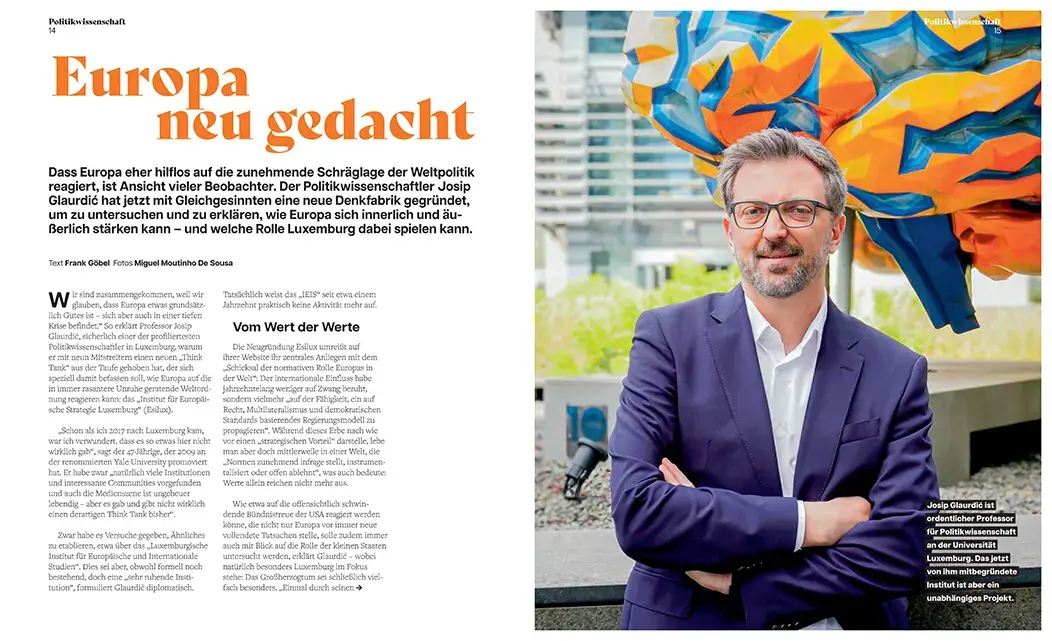
A recurring theme in both interviews is that Europe’s post-Cold War mindset may no longer correspond to geopolitical reality. For decades, many Europeans assumed that economic interdependence, negotiation, and institutional integration would gradually reduce the likelihood of major conflict. Recent developments have exposed the limits of those assumptions. As Glaurdić remarked in Revue, there is often “a bordering naivety” in the belief that negotiations and rationality will inevitably prevail regardless of changing global power dynamics.
This does not mean abandoning Europe’s foundational values. On the contrary, ESILUX starts from the premise that democracy, the rule of law, and multilateralism remain among Europe’s greatest strengths. But values alone are insufficient without strategic capacity.
Europe increasingly needs to think not only about what it represents normatively, but also about whether it possesses the institutional, technological, economic, and security capabilities necessary to defend those values.
Another important motivation behind ESILUX is the conviction that academic expertise should not remain isolated from public debate. In the Luxembourg Times interview, Glaurdić described the responsibility of scholars to contribute evidence-based perspectives to public discussion rather than retreat into increasingly specialized academic conversations. “I would like my work to be socially relevant,” he explained.
That philosophy shapes ESILUX itself.
The Institute brings together researchers, policy professionals, and younger experts with the goal of producing analytically rigorous but publicly accessible work. At a moment when debate is often dominated by immediacy and polarization, ESILUX aims to create space for slower, evidence-driven strategic thinking.
This is particularly important in Luxembourg, where public debate on Europe’s long-term geopolitical role has often remained limited despite the country’s deep integration into European institutions and international governance networks.
ESILUX also reflects a generational project. In the Luxembourg Times interview, Glaurdić emphasized the importance of bringing younger researchers and emerging experts into direct engagement with policymaking and public debate.
“The intent was to bring in people who are at the beginning of their careers, who have a longer view into the future, who have energy and drive,” he explained. The Institute therefore aims to function not only as a think tank, but also as a platform connecting research, policy, media, and public engagement across generations.
The broader intellectual ambition behind ESILUX is captured by a question raised in the Luxembourg Times interview: “What comes after this crisis? What comes after this mayhem?” That question reflects a frustration with Europe’s tendency toward permanent crisis management. Whether dealing with financial instability, migration pressures, pandemics, war, or geopolitical competition, European policymaking often appears dominated by immediate adaptation rather than long-term strategic imagination.
ESILUX was created in response to that gap.
Its objective is not ideological positioning, but analytically grounded thinking about the institutional, economic, technological, and geopolitical transformations reshaping Europe. Underlying all these themes is a common premise: Europe cannot rely indefinitely on assumptions that belonged to a different historical era.
As Glaurdić argued in Revue, many of the political and institutional structures Europeans grew accustomed to may no longer be sustainable under contemporary geopolitical conditions. The challenge is therefore not simply to preserve Europe as it exists today, but to think seriously about how it must adapt if it is to remain politically coherent, economically competitive, and strategically capable in the decades ahead.