
Strategic Notes
Josip Glaurdić
Published on: May 28th 2026
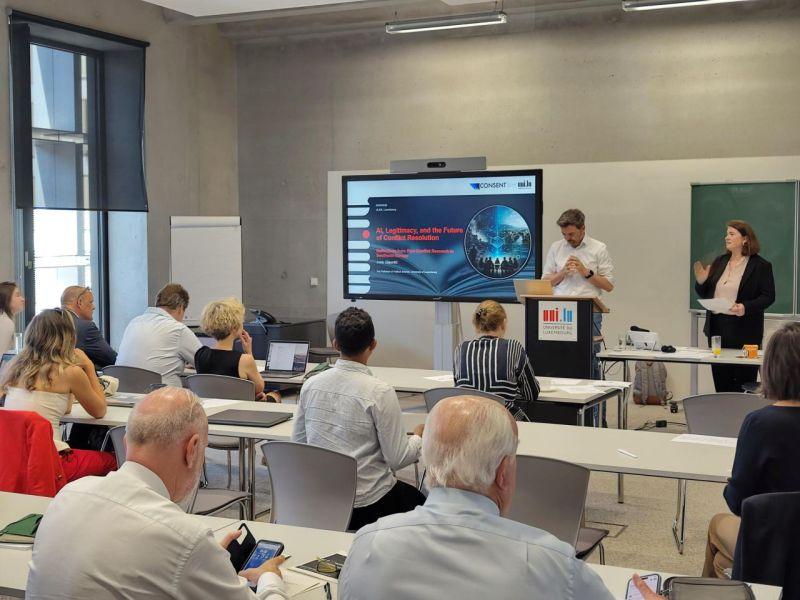
Prof. Josip Glaurdić’s presentation at the ULIDE Connect workshop “AI & International Conflict Resolution” examined how artificial intelligence is reshaping both conflict dynamics and peacebuilding research. Moving beyond military applications, the talk focused on AI’s role in transforming information environments, amplifying narratives, and interacting with unresolved memories and mistrust in post-conflict societies. Drawing on the CONSENT BiH project, Glaurdić showed how AI can help researchers analyse citizen voices and political legitimacy at previously impossible scale. Yet the central argument was cautionary: AI can map disagreement and expand knowledge, but legitimate coexistence remains a fundamentally political achievement.
On 28 May 2026, ESILUX President and Executive Director Prof. Josip Glaurdić took part in the University of Luxembourg Institute for Digital Ethics’ ULIDE Connect workshop on AI & International Conflict Resolution. The event brought together experts from academia, humanitarian practice, diplomacy, and peacebuilding to examine how artificial intelligence is reshaping the relationship between technology, war, humanitarian action, and conflict resolution. Organised as a workshop with expert presentations, Q&A, and a concluding roundtable, the event asked a central question: how can AI be designed to support, rather than undermine, pathways to peace in conflict zones?
Glaurdić’s presentation approached this question from the standpoint of political science, post-conflict research, and democratic legitimacy. Rather than focusing primarily on the military uses of AI, he shifted attention to a less visible but politically crucial dimension: the role AI now plays in shaping the informational, emotional, and narrative environments through which societies understand conflict and imagine coexistence.
His point of departure was simple but consequential. Conflicts rarely persist only because actors continue fighting militarily. They endure because societies remain divided over memory, legitimacy, identity, authority, victimhood, responsibility, and the meaning of political community itself. This is particularly evident in post-conflict societies, where formal peace may coexist for decades with mistrust, polarization, competing historical interpretations, and institutional fragility. In such settings, AI matters not only because it may transform the battlefield, but because it increasingly structures the political and symbolic terrain on which peace is contested.
The first part of the presentation examined how AI is changing the political dynamics surrounding conflict. AI dramatically lowers the cost of producing political content at scale: text, images, videos, synthetic media, emotionally targeted messages, and narrative fragments can now be generated, adapted, and circulated with unprecedented speed. Yet Glaurdić stressed that the most important effect may not be persuasion in the classical sense. Increasingly, the objective is fragmentation: flooding public space with competing claims, exhausting citizens’ confidence in shared facts, and weakening the possibility of a common political reality.
For post-conflict societies, this is especially dangerous. Such societies are often politically organised around memory: who suffered, who is recognised, who is blamed, and whose fears are treated as legitimate. AI allows political actors to activate these sensitivities with far greater precision than before. Messages can be tailored to identities, grievances, anxieties, symbolic attachments, and historical narratives. In this sense, AI does not usually invent political fractures from scratch. It interacts with existing divisions, amplifies them, and may make them more emotionally immediate.
The second part of the presentation turned from the politics of conflict to the practice of research. Here, Glaurdić argued that AI is not merely adding a few new tools to peace and conflict studies. It is transforming the entire research pipeline: from data collection and processing to analysis, interpretation, monitoring, and communication. Its most important contribution lies in the ability to integrate forms of evidence that were previously difficult to analyse together, including interviews, multilingual texts, social media data, archival material, satellite imagery, population movement data, and real-time digital communication.
This transformation is especially significant for qualitative research. Large-scale qualitative work in post-conflict societies has traditionally been constrained by time, resources, transcription costs, language barriers, and the need to simplify complexity early in the research process. AI changes some of these constraints. It allows researchers to analyse citizen voices at a scale that was previously inaccessible to small and medium-sized research teams. More importantly, it enables analysis that goes beyond the simple coding of responses. Researchers can now examine how citizens emotionally engage with political questions, how concepts cluster together, how narratives are structured, and how legitimacy is articulated in language.
Glaurdić illustrated these points through CONSENT BiH, a research project on constitutional engagement and political legitimacy in Bosnia and Herzegovina. The project explores how citizens themselves think about constitutional reform, governance, and political authority in a deeply divided post-conflict society. In this context, AI is not used as a substitute for political judgment. Rather, it expands the capacity of researchers to listen more systematically to citizens, identify patterns across large volumes of qualitative material, and bring citizen perspectives into debates that are often dominated by elites, diplomats, and institutional actors.
This distinction was central to the presentation’s broader argument. AI may help societies map disagreement more effectively, process complexity, detect patterns, and surface voices that are otherwise ignored. It may enable more inclusive forms of knowledge production and help researchers, mediators, and institutions understand conflict societies in greater depth. But it cannot perform the political work of negotiation, recognition, compromise, and legitimate coexistence.
The organisers’ subsequent reflections on the event similarly emphasized AI’s potential to support inclusive bottom-up processes in peacebuilding, while warning that such systems must reflect the values and languages of local communities rather than rely on generic, off-the-shelf models. The workshop also connected these questions to international humanitarian law, digital sovereignty, and the need for governance and risk-management frameworks capable of enabling positive uses of AI while constraining its misuse.
Glaurdić concluded on a balanced note. AI genuinely expands analytical and research capacities. It can help institutions process complexity, hear citizen voices at scale, and potentially democratise access to political knowledge. But more information does not automatically produce more legitimacy. The central challenge in post-conflict societies is often not the absence of information. It is the absence of legitimate mechanisms through which disagreement can be negotiated politically.
For ESILUX, this is precisely where the debate on AI and peacebuilding must be situated. The question is not whether technology can “solve” conflict. It cannot. The more important question is whether AI can help societies understand themselves more clearly, hear their own plural voices more systematically, and create better conditions for political negotiation. Used responsibly, AI may support peacebuilding. But peace itself remains a political achievement.
Photo credit: Carsten Ullrich and Pexels.com.