Strategic Notes
Josip Glaurdić
Christophe Lesschaeve
Published on: Jun 29th 2026
Luxsentinel 2026 examines how Luxembourg’s expert community and wider public view Europe’s changing strategic environment. Based on surveys of 102 experts and a representative sample of 448 residents, the report finds a country concerned by instability but not resigned to decline. Respondents see Europe facing a harder world marked by war, hybrid threats, technological dependence, economic vulnerability, and uncertainty over the United States. Experts are more pessimistic about EU security readiness and strategic autonomy, while the public focuses more on visible pressures such as war, energy prices, terrorism, and institutional trust. Yet both groups support a more capable Europe: faster decision-making, differentiated integration, credible enlargement, stronger preparedness, and reduced critical dependencies. For Luxembourg, the central lesson is clear. As a small, open, and highly exposed state, it cannot escape Europe’s strategic dilemmas. It must prepare for them more deliberately.
Download PDFEurope is entering the summer of 2026 with fewer certainties than at any point in recent years. Russia’s war against Ukraine continues. The United States is no longer an unquestioned security anchor. The Middle East remains volatile. Cyberattacks, disinformation, economic coercion, energy insecurity, and technological dependence have moved from the margins of policy debate to the centre of European politics.
For Luxembourg, none of this is abstract. The country’s security and prosperity depend on open borders, stable European institutions, reliable allies, functioning markets, secure digital infrastructure, and a predictable international order. Luxembourg is small, but it is not sheltered. It is highly exposed.
The leaders of NATO meet in Ankara on 7-8 July 2026, only one year after the Hague Summit committed allies to a major increase in defence-related spending by 2035.[1] The run-up to Ankara has been shaped by questions about European responsibility, US reliability, NATO force commitments, and the future of deterrence in Europe. These are not distant alliance-management issues. They go directly to the strategic position of every European state, including Luxembourg.
Luxsentinel 2026 asks how this moment is perceived in Luxembourg. The report is based on two surveys: a survey of 102 members of Luxembourg’s expert community, drawn from a pool of leaders in public institutions, the private sector, non-governmental organizations, media, and higher education; and a representative survey of 448 residents of Luxembourg. The expert survey captures the views of a professional community engaged with public policy, governance, European affairs, security, economics, and international questions. Full methodological details are provided in the appendix.
The central finding of the report is simple: Luxembourg is concerned, but not fatalistic. Respondents see a more dangerous world. They see an EU with real capacities, but also serious limits. They recognize that Europe needs to become more capable, more resilient, and less dependent. But they do not turn away from Europe. On the contrary, both experts and the public support different forms of European action that promise results: differentiated integration, selective policy cooperation, credible enlargement, stronger preparedness, and better coordination.
The report also shows a clear gap between expert and public perceptions, with experts more pessimistic about the EU’s security readiness and strategic autonomy. In contrast with the general public, experts place greater emphasis on systemic risks: the erosion of the rules-based international order, hybrid threats, technological dependencies, and slow EU decision-making. The public is more focused on direct and visible pressures: war, energy prices, terrorism, institutional trust, and inequality. This is not a story of experts “knowing” and the public “not knowing.” It is a story of different forms of exposure. Experts see systems under strain. The public sees vulnerability in everyday terms.
The most striking differences concern Europe’s partners and adversaries. Experts have a relatively coherent strategic map: Canada, the United Kingdom, Japan, Australia, and Ukraine are allies; Russia and Iran are adversaries; China is treated cautiously; the United States is uncertain. Public opinion is more fragmented. In several cases, especially regarding the United States and Russia, averages hide sharp disagreement and a broad spectrum of views. The United States is the clearest case. It sits at the centre of the scale for both experts and the public. But this placement hides the fact that the respondents are split on whether it is viewed as an adversary or an ally.
The report proceeds in six steps. First, it examines the overall strategic mood in Luxembourg: concern about instability, moderate confidence in EU capacity, and expert scepticism about Europe’s strategic autonomy. Second, it looks at the threats facing Europe and Luxembourg, from war and hybrid attacks to energy dependence, economic inequality, and technological vulnerability. Third, it maps perceptions of Europe’s allies and adversaries, with particular attention to the United States, Russia, Ukraine, Israel, and Iran.
Fourth, the report turns to what should be done. It shows that respondents favour a more capable Europe: differentiated integration, selective policy integration, enlargement linked to both accession criteria and strategic necessity, and institutional reform to reduce paralysis. Fifth, it examines Luxembourg’s own strategic position. Luxembourg is not a hard-power state, but it has assets that matter: financial and economic expertise, diplomatic brokerage, convening capacity, coordination, and targeted resilience. Sixth, the report presents expert forecasts for the coming years, including expectations of cyber and hybrid attacks, higher defence spending, enlargement, uncertainty over US military presence, and possible geopolitical disruption affecting Luxembourg’s financial and technological exposure.
Luxsentinel 2026 begins from a hard fact: Luxembourg cannot escape Europe’s strategic dilemmas. It can only decide how clearly to understand them and how seriously to prepare for them. The country does not need to pretend to be a large power. But it does need to become a more deliberate small one.
If we had to sum up the general sentiment of Luxsentinel 2026 findings, we could say that the data captures a strategic mood of deep concern without fatalism. Respondents in Luxembourg do not see the international environment as stable or predictable, but neither do they view Europe as powerless. The public survey figures suggest caution, uncertainty, and moderate confidence in the European Union’s capacity to respond. The expert survey numbers, on the other hand, present a more demanding diagnosis: experts see the world as more unstable, the EU as less ready in security terms, and European strategic autonomy as more limited. The overall picture is therefore not one of panic, but of serious concern nonetheless. Europe is seen as having enough capacity to matter but not using that capacity enough to act with the speed, autonomy, and geopolitical weight required by the current moment.
This mood is broadly consistent with the wider European debate. Recent Eurobarometer findings show that Europeans – and this includes the Luxembourgish public – continue to see the EU as a source of stability in a troubled world and strongly support common security and defence efforts.[2] At the same time, European Parliament polling points to a growing demand for more unity among member states and a stronger EU voice internationally.[3] Strategic assessments such as the Munich Security Report have similarly described an international environment marked by fragmentation, polarization, and increasingly difficult collective responses to global crises.[4] Luxsentinel therefore does not show Luxembourg standing outside the wider European conversation. Rather, it captures that conversation from the vantage point of a small, highly open, deeply Europeanized state: attentive to risk, still oriented toward European solutions, but uncertain that Europe has yet acquired the political and strategic capacity required by the scale of the challenge.
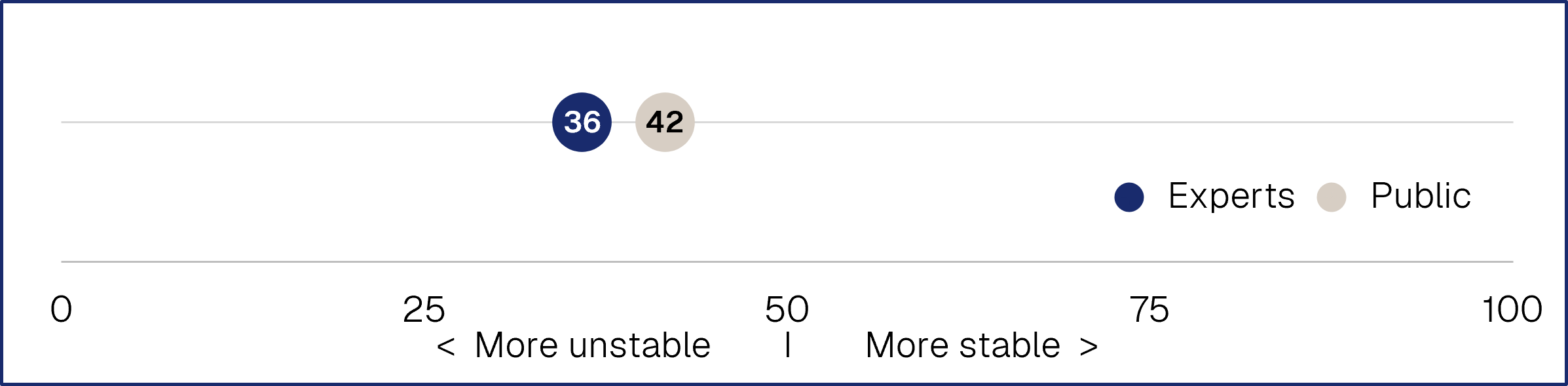
The first indication of this mood comes from respondents’ assessment of the global political and security environment, shown here in Figure 1. On a scale from 0 to 100, where higher values indicate greater stability and predictability, public respondents place the current situation at 42[5], while experts place it lower, at 36. Both scores are below the midpoint. This suggests that instability is not a niche expert concern, but a shared baseline perception. Yet the difference between the two groups is also meaningful. Experts locate the current environment further from stability, suggesting a sharper sensitivity to systemic risk, institutional fragility, and the deterioration of the international security environment.
This difference should not be interpreted as a contrast between an “informed expert” view and an “uninformed public” view. It more likely reflects different modes of perception. Public respondents may experience instability through visible pressures: war, energy prices, economic uncertainty, migration, inflation. Expert respondents are more likely to read those developments through longer institutional and geopolitical trajectories: weakening multilateral cooperation, fragmentation of the rules-based order, intensifying great-power rivalry, uncertainty over US commitments, and the EU’s difficulty in converting economic power into strategic influence. The result is a shared sense of instability, but a different expert diagnosis of the depth of the problem.
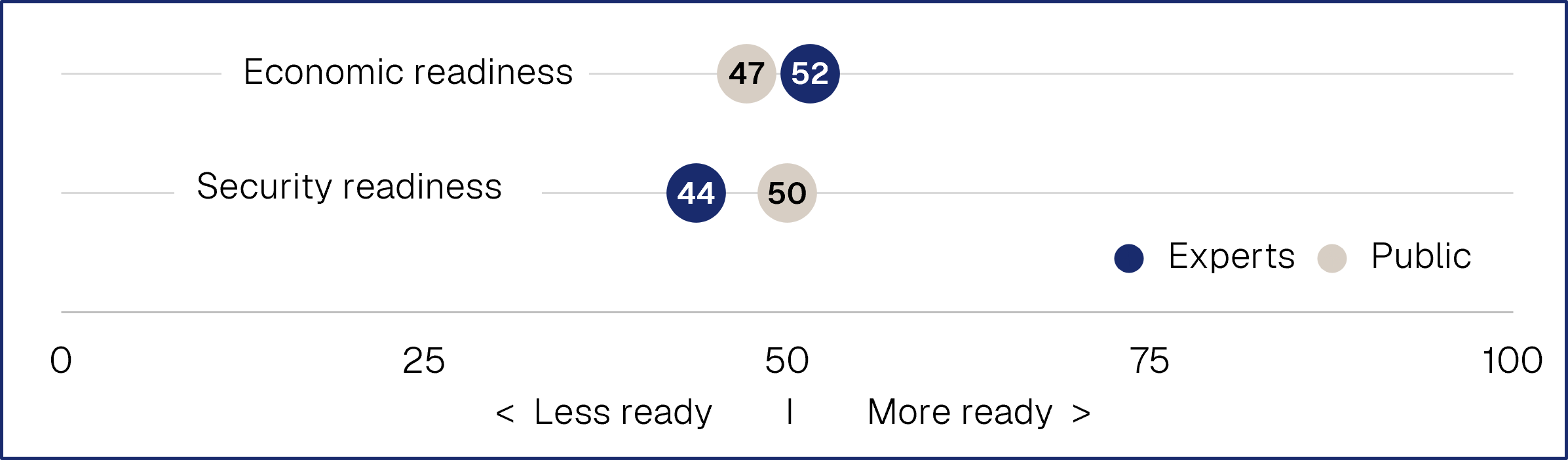
The second figure complicates the picture. Respondents do not see the EU as incapable. Public respondents rate the EU’s capacity to respond to threats to long-term economic prosperity at 47 on a scale from 0 to 100 and its capacity to respond to long-term security threats at 50. These scores sit almost exactly at the midpoint. They suggest neither strong confidence nor deep pessimism. In the public view, the EU appears moderately capable: not fully prepared, but not helpless either.
The expert pattern is slightly more differentiated. Experts rate the EU’s economic readiness somewhat higher, at 52, but its security readiness lower, at 44. This distinction is analytically important. It suggests that experts continue to recognize the EU’s relative credibility as an economic, regulatory, and market actor. The Union possesses resources, institutional experience, and policy instruments in areas such as trade, competition, regulation, finance, industrial policy, and sanctions. But experts are less convinced that the EU can respond effectively to long-term security threats. Here, the problem is not simply resources, but political coordination, decision-making speed, military capability, dependence on the United States, and the ability to act under conditions of crisis.
This is one of the central tensions revealed by Luxsentinel. The EU is not necessarily perceived as weak but, rather, as uneven. Its capacity is stronger in domains that correspond to its historical development as a regulatory, economic, and legal order. It is weaker where strategic action requires rapid decision-making, hard security capabilities, geopolitical prioritization, and willingness to bear costs. The public sees this unevenness somewhat differently, but both groups place EU readiness near or below the midpoint, pointing to a broader perception that Europe’s existing capacities do not match the strategic environment it faces.
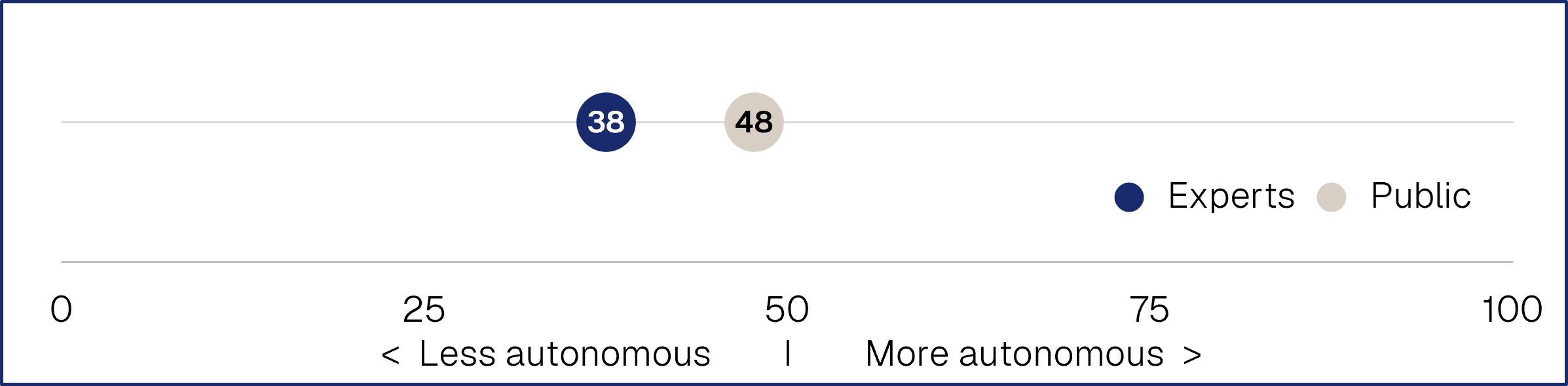
The same pattern is visible in assessments of EU strategic autonomy. Public respondents rate the Union’s current strategic autonomy at 48 out of 100. Experts rate it significantly lower, at 38. This should not be seen as a rejection of the concept of strategic autonomy. On the contrary, the wider European debate suggests growing public demand for European unity, self-reliance, and a stronger international role. But Luxsentinel shows that Luxembourgish respondents distinguish between aspiration and achievement.
The public score, just below the midpoint, suggests that EU strategic autonomy is seen as limited but not absent. Public respondents may recognize areas where the EU has developed capacity: sanctions policy, trade policy, regulatory influence, economic coordination, or support for Ukraine. At the same time, the score indicates uncertainty about whether the EU can decide and act independently when confronted with major crises. The expert score is more severe. At 38, it suggests that those closer to policy, research, and institutional debates see strategic autonomy as substantially incomplete. For them, Europe’s dependence on external security guarantees, non-European technologies, critical resources, energy suppliers, and fragmented national decision-making remains a major constraint.
This finding should be read alongside recent European polling that points to rising support for greater self-reliance, but also continuing caution about rupture with existing alliances, especially the transatlantic relationship. The issue is not whether Europeans want more capacity. Increasingly, they do. The issue is whether the EU has the institutional coherence and political will to turn that demand into operational autonomy. Luxsentinel’s contribution is to show that this question is visible from Luxembourg as well: strategic autonomy appears less as an established condition than as an unfinished project.
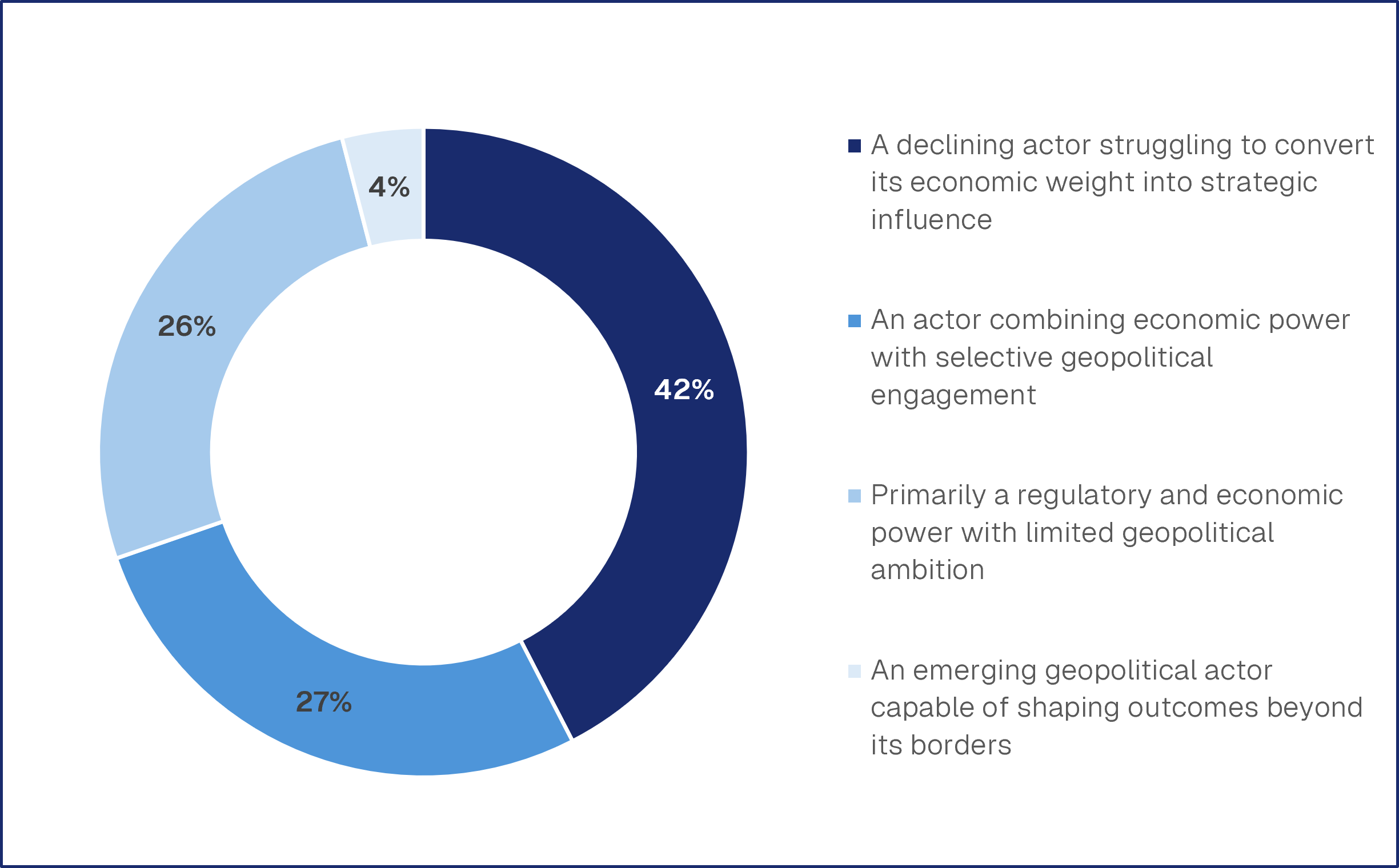
The expert survey makes this diagnosis even more explicit. Asked to characterize the EU’s current role in the international system, 42 percent of expert respondents describe it as “a declining actor struggling to convert its economic weight into strategic influence.” Another 27 percent see it as combining economic power with selective geopolitical engagement, while 26 percent describe it primarily as a regulatory and economic power with limited geopolitical ambition. Only 4 percent see the EU as an emerging geopolitical actor capable of shaping outcomes beyond its borders.
This is perhaps the clearest expression of the expert view in this section. Experts have serious doubts whether EU assets are being translated into consistent strategic agency. In that sense, the finding speaks directly to the long-standing question of what kind of power the EU is. The EU remains more credible as a regulatory and economic actor than as a geopolitical one. It can shape rules, markets, and standards, but it struggles to shape outcomes when strategic competition hardens, military force matters, and crisis response requires speed and unity.
The language of decline should therefore be interpreted carefully. Expert respondents appear to be identifying a relative decline in strategic effectiveness: a widening gap between the EU’s resources and its ability to use them in a more dangerous international environment. This is why the results in this section fit together. The world is seen as unstable. EU readiness is seen as moderate and uneven. Strategic autonomy is judged incomplete. And experts describe the EU as struggling to convert economic weight into strategic influence.
Taken together, these findings establish the strategic mood that frames the rest of the report. Luxembourg’s public and expert respondents share a basic concern about the international environment, but they differ somewhat in intensity and diagnosis. The public is cautious, but not despairing. Experts are more pessimistic, especially about security readiness, autonomy, and geopolitical agency. Both sets of the findings, however, point toward a demand for a more capable Europe: one that can protect prosperity, respond to security threats, reduce dependencies, and act with greater coherence.
For Luxembourg, this matters profoundly. As a small state deeply embedded in European, transatlantic, and multilateral structures, Luxembourg’s own security and prosperity depend heavily on whether the EU can close the gap between capacity and action. The next sections examine what respondents see as the main sources of that vulnerability: the threats facing Europe’s prosperity and security, the changing map of allies and adversaries, and the strategic choices confronting Luxembourg itself.
The data presented in this report shows a clear hierarchy of strategic concern. Security threats are no longer perceived as abstract or distant. Both expert and public respondents identify armed conflict in or near Europe and hybrid threats as central risks. But the two groups differ sharply in what they understand as the deeper source of European vulnerability. Experts emphasize systemic threats: erosion of the rules-based international order, hybrid operations, technological dependencies, and the weakening of collective defence. Public respondents are more focused on visible and direct threats: war, terrorism, cyber interference, and declining institutional trust. The difference is not marginal. Experts read the security environment in more structural or even abstract terms, whereas the public reads it through direct exposure.[6]
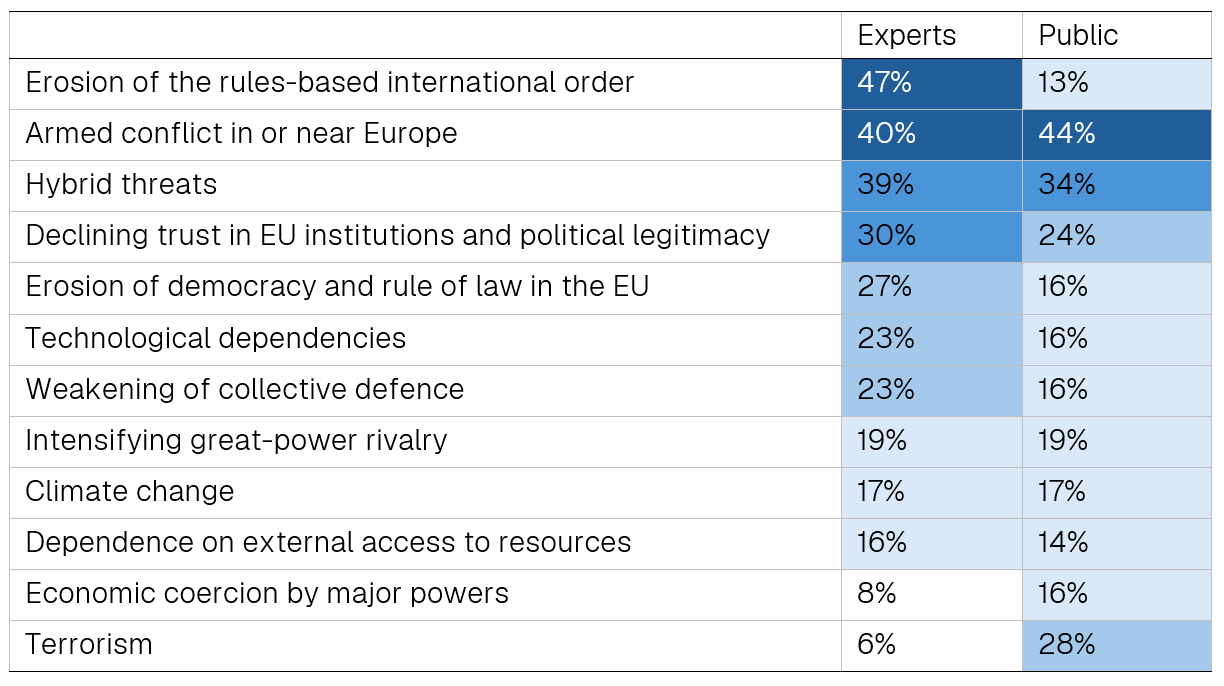
At the EU level, the contrast is stark. For experts, the leading threat to Europe’s long-term security is the erosion of the rules-based international order, selected by 47 percent. Armed conflict in or near Europe follows at 40 percent, and hybrid threats at 39 percent. This is a hard geopolitical diagnosis. It places Europe’s insecurity in the breakdown of the wider order that previously made European integration, open markets, and multilateral security possible. It also aligns with recent strategic assessments describing an international system marked by growing fragmentation, major-power rivalry, and the declining effectiveness of multilateral responses.[7]
Public respondents identify a different hierarchy. Armed conflict in or near Europe ranks first at 44 percent, followed by hybrid threats at 34 percent and terrorism at 28 percent. The public appears to see strategic risk differently, and gives less weight to systemic categories such as erosion of the rules-based order or democratic backsliding inside the EU. Terrorism is the clearest divergence: only 6 percent of experts place it among the biggest long-term EU security threats, compared with 28 percent of the public. Experts have largely moved to a post-9/11 threat map dominated by state competition, hybrid conflict, institutional erosion, and technological vulnerability. Public perceptions remain more strongly shaped by conventional mass-security concerns.
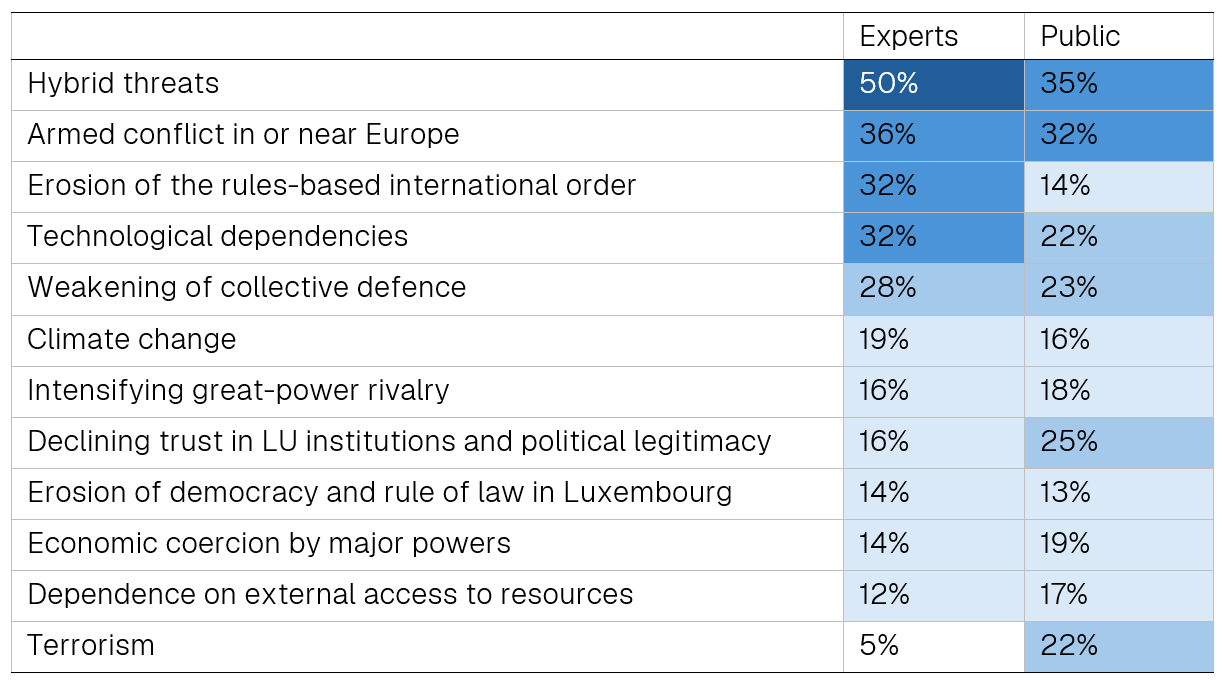
The Luxembourg-specific security picture largely confirms this pattern. Experts identify hybrid threats as the leading threat to Luxembourg’s long-term security, at 50 percent. For a small, highly connected state with a major financial sector, dense digital infrastructure, and deep institutional embeddedness in the EU and NATO, hybrid threats are not secondary. They are arguably the most plausible form of strategic pressure. Cyberattacks, disinformation, coercive economic measures, infrastructure disruption, and influence operations are precisely the kinds of instruments through which hostile actors can pressure small states below the threshold of open conflict. This is also consistent with the EU’s own security agenda, which has placed hybrid threats, cyber resilience, foreign information manipulation, and cross-border crisis response at the centre of its security and defence planning.[8]
The public also recognizes hybrid threats, but less strongly: 35 percent select them, closely followed by armed conflict in or near Europe at 32 percent. Public respondents also give more weight than experts to terrorism, declining trust in Luxembourgish institutions, economic coercion, and dependence on external resources. These results should not be dismissed. They reveal a broader public understanding of security as social and institutional vulnerability, not only external defence. Still, the expert-public gap is clear. Experts see Luxembourg’s security problem primarily as exposure to hybrid and technological disruption. The public sees a wider mix of war proximity, terrorism, institutional trust, and material dependence.
The economic threat picture tells a parallel and related story. At the EU level, experts identify technological dependencies and vulnerabilities as the leading threat to long-term economic prosperity, at 41 percent. Weakening EU competitiveness, dependence on external access to critical resources, and rising economic inequality each follow at 32 percent. This is a structural competitiveness agenda. Experts are pointing to the EU’s position in a global economy increasingly shaped by technology, industrial policy, supply-chain control, critical raw materials, and geopolitical competition. The Draghi report on European competitiveness makes precisely this point: Europe’s prosperity problem is not cyclical weakness, but a structural gap in productivity, innovation, energy costs, technological capacity, and strategic investment.[9]
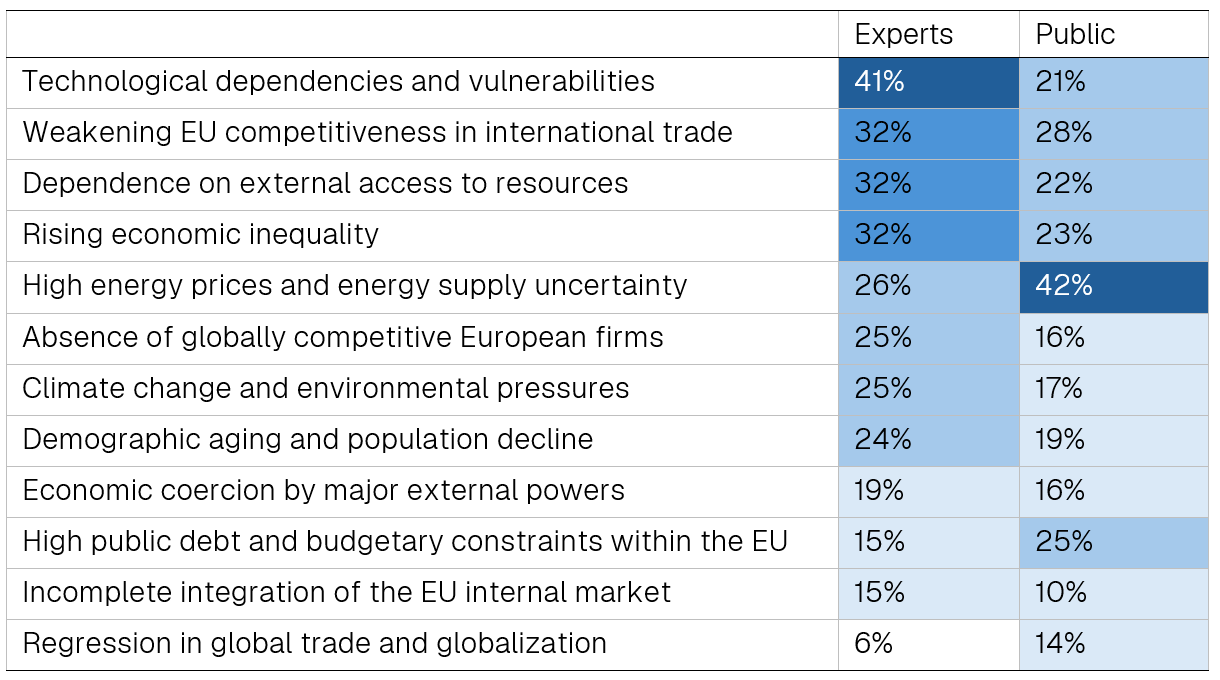
Public respondents, by contrast, place high energy prices and energy supply uncertainty first, at 42 percent. This is not surprising, and it is not wrong. Energy prices are where geopolitics becomes household economics. The public sees strategic vulnerability through its cost-of-living consequences. Rising economic inequality, weakening EU competitiveness, high public debt, and resource dependence also matter, but energy dominates. The public economic threat map is therefore more immediate and distributive. The expert map is more structural and technological.
For Luxembourg, the economic findings are especially revealing. Experts identify rising economic inequality as the leading threat to long-term prosperity, at 51 percent. That is a striking result, and it deserves to be taken seriously. Luxembourg’s prosperity model is not only exposed externally; it is also under pressure internally. Housing costs, inequality, labour-market segmentation, cross-border dependence, and the distributional effects of economic openness are strategic issues because they affect social cohesion and political legitimacy. A wealthy state can still become strategically fragile if prosperity is increasingly experienced as uneven, inaccessible, or dependent on a narrow economic base. Here it should be noted that 18% of our expert respondents chose the option to write in additional threats to Luxembourg’s long-term economic prosperity, and they almost uniformly wrote in the housing crisis in the country as that threat.
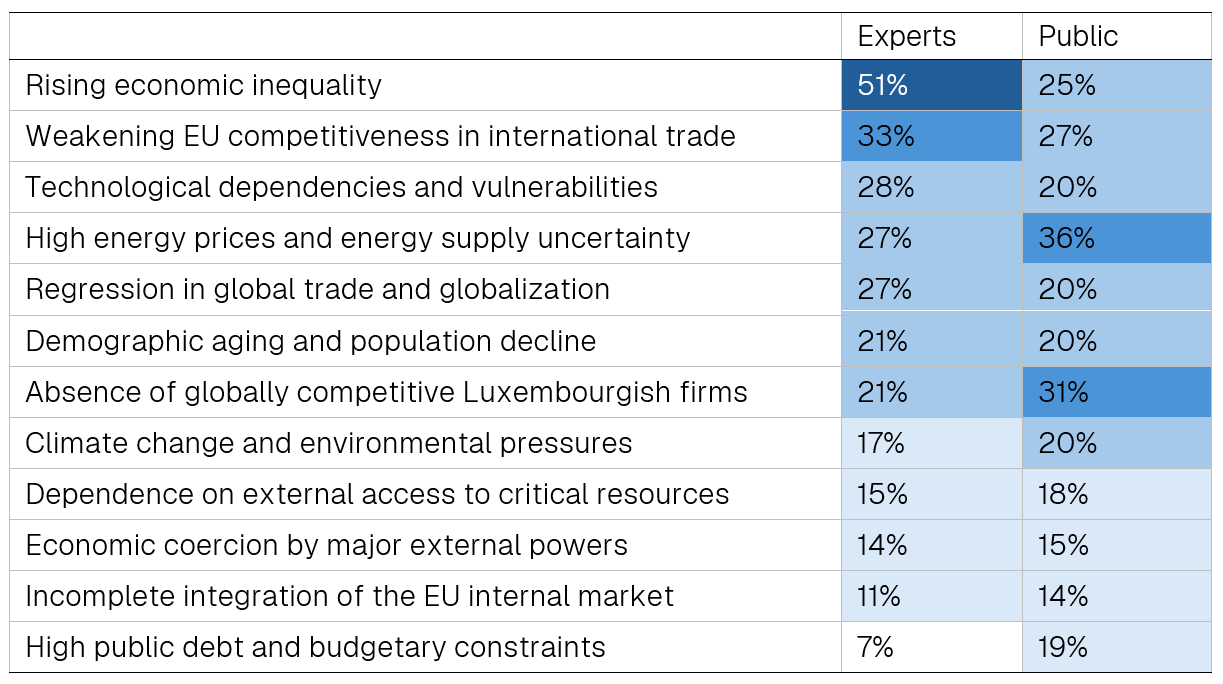
Public respondents also identify inequality as important, but less overwhelmingly, at 25 percent. Their top concerns are again energy prices and supply uncertainty, at 36 percent. They also place more weight than experts on the absence of globally competitive Luxembourgish firms, dependence on critical resources, and public debt. Experts, meanwhile, rank weakening EU competitiveness, technological dependencies, and regression in global trade more highly. This is the same divide seen at the EU level: public respondents emphasize direct pressures on households and the national economy; experts emphasize structural exposure in a more competitive and politicized global economy. The Letta report on the future of the Single Market is relevant here: Europe’s internal market is no longer only a prosperity mechanism; it is increasingly a strategic instrument for resilience, scale, investment, and security.[10]
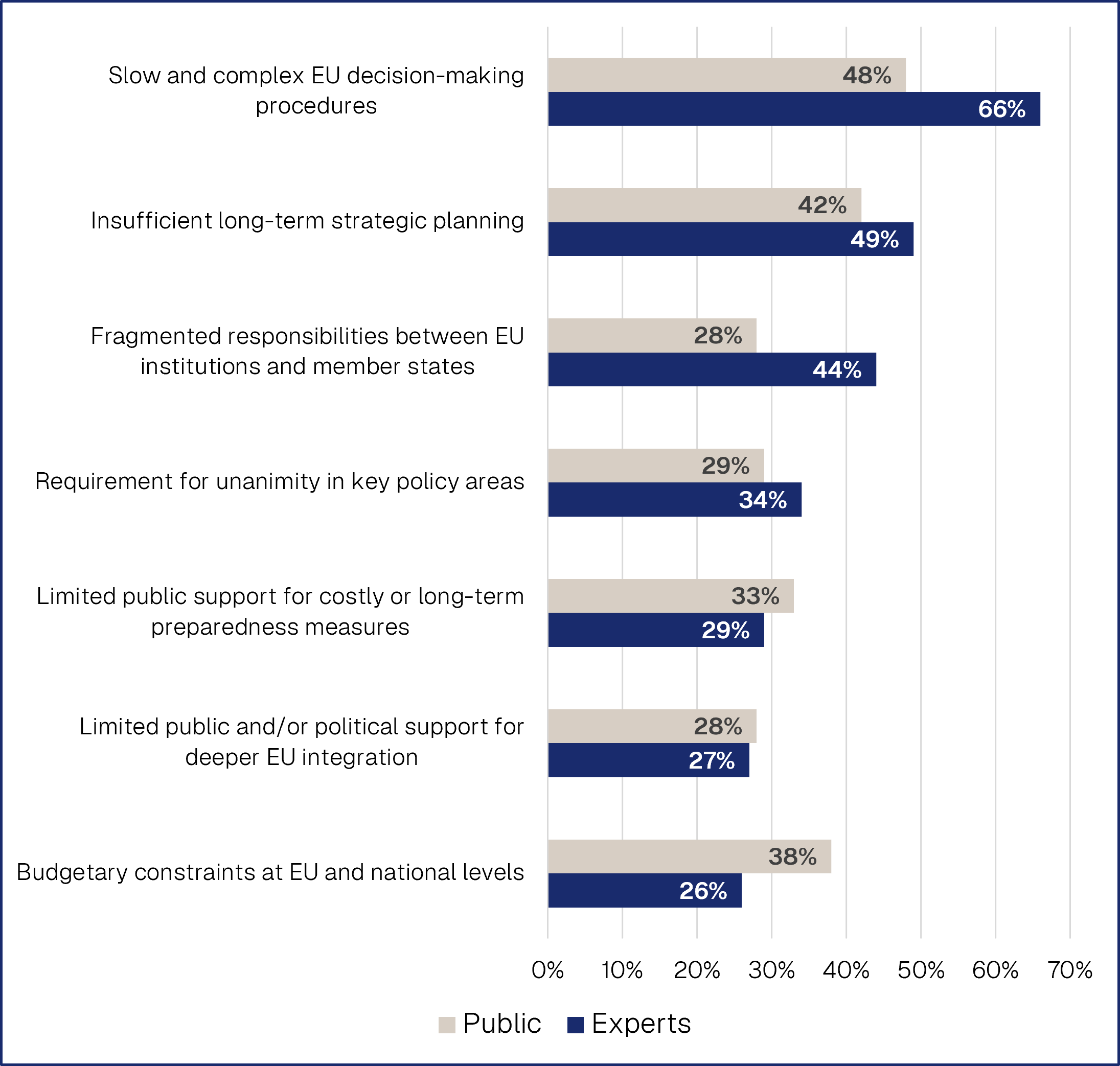
The section’s most important conclusion comes from the preparedness question. Both groups identify the EU’s problem as political and institutional. Experts are unequivocal: 66 percent select slow and complex EU decision-making procedures as a main obstacle to preparedness. The public also places decision-making at the top with 48%, followed by insufficient long-term strategic planning at 42 percent. Fragmented responsibilities between EU institutions and member states rank high among experts, at 44 percent, and remain important for the public, at 28 percent. Unanimity, budget constraints, and limited public support matter, but they are not the core problem, though the importance of budgetary constraints for public respondents should be noted.
This is the clearest message of the section. Europe’s strategic vulnerability is not simply that it faces too many threats. It is that its political system is too slow, too fragmented, and too poorly organized for the threat environment it now confronts. Respondents are not asking the EU to invent a threat agenda from scratch. They already see the threats: war, hybrid attacks, technological dependence, energy exposure, competitiveness decline, inequality, and the erosion of international order. The bottleneck is implementation. On security and prosperity alike, Luxsentinel points to the same conclusion: Europe knows more than it can act on. Its preparedness gap is, above all, a governance gap.
Luxsentinel’s ally/adversary battery of questions captures one of the clearest findings of the report: Europe’s strategic map is no longer self-evident. Some alignments remain clear, especially among experts. Canada, the United Kingdom, Japan, Australia, and Ukraine are placed firmly on the ally side by expert respondents, while Russia and Iran are placed firmly on the adversary side. But the public map seems flatter. Public respondents seem to cluster many countries closer to the midpoint, including the United States, China, India, Turkey, Ukraine, and Brazil.
These composite results, however, hide the fact that there was a great variety of responses among both the experts and even more so among the public. To be more specific, standard deviations of public responses were on average 54 points, whereas for the experts they were 41. In other words, the clustering around the middle of the public’s composite figures does not mean that regular people have no views on foreign policy. On the contrary, public views are not moderate – they are divided. The public mean often conceals opposing judgments that cancel each other out.
The Luxsentinel data strongly suggest that public respondents are not simply less willing to classify international actors. Rather, the Luxembourgish public contains competing strategic orientations. This is consistent with the broader literature on expert-public gaps, which shows that differences between expert and mass publics often reflect different information environments, issue salience, professional socialization, and interpretive frameworks.[11] In this case the more important finding is not merely that experts and the public differ. It is that expert respondents converge more strongly around a shared strategic map, while public opinion is internally fragmented.
The most important case here concerns the United States. In the weighted public data, the US sits almost exactly at zero. Experts also place it at zero. This is a remarkable result. The United States remains Europe’s most important military partner, the central actor in NATO, and the country around which European defence planning has been organized for decades. Yet neither experts nor the public in Luxembourg currently rate it as a clear strategic ally. Even more importantly, the high standard deviations (53 for the experts and 63 for the public) show that the US is not simply seen as neutral. It is divisive. Some respondents still view it as a major ally. Others clearly do not. The mean lands at zero because these views cancel out.
This finding should be stated plainly: the transatlantic relationship has entered a period of profound political and strategic uncertainty. The return of Donald Trump to the White House, his repeated doubts about US security guarantees, pressure on European allies to assume more of the defence burden, tariff threats, and the wider unpredictability of US foreign policy have all affected how Europeans assess American reliability. Recent ECFR polling similarly finds that European confidence in the United States has collapsed, with only a small minority now viewing it as an ally.[12] Luxsentinel shows the same problem from Luxembourg: the US is not seen as an adversary, but it is no longer taken for granted as a dependable ally. It has become the central ambiguity in Europe’s strategic map.
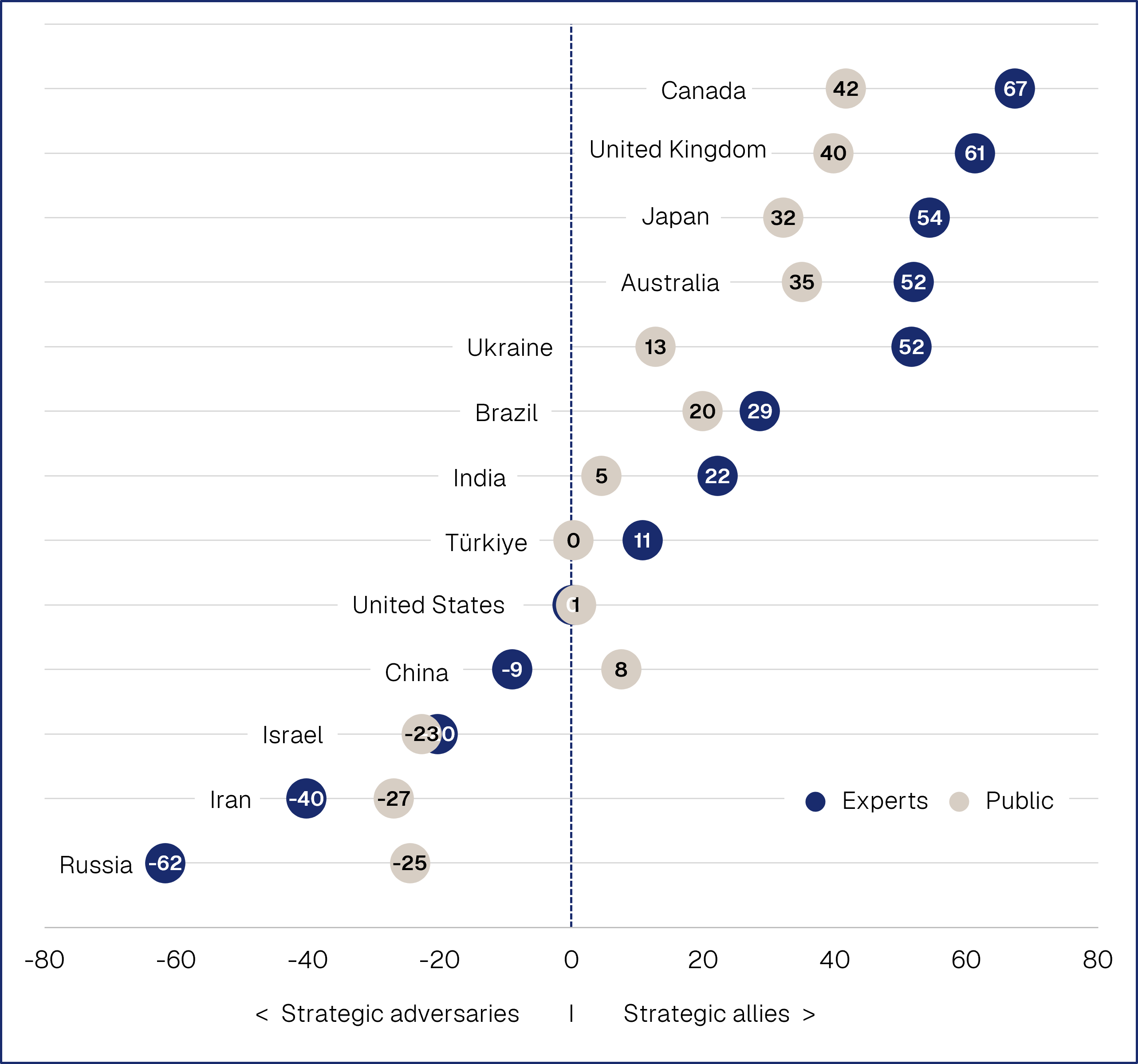
The expert-public difference is otherwise substantial. Experts place Canada at +67, the United Kingdom at +61, Japan at +54, Australia at +52, and Ukraine at +52. Public respondents also rate these countries positively, but much less strongly: Canada at +42, the United Kingdom at +40, Australia at +35, Japan at +32, and Ukraine at +13. The expert map therefore retains a recognizable community of strategic partners. The public map does too, but with weaker consensus. The difference is not that the public rejects these countries. It is that the public is less unified in seeing them as clear strategic allies.
The largest substantive gap concerns Ukraine and Russia. Experts place Ukraine clearly on the ally side, at +52, and Russia clearly on the adversary side, at -62. Public respondents place Ukraine only modestly on the ally side, at +13, and Russia on the adversary side at -25. These public averages are not trivial, but they are far less consolidated than the expert scores. The high public standard deviation for Russia (67 for the public and 47 for the experts) is especially important. Russia is not uniformly understood by the Luxembourgish public as the central adversary of the European security order. For some respondents it clearly is. For others, the view is weaker, neutral, or possibly even positive.
This is one of the most consequential findings in the report. Since Russia’s full-scale invasion of Ukraine, the EU has framed Ukraine’s defence as inseparable from European security, sanctions against Russia as a defence of the rules-based order, and Ukraine’s long-term stability as a European strategic interest. The European Council has repeatedly reaffirmed that Ukraine’s security is tied to Europe’s own security and has continued to combine financial, military, political, and sanctions support.[13] Expert respondents have clearly internalized this frame: Russia is the adversary and Ukraine is the frontline partner. Public opinion has not consolidated to the same degree. That gap matters because the war in Ukraine is a long-term test of European political endurance. If public support depends on sustained sacrifices, sanctions, military assistance, enlargement commitments, and higher defence spending, policymakers cannot assume that the public sees the conflict through the same strategic lens as expert communities.
China occupies a different but equally telling position. Experts place China slightly on the adversary side, at -9, while the public places it slightly on the ally side, at +8. Neither group treats China as a clear adversary, but experts are more cautious. This fits the broader European dilemma. China is simultaneously a trading partner, systemic rival, technological competitor, and geopolitical actor aligned with many of the forces challenging the Western-led order. The modest expert negativity likely reflects concerns about technological dependence, economic coercion, critical supply chains, and China’s relationship with Russia. The public’s slightly positive score suggests either weaker salience or a more economically pragmatic reading. In either case, China is not classified in Luxembourg as a straightforward adversary. It remains in the grey zone.
The Middle East results show how recent events can disrupt conventional strategic alignments. Both experts and the public place Israel and Iran on the adversary side, but they do so differently. Experts distinguish sharply between the two: Iran is rated at -40, Israel at -20. Public respondents place both countries in a similar adversarial range: Iran at -27 and Israel at -23. In other words, Israel is rated by the Luxembourgish public almost as negatively as Iran.
This result likely reflects the political consequences of the Gaza war and the collapse of Israel’s public standing across much of Europe. Pew’s 2026 global survey found broadly negative views of Israel across the countries surveyed, with a median of 67 percent expressing an unfavourable view and little confidence in Benjamin Netanyahu.[14] Luxsentinel fits this wider shift. Public judgments are not based only on formal alignments, regime type, or security partnerships. They are also shaped by images of war, humanitarian suffering, allegations of violations of international law, and the perceived moral positioning of European governments.
Experts, by contrast, continue to classify Iran as the more serious strategic adversary. That reflects a more conventional security assessment: Iran’s nuclear programme, regional proxy networks, threats to maritime and energy security, and recent war with Israel and the United States. CSIS analysis of the Israel-Iran confrontation has emphasized precisely these risks of regional escalation and wider strategic spillover.[15] The expert-public difference therefore reflects two distinct logics. Experts weigh Iran’s role in regional destabilization more heavily. The public weighs Israel’s conduct in Gaza more heavily. Both are politically meaningful.
Taken together, the ally/adversary results show that Europe’s partnerships are more conditional, more contested, and less self-evident than before. Experts still possess a relatively coherent strategic map: Canada, the UK, Japan, Australia, and Ukraine are allies; Russia and Iran are adversaries; China is a cautious competitor; the US is uncertain. The public map is not simply flatter. It is more fragmented. The US divides opinion so deeply that the weighted mean lands exactly at zero. Russia is negative, but public views are highly dispersed. Ukraine is positive, but not yet consolidated as a strategic ally. Israel’s public standing has deteriorated to the point where it sits close to Iran.
This is a strategic problem. European policy increasingly assumes a world of sharper geopolitical alignments, but public opinion in Luxembourg does not fully match that assumption. Alliances can no longer be treated as self-explanatory. They have to be politically justified. If Europe wants durable public support for strategic partnerships, sanctions, defence commitments, enlargement, and long-term aid to Ukraine, it must explain not only what Europe opposes, but whom it trusts, why it trusts them, and what those partnerships are meant to achieve.
The previous sections show the problem clearly: Europe faces a harsher strategic environment, but its capacity to act remains constrained by fragmentation, slow decision-making, uneven preparedness, and contested public perceptions of partners and adversaries. The question is therefore not whether the EU should become more strategically capable. It must. The question is how. Luxsentinel’s answer is strikingly pragmatic. Respondents do not call for a retreat from European integration, nor do they endorse a purely rhetorical language of strategic autonomy. They support institutional forms that promise effectiveness: differentiated integration, selective policy integration, and enlargement where it either meets established criteria or strengthens Europe’s strategic position.
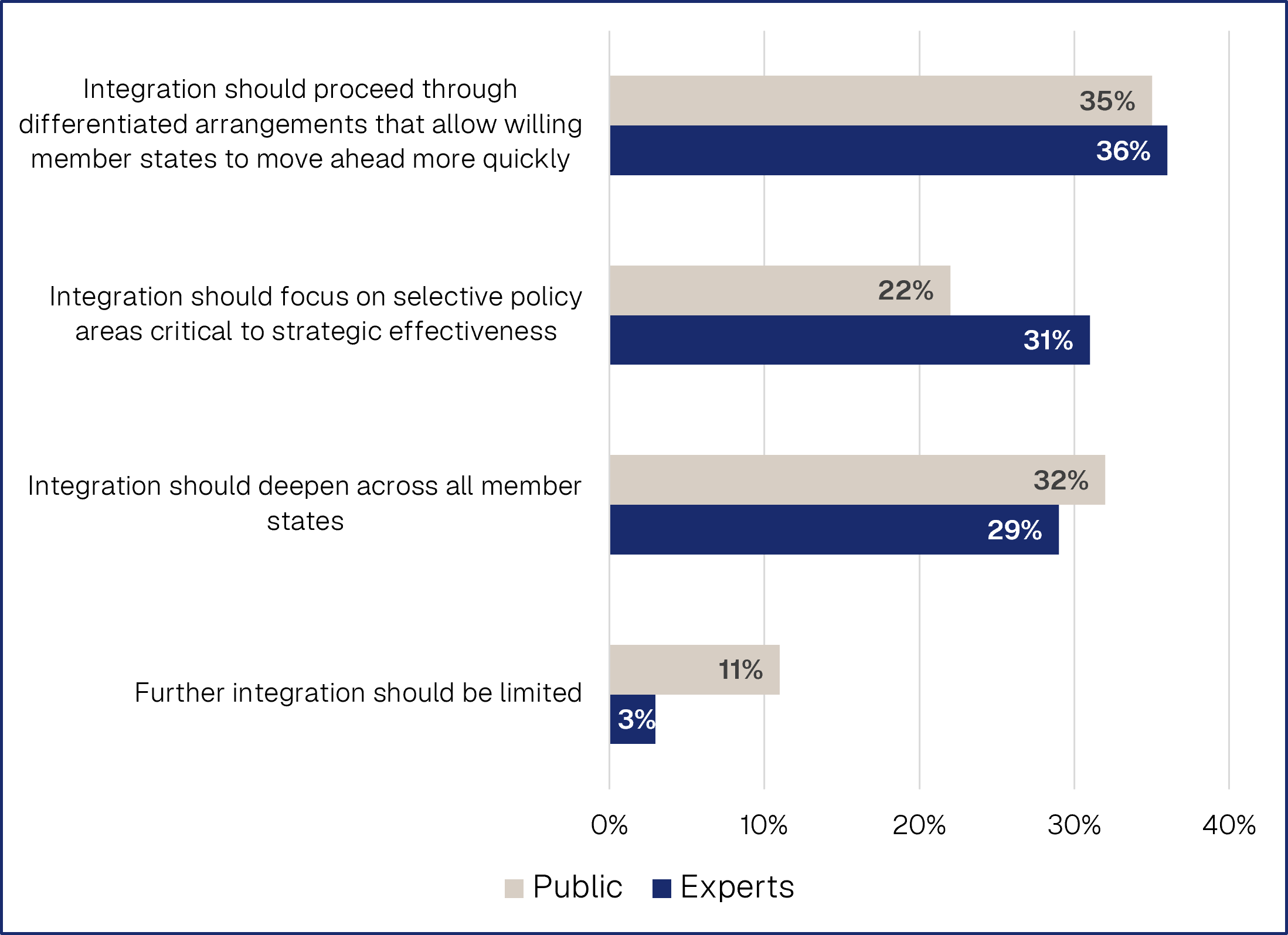
The first message is that further European integration retains legitimacy, but not in a uniform or ideological form. As Figure 7 shows, among public respondents, 35 percent say integration should proceed through differentiated arrangements allowing willing member states to move ahead more quickly; 32 percent support deepening integration across all member states; and 22 percent prefer selective integration in policy areas critical to strategic effectiveness. Only 11 percent say further integration should be limited. Experts are even clearer: 36 percent support differentiated arrangements, 31 percent selective policy integration, and 29 percent deeper integration across all member states. Only 3 percent want integration limited.
This is a strong result. The dominant preference is not “less Europe.” It is a Europe that can act. The public and expert samples both accept that the EU’s current strategic challenges require deeper or more flexible forms of integration. The difference lies in emphasis. The public remains somewhat more open to broad-based deepening across all member states. Experts are more inclined toward selective and differentiated approaches. That makes sense. Experts have spent the previous sections identifying decision-making complexity, fragmented responsibilities, and institutional inertia as core obstacles. For them, integration has to solve the capacity problem, not simply reaffirm the European project.
This finding fits the direction of recent European debate. The European Parliament’s 2025 survey found overwhelming support for greater unity among member states in facing global challenges and for a stronger EU voice internationally.[16] But unity does not necessarily mean uniformity. The Letta report argues that the Single Market must be adapted to a more geopolitical age, with deeper integration in finance, energy, telecommunications, and strategic sectors.[17] The Luxsentinel data point in the same direction: integration is politically viable when it is tied to strategic effectiveness.
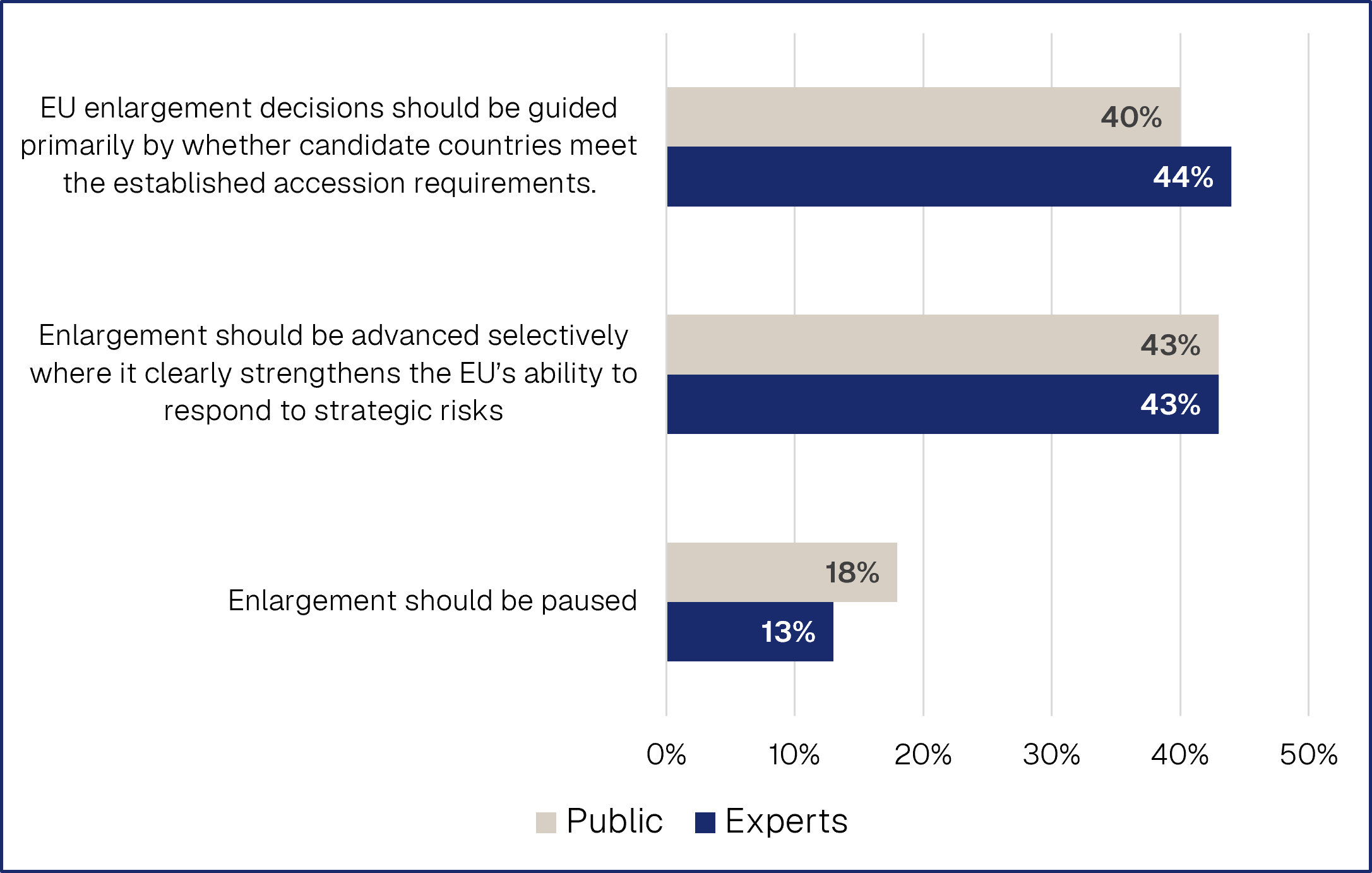
The results regarding enlargement are equally pragmatic. Public respondents are almost evenly split between two logics: 43 percent say enlargement should be advanced selectively where it strengthens the EU’s ability to respond to strategic risks, while 40 percent say decisions should be guided primarily by whether candidate countries meet established accession requirements. Experts show the same balance: 43 percent support selective strategic enlargement and 44 percent prioritize established accession requirements. Only small minorities support pausing enlargement: 18 percent of the public and 13 percent of experts.
This is another important finding. Enlargement is not rejected, but neither is it treated as a purely technocratic process insulated from geopolitics. Respondents recognize both principles at once: accession should remain conditional and rules-based, but enlargement also has strategic consequences. This is exactly the tension at the centre of current EU enlargement policy. The Commission’s 2025 Enlargement Package explicitly frames enlargement as a matter of prosperity, democracy, security, stability, and strategic investment, while still grounding accession in reforms and established criteria.[18] The Luxsentinel data suggest that this dual logic is politically intelligible in Luxembourg. Respondents do not want enlargement to become reckless. But they also do not want it frozen.
Ukraine, Moldova, the Western Balkans, and other candidate countries have made enlargement a strategic question again. A larger EU could strengthen Europe’s geopolitical reach, stabilize its neighbourhood, and prevent strategic vacuums. But a larger EU without institutional reform could also deepen the very problems respondents identify elsewhere in the survey: slow decision-making, fragmented responsibilities, veto points, and weak implementation. Enlargement and reform therefore cannot be treated separately. If the EU is to enlarge, it must also become more governable.
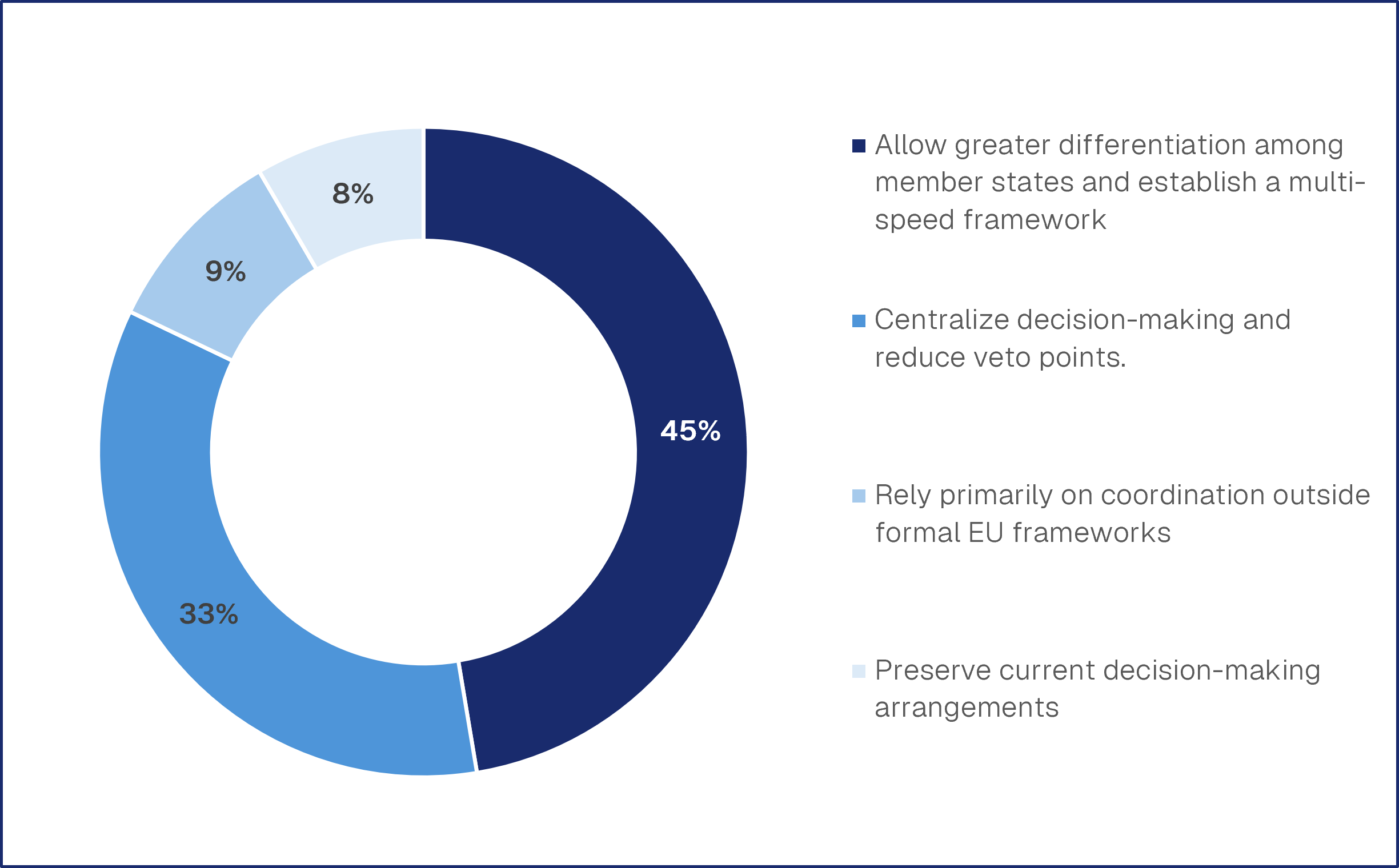
The expert reform preferences on this front are direct. Forty-five percent say the EU should allow greater differentiation among member states and establish a multi-speed framework. Another 33 percent support centralizing decision-making and reducing veto points. Only 9 percent favour relying primarily on coordination outside formal EU frameworks, and only 8 percent support preserving current decision-making arrangements. The status quo has almost no constituency among experts.
This is the institutional core of the section. Experts do not want informal improvisation to substitute for reform. Nor do they want to preserve current arrangements. They want either differentiated integration or fewer veto points. That means the EU’s problem is not simply a lack of ambition or resources. It is institutional design. A Union built to reconcile national preferences under conditions of relative stability is struggling to act under conditions of strategic pressure. The Draghi report makes a similar point in economic terms: Europe requires more coordinated investment, faster decisions, deeper capital markets, stronger industrial capacity, and greater capacity to compete with the United States and China.[19] Strategic autonomy will remain rhetorical unless the EU can mobilize resources and make decisions at the speed required by the environment.
The section’s conclusion is straightforward. Luxsentinel does not reveal support for withdrawal, paralysis, or symbolic Europeanism. It reveals support for a more capable Europe. Respondents favour integration when it improves effectiveness. They accept enlargement when it is tied either to accession criteria or strategic necessity. Experts are clear that institutional reform is indispensable. The message for policymakers is therefore not ambiguous: the EU does not need more slogans about strategic autonomy. It needs decision-making capacity, differentiated routes for willing states, credible enlargement, and the ability to turn economic and regulatory weight into strategic action.
Luxembourg’s strategic position is defined by a basic tension. It is a small state with limited hard-power capacity, but it is deeply exposed to the consequences of geopolitical fragmentation, economic coercion, cyber disruption, energy insecurity, and instability in the European order. Luxsentinel’s expert respondents understand this clearly. They do not imagine Luxembourg as a major strategic actor in its own right. But neither do they see it as irrelevant. Luxembourg’s value lies in brokerage, expertise, convening capacity, financial and economic knowledge, and its ability to operate through European and multilateral institutions. That is classic small-state statecraft: influence through embeddedness, specialization, and coalition-building rather than through autonomous material power.[20]
The first finding, shown in Figure 10, can be seen as sobering, however expected it might be. Forty percent of experts say Luxembourg primarily adapts to positions set by larger member states. Thirty-five percent see it as acting as a facilitator among member states, and 25 percent see it as contributing expertise in specific policy areas such as finance, regulation, or technology. This is not a picture of a state shaping the European agenda from the front. It is a picture of a state navigating a strategic environment largely structured by others.
Adaptation, however, should not be confused with passivity. For small states, foreign policy often consists of choosing the right coalitions, identifying moments of leverage, and embedding national priorities in larger European frameworks. Luxembourg rarely has the scale to impose outcomes. It can, however, help shape procedures, host debates, convene actors, provide technical knowledge, and support coalitions that move EU policy in strategically useful directions. The expert responses therefore point to a realistic view of Luxembourg’s role: it is not a great power, but it can still be a useful and sometimes influential European actor.
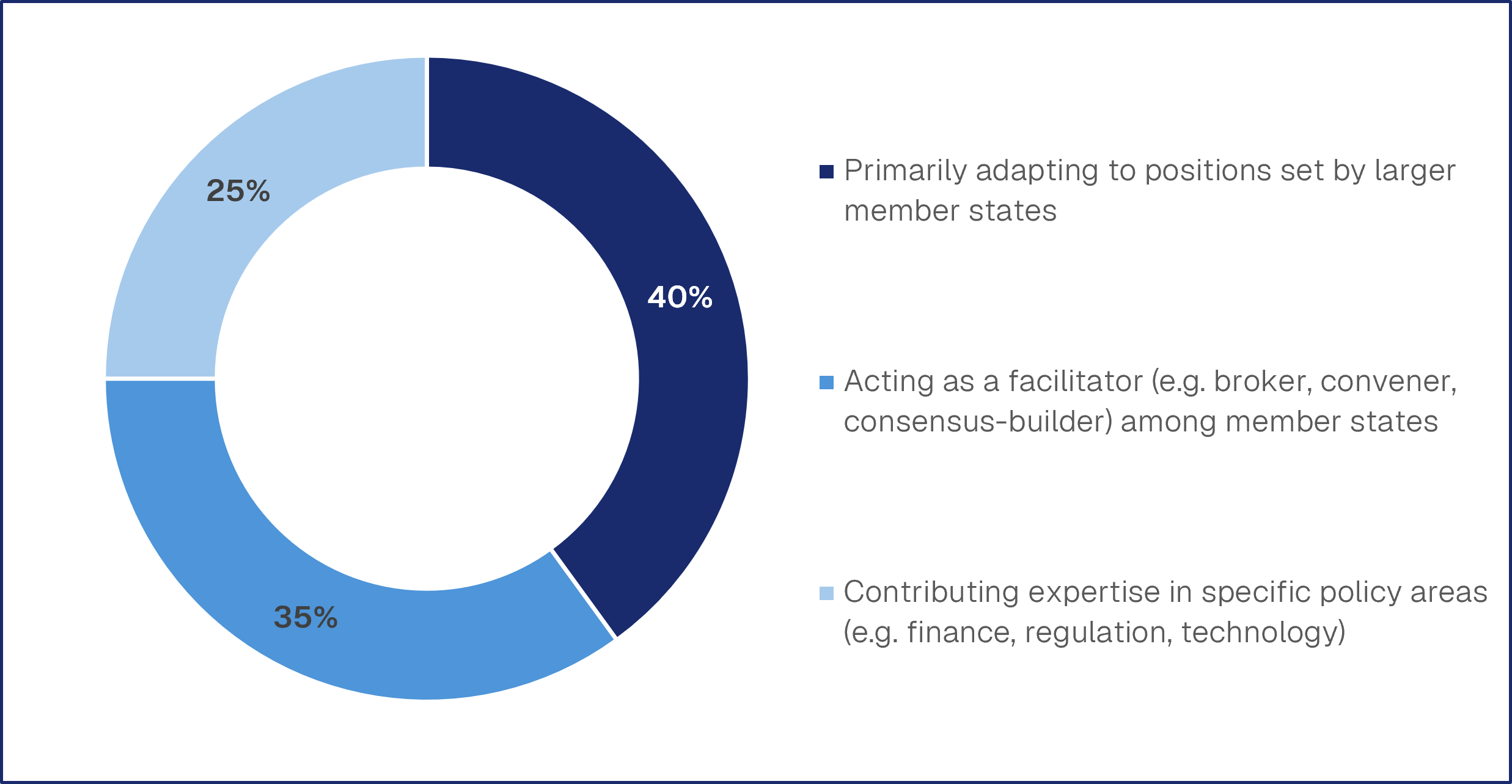
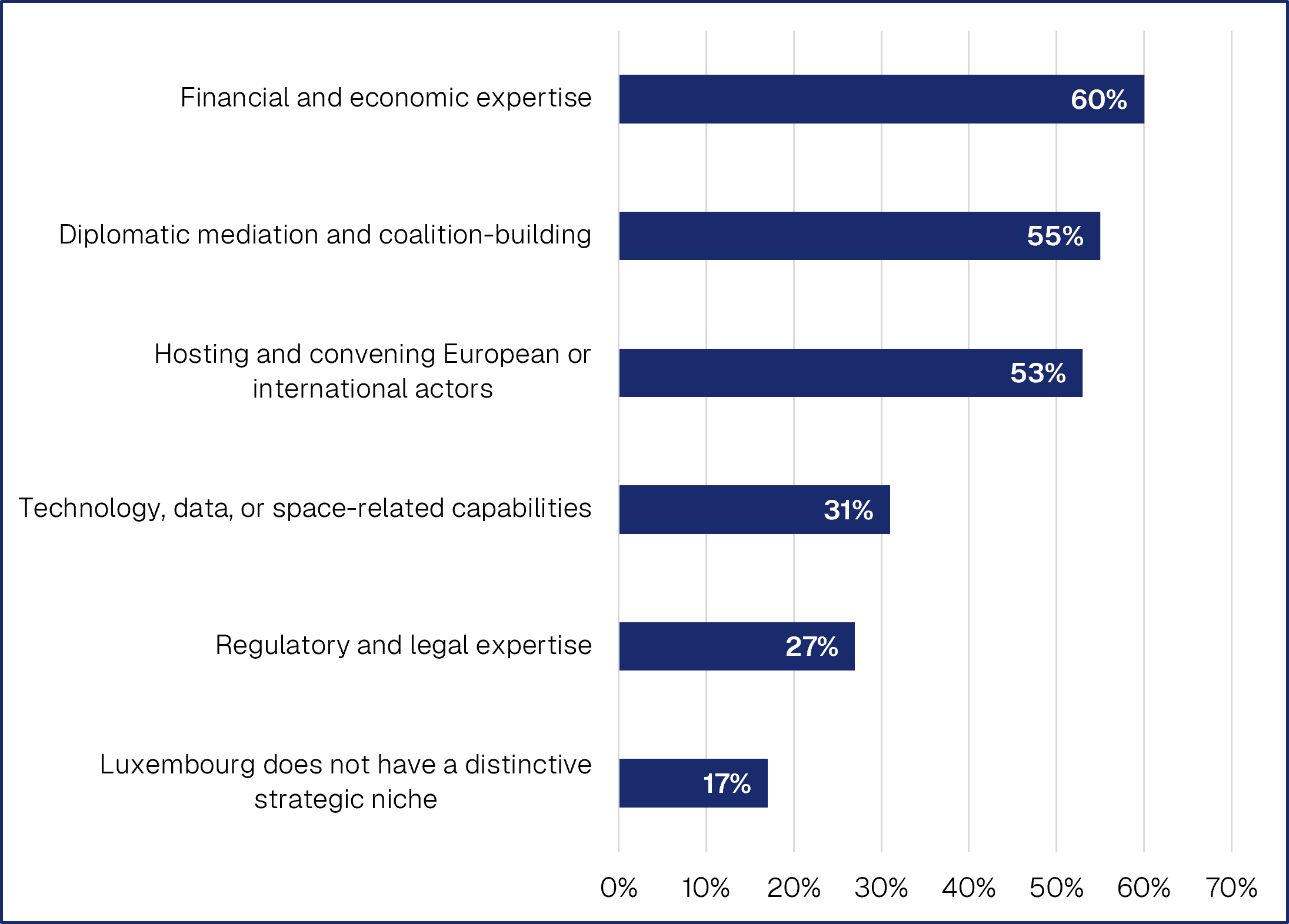
Figure 11 identifies where that value lies. Experts place financial and economic expertise first, at 60 percent. Diplomatic mediation and coalition-building follow closely at 55 percent, while hosting and convening European or international actors stands at 53 percent. These are Luxembourg’s strategic niches. They are not peripheral. In a Europe where finance, sanctions, investment screening, economic security, competitiveness, defence financing, and regulatory capacity are increasingly central to geopolitical power, Luxembourg’s economic and institutional expertise matters. The Letta and Draghi reports both make clear that Europe’s strategic capacity depends on deeper markets, investment, competitiveness, and the ability to mobilize economic instruments at scale.[21] Luxembourg is directly implicated in that agenda.
The findings also show what Luxembourg is not yet perceived to be. Only 31 percent of experts identify technology, data, or space-related capabilities as a distinctive source of value, and only 27 percent identify regulatory and legal expertise. Those numbers are not negligible, but they are clearly below finance, diplomacy, and convening. This suggests that Luxembourg’s emerging strategic sectors have not yet achieved the same perceived weight as its established niches. That is a challenge. If technological dependence, cyber vulnerability, data governance, space infrastructure, and digital resilience are becoming central to European security, Luxembourg cannot rely only on its traditional profile. It needs to translate its technology and space ambitions into a more visible strategic contribution.
The most reassuring result is that only 17 percent of experts say Luxembourg lacks a distinctive strategic niche. In other words, the expert community does see Luxembourg as strategically useful. The issue is focus. Luxembourg’s comparative advantage is not broad-spectrum power. It is targeted relevance. Its foreign policy should therefore be judged less by whether it leads Europe and more by whether it consistently adds value in the domains where small states can matter: coalition-building, financial expertise, institutional brokerage, hosting, regulation, and specialized technological capabilities.
The priorities identified by experts for Luxembourg, shown in Figure 1, follow directly from this diagnosis. The top priority is strengthening coordination across national, EU, and multilateral levels, selected by 51 percent. This is a sensible answer for Luxembourg. A state whose influence depends on embeddedness must be exceptionally good at coordination. Fragmentation between national ministries, EU processes, NATO commitments, multilateral diplomacy, financial regulation, cyber preparedness, and strategic communication would weaken precisely the channels through which Luxembourg can exercise influence.
The second and third priorities are equally important: reducing dependence on non-European technologies in strategic sectors, selected by 43 percent, and strengthening public resilience against disinformation and external interference, selected by 42 percent. These results confirm that Luxembourg’s exposure is not primarily territorial. It is infrastructural, technological, financial, informational, and institutional. Hybrid threats are the strategic problem most suited to Luxembourg’s vulnerability profile. EU and NATO documents have both placed hybrid threats, cyberattacks, foreign interference, and critical infrastructure resilience at the centre of the contemporary security agenda.[22] Luxembourg should do the same.
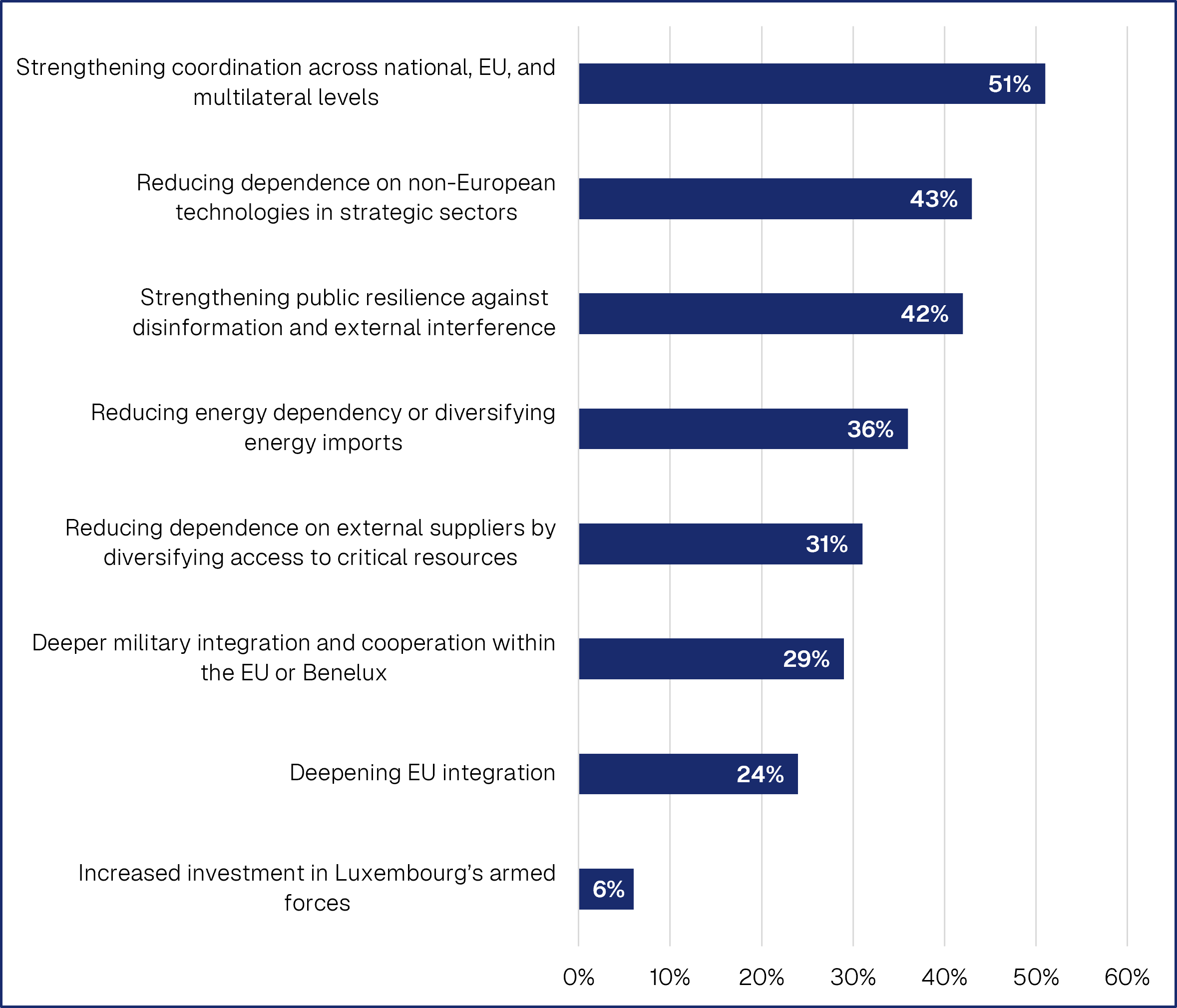
Energy dependency and access to critical resources also rank highly, at 36 and 31 percent respectively. This reflects the same lesson from earlier sections: economic openness creates strategic exposure. Luxembourg benefits enormously from integration into European and global markets, but that openness is sustainable only if dependencies are managed. Strategic preparedness therefore cannot be reduced to defence spending. It requires resilience in energy, technology, data, supply chains, infrastructure, public communication, and institutional coordination.
The lowest-ranked priority is increased investment in Luxembourg’s armed forces, selected by only 6 percent. That result should be read carefully. It does not mean defence is irrelevant. Luxembourg’s Defence Guidelines 2035 make clear that the country’s security is embedded in NATO, the EU’s Common Security and Defence Policy, and wider collective defence structures.[23] But the expert responses suggest that Luxembourg’s most urgent contribution is not simply a larger national military. It is smarter integration into collective defence, deeper EU and Benelux cooperation, resilience against hybrid threats, and investment in the strategic functions where Luxembourg has comparative advantage.
The conclusion is clear. Luxembourg’s strategic problem is not that it is small. It is that it is highly exposed. Its response should not be symbolic militarization or passive adaptation to larger states. It should be focused statecraft: stronger coordination, technological resilience, public preparedness, energy diversification, and deliberate use of Luxembourg’s financial, diplomatic, and convening power. In a harsher Europe, Luxembourg will matter if it knows where it matters.
Luxsentinel’s forecast questions show that experts expect a Europe under continued pressure. The dominant expectation is not a dramatic single rupture, but a sequence of plausible shocks: cyber and hybrid attacks, higher defence spending, enlargement, continued uncertainty over the United States, and persistent exposure to geopolitical disruptions. These forecasts matter because they reveal the strategic environment experts believe policymakers should already be preparing for. The message is clear: instability is not a distant possibility.
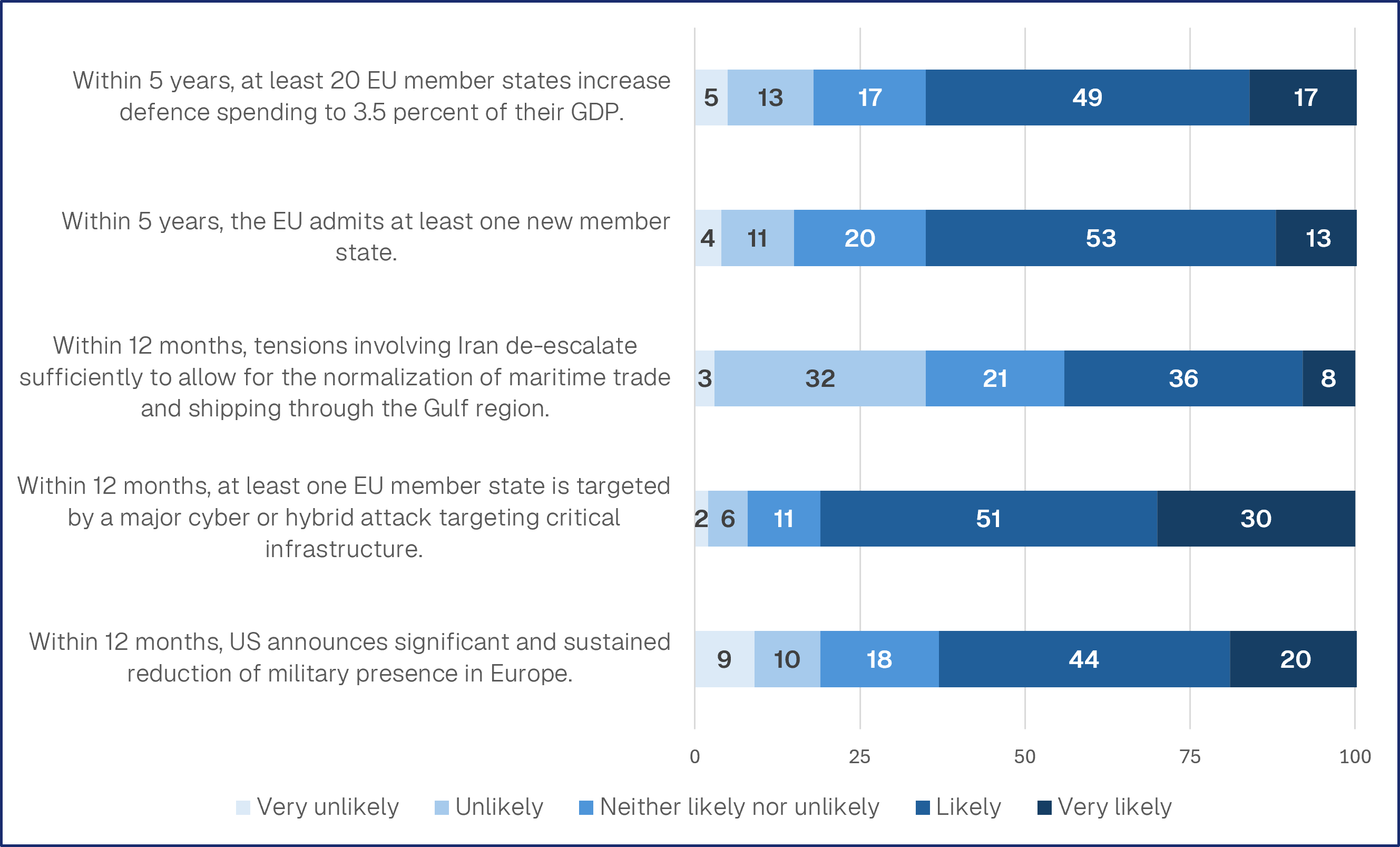
The strongest expectation concerns cyber and hybrid threats. As Figure 13 shows, eighty-one percent of experts say it is likely or very likely that, within twelve months, at least one EU member state will be targeted by a major cyber or hybrid attack against critical infrastructure. This is the most decisive prediction in the section. It also fits the threat hierarchy identified earlier in the report. Experts do not see hybrid threats as hypothetical. They see them as imminent. ENISA’s 2025 threat landscape similarly emphasizes sustained and converging attacks against the EU’s digital infrastructure, with threat actors reusing tools, exploiting vulnerabilities, and developing new attack models.[24] The policy implication is straightforward: cyber and hybrid resilience should be treated as core security policy, not as a technical subfield.
Experts also expect a major shift in European defence spending. Sixty-six percent say it is likely or very likely that, within five years, at least twenty EU member states will increase defence spending to 3.5 percent of GDP. This is no longer a marginal scenario. NATO’s 2025 Hague Summit Declaration committed allies to invest 5 percent of GDP annually in defence-related spending by 2035, including at least 3.5 percent for core defence requirements.[25] The Luxsentinel result shows that experts take this shift seriously. Defence spending is moving from political aspiration to expected policy trajectory.
The forecast on enlargement is similarly clear. Sixty-six percent of experts say it is likely or very likely that the EU will admit at least one new member state within five years. This aligns with the renewed strategic momentum behind enlargement after Russia’s full-scale invasion of Ukraine. The European Commission’s 2025 Enlargement Package described enlargement as high on the EU’s priority agenda and argued that accession of new member states is increasingly within reach, while insisting that there can be no shortcuts on rule of law, democratic institutions, and fundamental freedoms.[26] Experts therefore expect enlargement to move, but not necessarily quickly or cleanly. It remains a strategic necessity constrained by institutional and political realities.
The United States remains the major uncertainty. Sixty-four percent of experts say it is likely or very likely that, within twelve months, the US will announce a significant and sustained reduction of its military presence in Europe. That is a striking forecast. It reinforces the earlier finding that the US sits at the midpoint of the ally/adversary scale. Experts are not simply worried about American rhetoric. They consider a concrete reduction of US military presence in Europe more likely than not. European defence planning can no longer assume that American force posture will remain stable.
The least settled European scenario concerns the Gulf. Forty-four percent of experts say it is likely or very likely that tensions involving Iran will de-escalate sufficiently within twelve months to allow normalization of maritime trade and shipping through the Gulf region, while 35 percent consider this unlikely or very unlikely. This divided result reflects genuine uncertainty. The Israel-Iran confrontation, risks to maritime security, and the possibility of wider escalation make de-escalation possible but fragile. Recent strategic analysis has emphasized precisely this uncertainty: escalation can be rapid, but durable stabilization is much harder to secure.[27]
The Luxembourg-specific forecasts, presented in Figure 14, are more cautious. Experts see risk, but they are less certain about whether the most serious disruptions will hit Luxembourg directly. Thirty-six percent say it is likely or very likely that Luxembourg will be the target of a major state-attributed cyber or hybrid attack affecting critical infrastructure within twelve months, while 31 percent say this is unlikely or very unlikely, and 33 percent choose the middle category. Luxembourg’s exposure is real, but experts are divided on whether it will materialize as a direct attack in the next year.
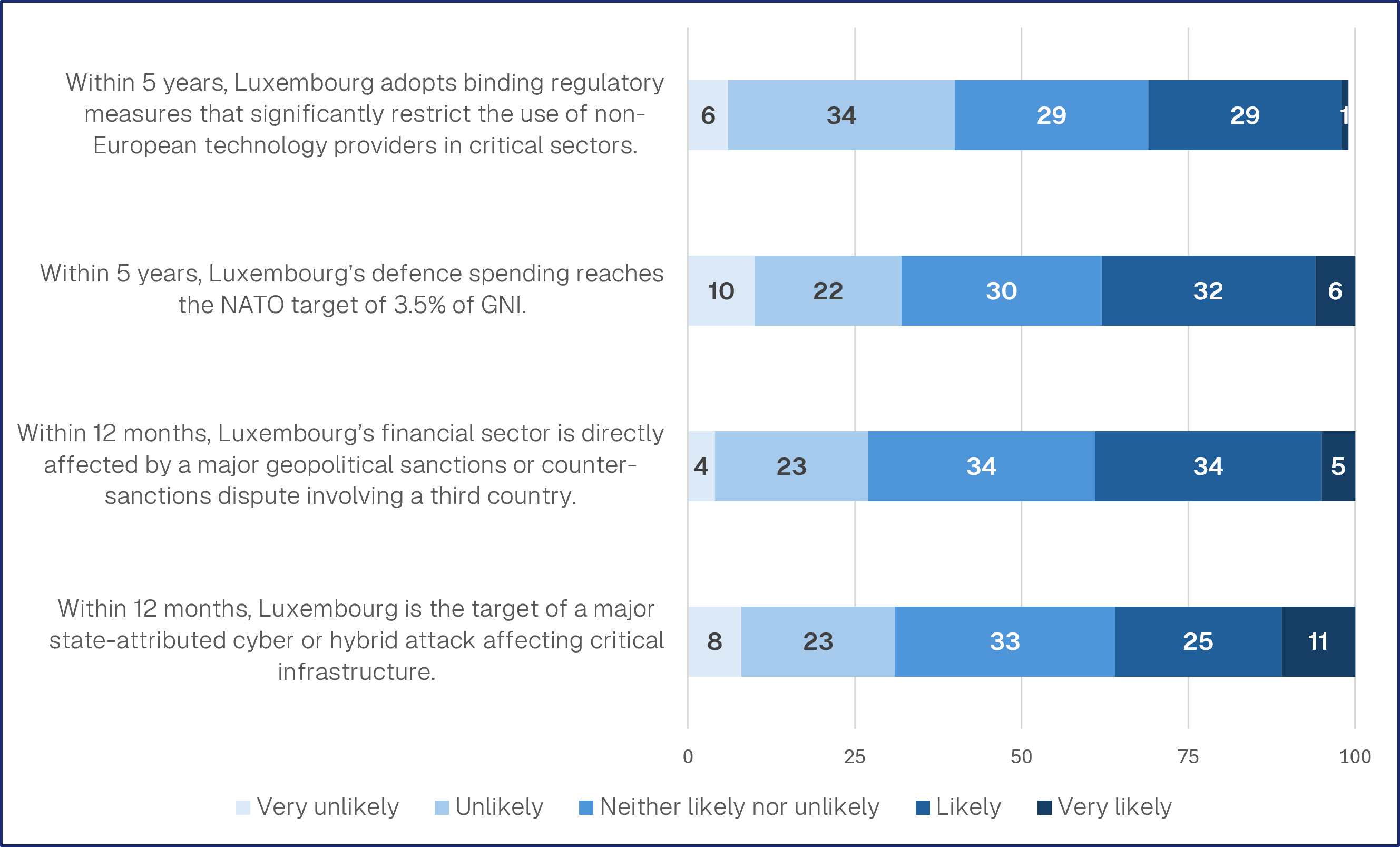
The same pattern appears in relation to the financial sector. Thirty-nine percent say it is likely or very likely that Luxembourg’s financial sector will be directly affected within twelve months by a major geopolitical sanctions or counter-sanctions dispute involving a third country. Twenty-seven percent view this as unlikely or very unlikely, while 34 percent are unsure. This is exactly the kind of risk Luxembourg must take seriously. Its financial sector is not insulated from geopolitics. Sanctions, counter-sanctions, regulatory fragmentation, and financial coercion are now part of the strategic environment.
On defence spending, experts are again divided. Thirty-eight percent say it is likely or very likely that Luxembourg’s defence spending will reach the NATO target of 3.5 percent of GNI within five years. Thirty-two percent consider this unlikely or very unlikely, and 30 percent remain in the middle. The result suggests that experts recognize the pressure created by NATO commitments, but are not convinced that Luxembourg will move quickly enough to meet the core defence-spending benchmark.
Finally, the technology scenario is split almost evenly. Thirty-five percent say Luxembourg is likely or very likely to adopt binding regulatory measures significantly restricting the use of non-European technology providers in critical sectors within five years; 40 percent say this is unlikely or very unlikely. This is revealing. Experts identify technology dependence as a major vulnerability, but they are not confident that Luxembourg will respond with hard regulatory restrictions. The gap between recognizing dependence and acting on it remains large.
The section’s conclusion is blunt. Experts expect Europe to face more shocks, more defence pressure, more hybrid threats, and more uncertainty over American commitments. They also expect enlargement to advance. For Luxembourg, however, the forecasts are less decisive. Experts see exposure, but they are unsure whether the country will act with sufficient speed and force. That is the central warning. Luxembourg does not need to predict the exact form of the next crisis. It needs to prepare for the kinds of crises that experts already consider plausible.
Luxsentinel 2026 points to a clear conclusion: Luxembourg is entering a period in which strategic preparedness can no longer be treated as a secondary policy concern. The country is small, open, wealthy, and deeply embedded in European and global networks. These are strengths. They are also vulnerabilities. Luxembourg benefits from open markets, European integration, NATO protection, cross-border labour, financial connectivity, digital infrastructure, and a rules-based international order. If those systems weaken, Luxembourg is exposed.
The report’s findings do not show panic. They show realism. Both experts and the public see a more unstable world. Both recognize that the EU has capacities, but also serious limits. Both support forms of European action that promise results. There is no appetite for retreat, paralysis, or symbolic Europeanism. The demand is for a Europe that can act.
That is the first implication. Europe’s problem is not a lack of threat awareness. Respondents already see the threats: war in or near Europe, hybrid attacks, technological dependence, energy insecurity, economic inequality, declining competitiveness, institutional fragmentation, and uncertainty over the United States. The problem is implementation. The EU knows more than it can act on. Its strategic gap is above all a governance gap.
This matters for Luxembourg because Luxembourg’s own room for manoeuvre depends heavily on European capacity. A slow, fragmented, strategically underpowered EU leaves small states more exposed. A more capable EU gives Luxembourg scale, protection, and influence. For that reason, Luxembourg’s interest is not simply in “more Europe” as an abstract principle. Its interest is in a Europe that works: faster decision-making, stronger coordination, deeper resilience, credible enlargement, and differentiated arrangements where willing states can move ahead.
The second implication is that strategic autonomy must become practical. The phrase itself risks becoming empty if it is not tied to concrete capabilities. For Luxembourg, strategic autonomy should not mean rhetorical distance from allies or symbolic declarations of European ambition. It should mean reducing dangerous dependencies, strengthening technological resilience, protecting critical infrastructure, securing energy supply, improving cyber readiness, supporting defence cooperation, and ensuring that Europe can make decisions under pressure.
The third implication concerns the public. The expert-public gap in this report is real. Experts are more likely to identify systemic risks: the erosion of the rules-based order, hybrid threats, technological dependencies, institutional fragmentation, and the EU’s limited strategic autonomy. The public is more focused on direct pressures: war, energy prices, terrorism, institutional trust, inequality, and the cost of insecurity. That difference should not be dismissed. It is not a knowledge deficit. It is a political fact.
If policymakers want durable public support for strategic action, they need to connect systemic risks to everyday vulnerability. Technology dependence is not only a matter for specialists; it affects data security, critical services, infrastructure, and national resilience. Energy dependence is not only a market problem; it is where geopolitics becomes household cost. Defence spending is not only an alliance obligation; it is part of the price of living in a more dangerous Europe. Enlargement is not only a bureaucratic process; it is about whether Europe’s neighbourhood is stabilized or left open to coercion. Strategic policy will fail politically if it is explained only in elite language.
The fourth implication is that alliances can no longer be treated as self-evident. The United States remains indispensable to European security, but Luxsentinel shows that it is no longer perceived as an unquestioned ally. Among both experts and the public, the US sits at the centre of the ally-adversary scale. It is not seen as an adversary. But neither is it seen as a clearly dependable partner. That is a major finding. Europe’s security architecture still depends heavily on the United States, while public and expert confidence in American reliability has weakened. This is not sustainable as a long-term strategic posture.
For Luxembourg, this means two things at once. It should remain committed to NATO and the transatlantic relationship. But it should also support serious European capability-building. These are not contradictory positions. They are now inseparable. A stronger European pillar within NATO is no longer a French slogan or a theoretical debate. It is a basic requirement of strategic insurance.
The fifth implication concerns Luxembourg’s own role. Luxembourg is not, and will not become, a hard-power state on the scale of larger European allies. Pretending otherwise would be unserious. But smallness is not irrelevance. Luxsentinel’s expert respondents identify clear areas where Luxembourg adds value: financial and economic expertise, diplomatic mediation, coalition-building, hosting and convening, and targeted policy expertise. These are not marginal assets. In a Europe where sanctions, defence financing, investment screening, economic security, technological dependence, and financial regulation are part of geopolitics, Luxembourg’s niches matter.
The challenge is focus. Luxembourg should not try to do everything. It should become more deliberate in the areas where it can make a real contribution. That means better coordination across national, EU, NATO, and multilateral levels. It means treating cyber and hybrid resilience as core national security tasks. It means reducing dependence on non-European technologies in strategic sectors where feasible. It means strengthening public resilience against disinformation and external interference. It means using Luxembourg’s financial expertise to contribute to European defence financing, economic security, and resilience. And it means turning hosting and convening power into strategic agenda-setting, not just event management.
The report also shows that Luxembourg’s vulnerabilities are not only external. Rising inequality, housing pressures, labour-market segmentation, and the uneven experience of prosperity are strategic issues because they affect social cohesion and political trust. A wealthy country can still become fragile if its prosperity model is seen as inaccessible or unfair. Strategic preparedness therefore cannot be reduced to defence, technology, or diplomacy. It must also include the domestic foundations of resilience.
The expert forecasts reinforce the urgency. Experts expect Europe to face more cyber and hybrid threats, more defence pressure, further enlargement, continued uncertainty over US military presence, and possible geopolitical disruption affecting Luxembourg’s financial and technological exposure. For Luxembourg, the forecasts are less about predicting the exact next shock than about recognizing the direction of travel. The risks are visible. The question is whether the country prepares before they arrive.
Luxsentinel 2026 therefore ends with a simple message. Luxembourg cannot insulate itself from Europe’s strategic interregnum. The old order is weaker. The new one is not yet settled. The United States is less predictable. Russia remains a threat. Ukraine’s future is tied to Europe’s own security. The Middle East is reshaping public perceptions of partners and adversaries. Technology, finance, energy, and information are now instruments of strategic power. The EU has capacity, but not enough speed or coherence. NATO remains essential, but Europe must carry more of the burden.
In this environment, Luxembourg’s task is not to become something it is not. It does not need to pretend to be a large power. It needs to become a more deliberate small one: clearer about its vulnerabilities, sharper about its niches, more serious about preparedness, and more active in building the European capacity on which its own security and prosperity depend.
The choice is not between complacency and alarmism. It is between passive exposure and strategic preparation. Luxsentinel shows that Luxembourg’s experts and public already understand that the world has changed. The next step is to act accordingly.
The findings presented in this report are based on two surveys conducted simultaneously between 6 and 31 May 2026: an expert survey and a survey of Luxembourg residents. Participation in both surveys was voluntary and anonymous.
The expert survey targeted individuals active in fields relevant to European policy and strategy. A database of approximately 1,000 potential respondents was compiled using publicly available information from research and higher education institutions, government institutions, regulatory agencies, European institutions, financial organisations, media outlets, and other professional networks operating in Luxembourg. Where necessary, contact details were reconstructed using publicly available institutional email conventions.
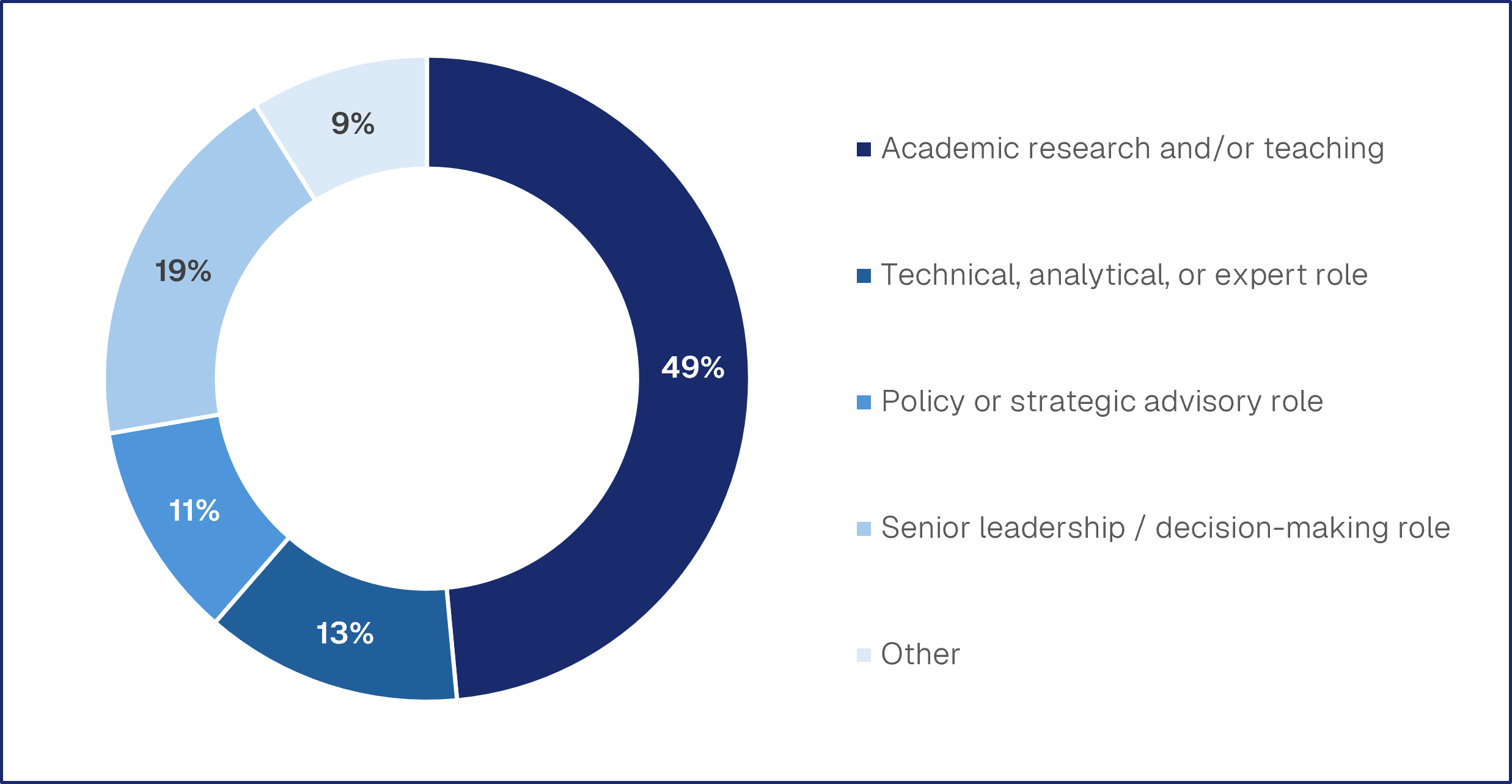
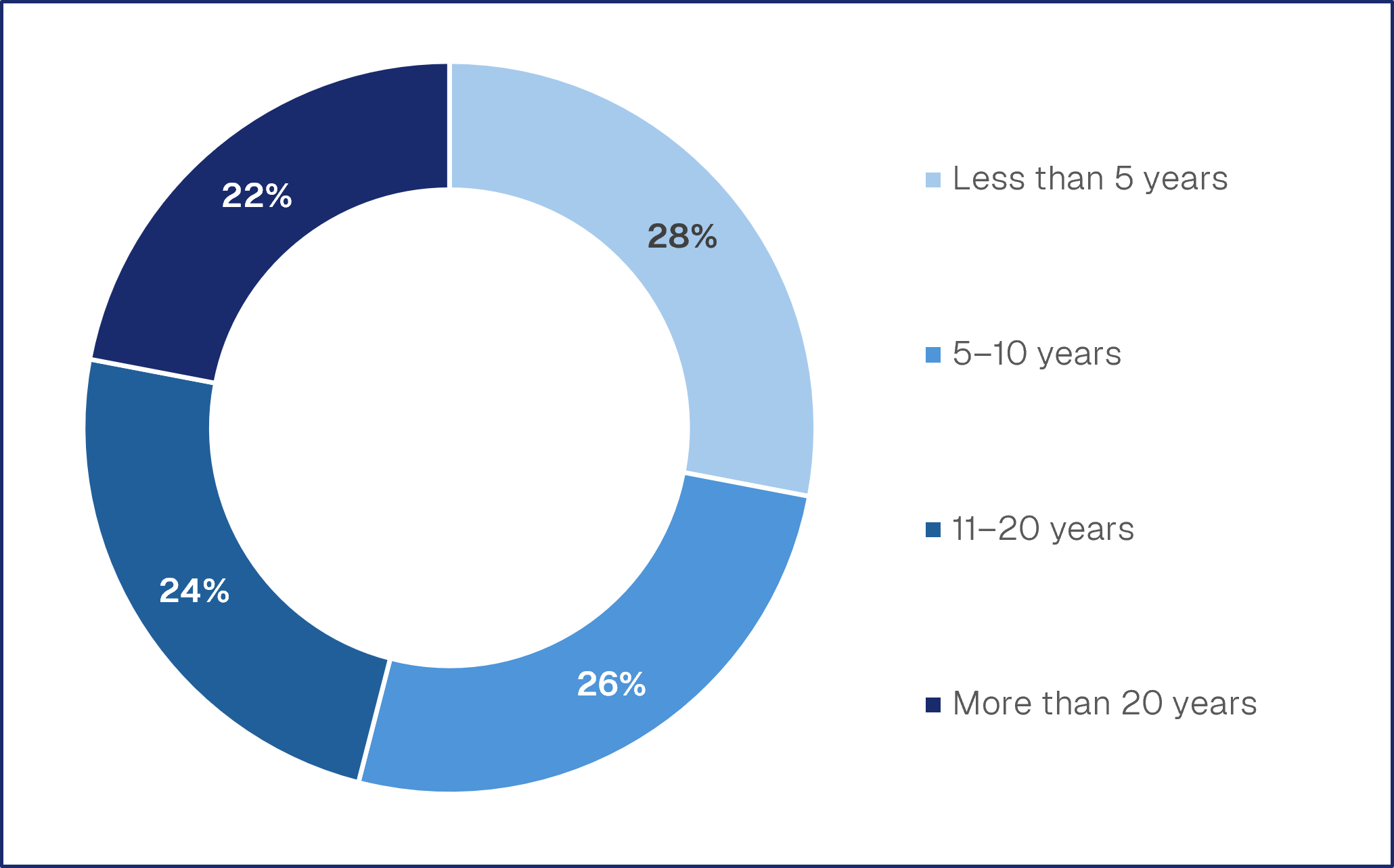
The final sample consists of 102 completed survey questionnaires. Approximately half of respondents were affiliated with academic institutions, while public-sector organisations account for roughly 18% of the sample. Figure 15 shows the breakdown of expert respondents by their primary professional roles, while Figure 16 shows their breakdown by length of experience. Given the absence of a comprehensive sampling frame for the expert population in Luxembourg, no weighting procedure was applied.
The public opinion survey was conducted among adults residing in Luxembourg. Eligibility was restricted to residents aged 18 years or older. Given Luxembourg's highly international population, the survey was based on residency rather than citizenship and therefore included both Luxembourg citizens and foreign residents.
The final sample consists of 448 respondents, of whom approximately 65% are Luxembourg citizens and 35% are foreign residents. Data collection was carried out through established online research panel providers. Quotas for age and gender were applied and monitored throughout fieldwork to ensure balanced representation across these key demographic characteristics. The incidence rate was 48%, indicating that approximately half of panel members entering the survey met the eligibility criteria and qualified for participation.
Following fieldwork, survey weights were calculated for the resident survey using iterative proportional fitting (raking). The weighting procedure aligned the sample with known population distributions for age, gender, and income. To limit the influence of individual observations, weights were capped at a maximum value of 4.0. All results reported for the resident survey should therefore be seen as representative of the resident population of Luxembourg. Lastly, in the resident survey a number of quality-control procedures were applied, including screening respondents for excessively rapid completion.
Photo credit: Tristan Schmurr.
[1] North Atlantic Treaty Organization, “NATO Summit,” media advisory, April 22, 2026.
[2] European Commission, Standard Eurobarometer 105: Spring 2026 (Brussels: European Commission, 2026).
[3] European Parliament, EU Survey – Rising Concerns Push Demand for More European Action (Brussels: European Parliament, 2026).
[4] Tobias Bunde, Sophie Eisentraut, and Leonard Schütte, eds., Munich Security Report 2025: Multipolarization (Munich: Munich Security Conference, February 2025).
[5] All data for the public portion of the analysis that are presented in this report have been weighted to ensure that the sample is representative of the Luxembourgish public.
[6] In all questions presented in this section, both the experts and the public had an opportunity to choose up to three options as the top threats or obstacles. That is why the sums of percentages exceed 100%.
[7] Bunde, Eisentraut, and Schütte, Munich Security Report 2025.
[8] Council of the European Union, A Strategic Compass for Security and Defence: For a European Union That Protects Its Citizens, Values and Interests and Contributes to International Peace and Security (Brussels: Council of the European Union, March 2022).
[9] Mario Draghi, The Future of European Competitiveness: A Competitiveness Strategy for Europe (Brussels: European Commission, September 2024).
[10] Enrico Letta, Much More Than a Market: Speed, Security, Solidarity – Empowering the Single Market to Deliver a Sustainable Future and Prosperity for All EU Citizens (Brussels: Council of the European Union, April 2024).
[11] Joshua D. Kertzer, “Re-Assessing Elite-Public Gaps in Political Behavior,” American Journal of Political Science 66, no. 3 (2022): 539–553.
[12] Jana Kobzová and Paweł Zerka, Home Alone: Europeans Are Ready to Defend Themselves (Berlin: European Council on Foreign Relations, June 2026).
[13] European Council, “European Council Conclusions on Ukraine and on European Defence and Security,” June 18, 2026.
[14] Laura Silver and Laura Clancy, “Most People across 36 Countries Have Negative Views of Israel and Little Confidence in Netanyahu,” Pew Research Center, June 4, 2026.
[15] Center for Strategic and International Studies, “Israel and Iran at War: What Comes Next?” CSIS, accessed June 19, 2026.
[16] European Parliament, EU Survey.
[17] Letta, Much More Than a Market.
[18] European Commission, “2025 Enlargement Package Shows Progress towards EU Membership of Key Enlargement Partners,” November 4, 2025.
[19] Draghi, Future of European Competitiveness.
[20] Baldur Thorhallsson and Sverrir Steinsson, “Small State Foreign Policy,” in Oxford Research Encyclopedia of Politics (Oxford: Oxford University Press, 2017).
[21] Letta, Much More Than a Market; Draghi, Future of European Competitiveness.
[22] Council of the European Union, A Strategic Compass for Security and Defence: For a European Union That Protects Its Citizens, Values and Interests and Contributes to International Peace and Security (Brussels: Council of the European Union, March 21, 2022); NATO, “Deterrence and Defence,” last updated December 10, 2025.
[23] Luxembourg Directorate of Defence, Luxembourg Defence Guidelines 2035 (Luxembourg: Government of the Grand Duchy of Luxembourg, 2023).
[24] European Union Agency for Cybersecurity, ENISA Threat Landscape 2025 (Athens: ENISA, 2025)
[25] NATO, “The Hague Summit Declaration,” June 25, 2025.
[26] European Commission, “2025 Enlargement Package.”
[27] Center for Strategic and International Studies, “Israel and Iran at War.”