Strategic Notes
Rafael Zimmer
Published on: Sept 23rd 2026
This policy analysis examines how Luxembourg maintained close economic ties with China between 2016 and 2026 despite growing geopolitical tensions and the European Union’s shift toward economic de-risking. It argues that Luxembourg has pursued a calibrated small-state hedging strategy: politically, it remains aligned with the EU and NATO; commercially, it keeps selected channels with China open, particularly in finance, logistics, and diplomacy. The analysis shows how Luxembourg’s role as a financial gateway, the Air Silk Road with Henan Province, and continued diplomatic engagement have allowed it to preserve economic benefits without breaking with its Euro-Atlantic partners. This strategy remains viable, however, only if economic channels remain reversible, national rules do not weaken EU instruments, commercial arrangements remain transparent to allied oversight, and supervisory capacity grows with exposure. The Luxembourg case illustrates both the opportunities and limits of small-state hedging within an increasingly restrictive European economic security environment.
Download PDFThe central puzzle of Luxembourg’s foreign policy over the past decade is how it has maintained close economic ties with China despite growing Sino-Western tensions. The foundations of these close ties were established in the early 2010s, when Luxembourg developed into a European centre for financial transactions in the Chinese currency, the renminbi (RMB), and a Chinese provincial investor took a stake in the national cargo airline. Between 2016 and 2026, the Grand Duchy became the main institutional gateway for Chinese capital, hosting seven of China’s major banking groups and a growing share of cross-border investment fund business. The relationship also took physical form in the Air Silk Road, the air freight corridor linking Luxembourg to Henan Province, and in cooperation agreements signed under the Belt and Road Initiative (BRI).
This report asks how the relationship developed across finance, logistics, and diplomacy between 2016 and 2026, and whether a specialized small state can maintain economic ties with a systemic rival as European security rules tighten. This leads to a second question: is this a model of careful small-state strategy, or a vulnerability for Europe’s de-risking agenda and collective economic security?
Luxembourg’s approach is described as a limited and calibrated hedging strategy based on two signals. Politically, the Grand Duchy stays in line with the EU and NATO. Commercially, it keeps economic channels with China open and out of the political spotlight, through travel arrangements and continued cooperation in areas such as finance. Finance is the foundation of the relationship and gives it much of its strategic importance; logistics is its largest physical expression; and diplomacy helps keep both working. The approach is seen as defensible for a small state like Luxembourg only if four conditions are met: the channels are reversible, national rules do not weaken EU instruments, the low-profile structures are transparent to allied oversight, and supervision grows with exposure.
The report proceeds in four parts. Section 2 explains how hedging and Luxembourg’s economic specialization help us understand this strategy. Section 3 examines the relationship with China across finance, logistics, and diplomatic relations. Section 4 asks whether Luxembourg’s approach is a smart hedge or a strategic vulnerability and makes recommendations for keeping it viable as European economic security rules tighten. Section 5 asks whether other small states could follow the same strategy, as well as what this would mean for the Union’s collective economic security.
Hedging describes how small states navigate increasing great-power rivalry without picking one side. It is defined as a form of insurance against an uncertain future.[1] Hedging is a third option alongside balancing against and bandwagoning with a great power. Rather than choosing either, a hedging state combines economic and diplomatic engagement with precautions that secure a fallback position if the strategic environment deteriorates.[2] Small states do this by diversifying partnerships, signalling continued openness to cooperation and avoiding irreversible commitments that could leave them trapped in a larger power’s conflict.[3] Hedging is therefore a calibrated mix of engagement and risk management.
Luxembourg has historically protected its autonomy by developing specialized economic roles and maintaining economic ties in many directions and embedding itself in larger security and economic frameworks.[4] Luxembourg continues this strategy today. Its financial sector makes it useful to larger economic powers, while membership of the EU and NATO provides political and security protection. This combination allows Luxembourg to maintain economic ties in different directions without weakening its European alignment.[5]
Scholars describe the 2013–2014 creation of the Air Silk Road as a moment in which Luxembourg’s search for a new investor in its national cargo carrier Cargolux aligned with Henan Province’s efforts to expand internationally.[6] In finance, Luxembourg has meanwhile become the primary hub for investment funds investing in mainland China.[7]
What remains unclear is how Luxembourg’s relationship with China fits with the EU’s growing emphasis on de-risking, which aims to reduce dependencies that could create economic or security risks for Europe. The next section therefore examines how Luxembourg has maintained its relations with China over the last ten years within this changing European framework, focusing on finance, logistics, and diplomacy.
Luxembourg built its position at the centre of China’s European finance deliberately over four decades. The Bank of China (BoC) opened its Luxembourg branch in 1979, its first overseas establishment after the founding of the People’s Republic. In 1994, the double-taxation agreement with Beijing made Luxembourg more attractive for investment between China and Europe.[8] After 2008, Luxembourg began actively and deliberately courting Chinese financial institutions through Luxembourg for Finance and other public institutions.[9] When the Industrial and Commercial Bank of China (ICBC) selected its European headquarters, it chose Luxembourg. Five more Chinese banks followed between 2013 and 2017, establishing the Grand Duchy as the European base for Chinese banks.[10]
Chinese authorities grant access to China’s financial system selectively, and Luxembourg had to compete with far larger financial centres for each instrument it obtained. In May 2011, Volkswagen listed the first European RMB-denominated bond on the Luxembourg Stock Exchange (LuxSE).[11] In September 2014, the People’s Bank of China, China’s central bank, designated ICBC’s Luxembourg branch as an RMB clearing bank, allowing RMB payments to be settled directly in Luxembourg.[12] In 2015, Luxembourg also received a ¥50 billion quota allowing financial institutions based there to invest RMB directly in Chinese securities.[13] By then, Luxembourg had become a major European centre for RMB deposits, loans and investment funds.[14]
This position was supported by close cooperation between Luxembourg and Chinese financial institutions, through memoranda of understanding (MoUs) and other agreements.[15] Over time, Luxembourg expanded financial access in both directions. Chinese banks increasingly used Luxembourg as a base for their European operations, while Luxembourg made it easier for investment funds based there to invest in Chinese markets.[16] Together, these developments made Luxembourg an important financial gateway between China and Europe. The relationship was built largely for commercial reasons, but growing tensions between China and the West have given it increasing strategic importance.
Between 2016 and 2026, Luxembourg consolidated its position as a major financial link between China and Europe.[17] The Luxembourg Stock Exchange also strengthened links with Chinese markets, including through cooperation with the Shanghai Stock Exchange and in green finance.[18]
Since 2020, however, investment between Luxembourg and China has moved in opposite directions (see Figure 1). Chinese investment into Luxembourg fell while Luxembourg’s investment in China rose.[19] Much of this money does not come from Luxembourg itself. International investors use companies and funds based in Luxembourg to invest in China. The figure therefore shows not only Luxembourg’s own investment in China, but also its role as a gateway for investment from elsewhere.
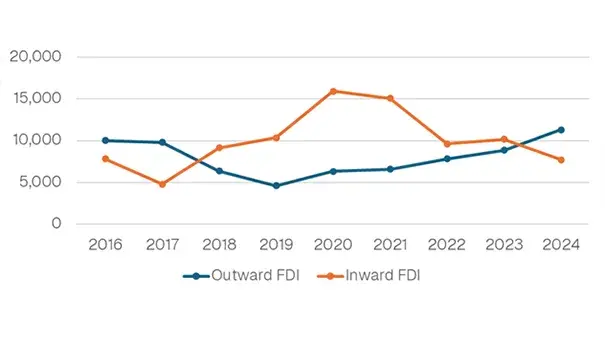
Source: STATEC Luxembourg, Net year-ending foreign direct investment position of Luxembourg by partner according to the extended directional principle (4th OECD benchmark definition), Partner: China, annual data, accessed May 2026, STATEC Data Portal.
Finance is the clearest example of how Luxembourg uses economic specialization to remain useful to larger countries. Once a Chinese banking group establishes itself in Luxembourg, it can sell regulated investment funds to retail and institutional investors in all 27 EU member states without individual licences for each. Its role as a financial gateway benefits both sides: China gains easier access to European markets, while Luxembourg attracts international capital and strengthens its position as a financial centre.[20]
This financial model is increasingly coming up against the EU’s economic security policy. Since 2019, the EU has gradually strengthened the screening of foreign investment that could pose security risks.[21] Luxembourg responded by introducing its own screening system in 2023. The law’s scope likely reflects the position Luxembourg has defended in Council negotiations on the Union framework, favouring a narrow mandatory screening. The law excludes portfolio investments and limits mandatory screening to investments that give foreign investors control over companies in critical sectors such as physical infrastructure, energy, defence, and central bank financial systems.[22] Most of Luxembourg’s financial links with China therefore remain outside the screening system. In this way, Luxembourg remains useful to China while formally complying with EU rules.
New EU rules will further strengthen investment screening but will continue to exclude investments made purely for financial return.[23] Luxembourg’s room to manoeuvre is nonetheless narrowing. EU investment screening initially focused on risky foreign investment entering Europe, but attention has more recently turned to European investment flowing into third countries, particularly where sensitive technologies are involved.[24] This matters for Luxembourg because its financial relationship with China has increasingly moved in the opposite direction: Chinese investment in Luxembourg has declined, while investment flowing through Luxembourg into China has increased. For now, most of these flows remain unaffected, but they could face greater scrutiny as the EU expands its economic security policy.
Between 2016 and 2026, Luxembourg and Henan Province developed a major air freight connection between Luxembourg and Zhengzhou in central China. The relationship began in 2014, when Henan Civil Aviation Development and Investment (HNCA), a state-owned company, bought a 35% stake in Cargolux, Luxembourg’s national cargo airline, for $120 million.[25] The deal benefited both sides: Cargolux needed investment, while Henan wanted better access to European markets.
The connection expanded rapidly, and Luxembourg joined China’s Belt and Road Initiative in 2019.[26] During Covid-19, the corridor was used to transport large volumes of medical cargo into Europe.[27] Cooperation has continued despite the deterioration in relations between China and the West.[28] The corridor creates a relationship that serves both sides’ national economic priorities. For Luxembourg, the air-freight corridor strengthens the country’s role as a logistics hub for goods entering the EU Single Market.[29] For Henan Province, the Air Silk Road provides direct access from central China to Europe.[30]
Much of the relationship developed between Henan Province and Luxembourgish companies rather than directly between the Chinese and Luxembourgish governments. Cooperation has since expanded beyond logistics, including through contacts between local authorities.[31] The political context surrounding the Cargolux deal has changed considerably since 2014. The EU now pays much greater attention to Chinese investment in critical infrastructure, particularly transport and logistics infrastructure that can serve both civilian and military purposes.[32] The Cargolux-HNCA partnership illustrates this change. A Chinese state-owned company acquiring a significant stake in an important European carrier would be exactly the type of transaction that EU and national screening rules now aim to scrutinize. The existing Cargolux investment predates these tighter rules and is exempt from the new rules. Luxembourg therefore keeps the economic gains from its ties with China while maintaining its standing within the EU and NATO. Whether it can continue to do so as European concerns about Chinese involvement in critical infrastructure grow is less certain.
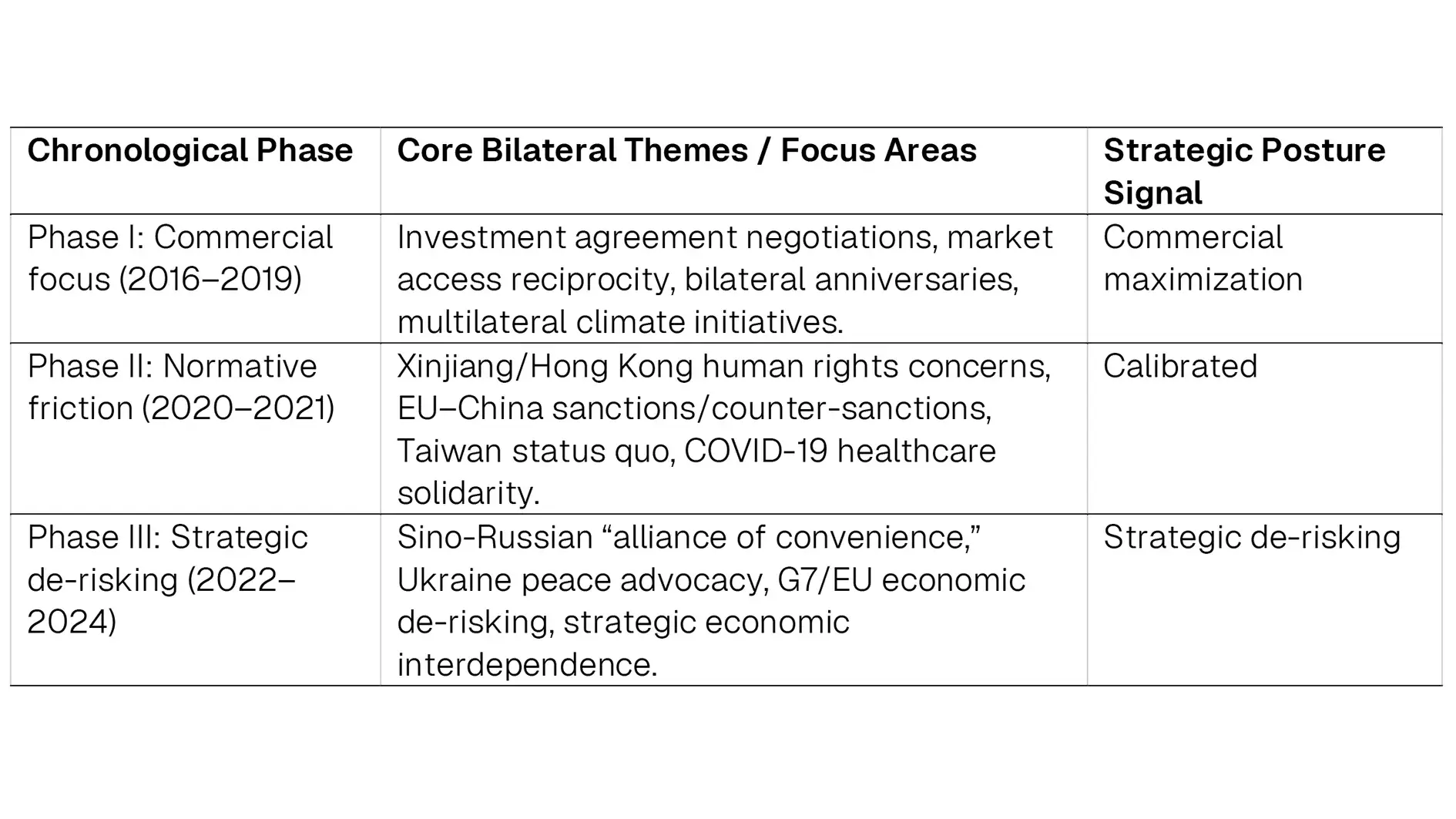
Between 2016 and 2026, Luxembourg’s diplomatic language toward China moved from open emphasis on economic partnership towards a more cautious position as geopolitical risks grew. Between 2016 and 2018, ministerial statements to the Chamber of Deputies prioritized the expansion of bilateral investment agreements and reciprocal market access.[33] The language shifted after the EU designated China as a “systemic rival” in 2019.[34] By 2021, Luxembourg’s official statements raised human rights concerns about Xinjiang and Hong Kong, while maintaining dialogue on climate change and public health.[35] Table 1 tracks how references to China changed across three phases.
As international pressure increased, Luxembourg adopted more nuanced language designed to prevent a full break in economic ties with China. After Russia’s 2022 invasion of Ukraine, ministers avoided presenting Beijing as an adversary. Their statements deliberately described the Sino-Russian relationship as an “alliance of convenience” and commended China for abstaining in key UN votes.[36] Concurrently, Luxembourg reaffirmed its alignment with its EU and NATO partners by warning that military escalation in the Taiwan Strait would trigger severe global turbulence.[37] This allowed the Grand Duchy to maintain economic ties with China while holding firm to its Euro-Atlantic commitments. By 2024, the government backed de-risking while rejecting total decoupling from Beijing.[38] Luxembourg noted that certain sectors in China were supporting Russia’s war effort in Ukraine yet maintained that China remained “one of the few actors capable of playing a key role in securing a lasting and equitable peace.”[39] The Grand Duchy has also consistently framed China as an essential partner for global climate objectives.
The same calibrated approach shaped a high-level economic mission to Beijing and Shanghai in late 2024.[40] In Shanghai, the mission centred on the automotive sector and clean technologies, and led to three MoUs between Luxembourgish and Chinese companies. China also eased travel rules, by granting visa-free entry for up to 30 days to Luxembourg passport holders travelling to China for business, tourism, and family visits from November 2024 to December 2026.[41] This made travel easier on the direct passenger route between Zhengzhou and Luxembourg. As a result, passenger numbers increased substantially in 2025 (see Figure 2).[42]
Keeping these diplomatic and travel links open serves different goals for each state. For Luxembourg, open political channels and easier travel help keep it attractive as a European headquarters for multinational companies. Direct diplomatic access to Beijing also helps keep the Grand Duchy from being sidelined in broader EU-level dialogues. For Beijing, the relationship provides a reliable partner in a founding EU member state. Luxembourg therefore applies the same approach in diplomacy as in finance and logistics: It aligns politically with the EU and Western allies while keeping bilateral channels with China open.
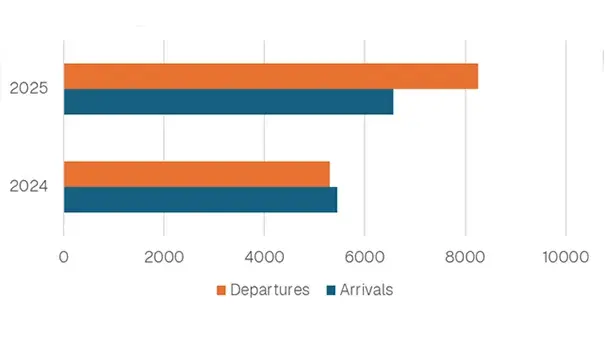
Source: Luxembourg Ministry of Foreign Affairs, 2024 Activity Report (2025), 23, and 2025 Activity Report (2026), 28.
The record of Luxembourg–China relations can be read in two ways. In the first, Luxembourg has pursued a calibrated hedging strategy. It has remained politically aligned with the EU and NATO while keeping open commercial channels with China. The second reading highlights how some features of the relationship may limit political scrutiny: the corporate structure of the Air Silk Road, the exclusion of fund and portfolio flows from Luxembourg’s investment screening regime, and the routing of new cooperation through municipal and technical bodies. The central question is therefore whether Luxembourg has successfully preserved room for economic engagement with China, or whether the mechanisms that make this possible have created new strategic vulnerabilities.
Hedging by a member state inside an integrated bloc differs from hedging by a standalone state. Hedging requires a fallback position in case the strategic environment deteriorates. For Luxembourg, that fallback position is the EU and NATO. Its market access, security, and ultimately its existence depend on these institutions. This creates a contradiction: Luxembourg’s hedge ultimately depends on the protection provided by the EU and NATO. But if the channels it keeps open with China undermine the EU’s efforts to reduce strategic dependencies, Luxembourg risks weakening the very institutions on which its own security depends. If Luxembourg’s role as a financial conduit makes restrictions applied elsewhere in the Union less effective, then its national strategy is also undermining the collective strategy on which it ultimately depends.
The Trojan horse concern is that Luxembourg could become a vehicle for Chinese interests inside Europe. The Chinese banks, investment funds, and the Cargolux-HNCA partnership give China access to the Single Market through Luxembourg. Whether that access has been converted into influence over Luxembourgish policy is difficult to establish. When Luxembourg set up its investment screening mechanism, it limited screening to acquisitions of control in critical sectors and left portfolio and fund flows outside. Yet this choice also serves Luxembourg’s own financial sector and cannot in itself be taken as evidence of Chinese influence. Nothing across the financial, logistics, or diplomatic axes suggests that Luxembourg’s role as a gateway was designed as a coherent geopolitical project, let alone a Chinese one. It developed through a series of commercial decisions, each rational on its own terms, whose combined strategic weight was never openly assessed.
On balance, Luxembourg’s China hedge remains defensible as a small-state strategy if, and only if, four conditions are met. First, the channels must remain reversible. A hedge, by definition, avoids commitments that cannot be undone, yet the financial links between Luxembourg and China would be costly to decouple. A channel that cannot be severed without systemic cost to Luxembourg itself is no longer a hedge but a dependency. Second, Luxembourg may legitimately advocate for proportionate EU economic security instruments, but it may not reduce their effectiveness. Where national choices about scope materially weaken a collective tool, Luxembourg’s national interest must give way.
Third, the corporate and regional structure may help insulate the Air Silk Road from political scrutiny, but it must not shield it from oversight by allies. Luxembourg should therefore ensure adequate information sharing with the Commission and its partners about the Air Silk Road’s ownership and governance. Fourth, oversight capacity must scale with exposure. If the volume and sensitivity of the flows grow faster than Luxembourg’s capacity to screen, investigate, and analyze them, its role as an intermediary becomes a risk.
Considering these conditions, the strategy carries costs for both Luxembourg and the Union. For Luxembourg, deep institutional ties with a systemic rival could create tensions with partners that see these ties as a vulnerability inside the Single Market. Should the US-China rivalry escalate severely, Luxembourg’s financial links could also become exposed to sanctions or capital restrictions, threatening its gateway model. Sustaining the intermediary role also requires expanded FDI screening capacity, financial monitoring, and sustained investment in defence and cybersecurity to show that commercial ties do not amount to subservience.
For the Union, Luxembourg’s narrow screening law limits the reach of an instrument in exactly the member state where China-linked capital is most concentrated. Luxembourg’s role as a gateway could weaken EU de-risking if restrictions imposed elsewhere can be circumvented through financial or logistics channels in the Grand Duchy. But none of these costs is decisive on its own. Together, they define the burden of proof that Luxembourg’s strategy must continuously meet.
The changing direction of financial flows shows that economic decoupling is neither workable nor necessary for an open financial centre aligned with the West. To sustain its calibrated hedging strategy as EU rules tighten, Luxembourg needs measures that protect its economic interests while honouring its obligations to the EU and its transatlantic partners. Four sets of such measures are recommended here.
Recommendation 1: Clarify Regulatory Boundaries for Cross-Border Asset Management
Luxembourg should maintain the working distinction between acquisitions of corporate control and passive portfolio flows, which protects its position as Europe’s main gateway for global asset management. In applying its FDI screening law, screening should stay focused on acquisitions that give direct control over critical assets or sensitive infrastructure.
Routine cross-border investment vehicles, such as UCITS and SIFs, should continue to be treated as financial products rather than strategic corporate investments. This distinction should, however, be accompanied by greater transparency. The Commission de Surveillance du Secteur Financier (CSSF) should therefore require stronger reporting on China-facing fund flows, so that what falls outside the screening regime remains visible to regulators. As the EU considers outbound investment screening, Luxembourg should advocate for a proportionate, risk-based framework that distinguishes passive investments from investments in strategic technologies.
Recommendation 2: Preserve the Corporate and Regional Structure of Logistics Links
Luxembourg should preserve the decentralized structure of the Cargolux-HNCA partnership. This structure keeps the partnership clear of geopolitical shocks and turning it into a formal bilateral infrastructure agreement between Luxembourg and China would add little in the way of oversight. Luxembourg should, however, regularly report the corridor’s ownership, governance, and shareholding arrangements to the Commission and partner services.
Recommendation 3: Attract investments in Non-Sensitive Sectors
The Ministry of Foreign and European Affairs (MAEE), alongside Luxembourg Trade and Invest, should expand existing efforts to attract multinationals in green technology and clean energy, using the direct channel with China and simple administrative procedures. This would move the Luxembourg-China relationship beyond finance. Luxembourg can also use its predictable regulatory environment and easy access to the Single Market to attract specialized companies in sectors that are not considered dual-use or critical technologies.
Recommendation 4: Keep Future Economic Security Legislation Risk-Based
Future economic security measures should remain risk based. Luxembourg should concentrate enforcement on sectors where risks to security and public order are greatest, namely defence, energy, and critical dual-use technology. Cross-border financial channels and RMB clearing should continue to be treated as regulated financial services rather than security liabilities, provided they comply with existing regulations and international sanctions. This would allow Luxembourg to address genuine security risks and maintain its standing within the EU and NATO without unnecessarily restricting its commercial activity.
Luxembourg should also continue to engage Beijing on shared global challenges, including climate policy and multilateral crisis management, where cooperation serves both sides. That engagement should not set the limits of what Luxembourg is willing to say. Holding critical positions, such as on human rights issues and Chinese support for Russia’s war effort, when they are necessary is what makes the difference between a hedge and a position that can drift into vulnerability due to commercial interests.
Luxembourg’s approach to China is reproducible by other small states with a similar mix of deep institutional membership and niche economic specialization. But the model requires robust multilateral anchoring. Luxembourg’s deep integration in the EU and its transatlantic ties provide it with the credibility to sustain commercial engagement with a systemic rival without its allies treating that engagement as defection.
The case also shows the strategic value of cooperation run at the regional and municipal level, while maintaining political alignment with allies. By keeping logistics cooperation largely at the corporate and provincial level, as the Air Silk Road does, a small state can partly insulate these economic links from geopolitical tensions. The Grand Duchy shows how small states can pursue economic opportunities by developing specialized roles that make them valuable both to their security and commercial partners. Small EU member states that combine EU membership with a recognized economic niche can apply the same approach without sacrificing their credibility with their allies, provided they keep operating within the rules and constraints that EU and NATO membership imposes.
Ireland and Switzerland illustrate why this model is not replicable everywhere. Ireland’s FDI-driven economy relies on American multinational companies, which by 2022 accounted for approximately 75% of Irish corporation tax revenue, concentrated mainly in pharmaceutical and technology businesses.[43] Ireland’s main exposure therefore runs through Washington. Its dependence on US companies therefore gives it less room to pursue an independent economic relationship with China. Outside the EU, Switzerland is trading openly with Beijing while facing growing pressure from both the EU and the US to align more explicitly on sanctions and human rights.[44] Neither country has the same combination of EU and NATO membership and economic specialization as Luxembourg.
The transferability of the model also creates a potential risk for the EU. If other small member states with comparable profiles reproduce the Luxembourg approach, the combined consequences for the Union could be larger than any single case suggests.
Between 2016 and 2026, Luxembourg neither chased commercial gain without regard for the consequences nor decoupled from China. It has pursued a calibrated hedging strategy, maintaining its security and normative commitments to the EU and NATO while keeping a profitable, specialized role as an intermediary for Chinese capital and cargo. Luxembourg built that position over four decades of policy choices. Over the past decade, it has maintained this position despite worsening geopolitical tensions.
This approach has worked by separating where Luxembourg stands politically from how it handles the practical business of the relationship. The Grand Duchy has stayed with the EU and NATO on matters of substance, while routing commercial cooperation through channels that attract little political attention. That strategy is still in use today as geopolitical tensions with China intensify.
The viability of this position faces growing pressure. As Brussels widens its economic security policies, the room for small states to maintain this approach is narrowing. This creates the central dilemma in Luxembourg’s foreign policy. The same measures that shut off other European entry points make the Grand Duchy’s role as a gateway more valuable, but at the same time more exposed to geopolitical tensions.
Luxembourg currently meets the four conditions of a defensible hedge unevenly. Reversibility is under visible strain, as some financial links would be costly to sever. Non-obstruction at EU level is currently satisfied, and the revised FDI Screening Regulation adopted in June 2026 has confirmed the exclusion of portfolio flows. However, Luxembourg will have to bring its national screening system into line with the new EU rules by January 2028. The flexibility in the regulation will show whether Luxembourg applies only the minimum requirements or goes beyond them. Transparency toward partners is harder to assess because there is little public information on what Luxembourg shares with its partners. Oversight capacity has not yet kept pace with exposure, with stronger forensic, analytical and screening capacity still needed. The balance would tip from hedging to vulnerability if Luxembourg weakened EU economic security measures, or if its economic channels deepened further while remaining outside adequate oversight.
The Luxembourg case shows that small states can navigate great-power rivalry by making themselves economically valuable to different partners. But the case also demonstrates the limits of that strategy. Niche specialization remains viable only while it strengthens, or at a minimum does not weaken, the collective architecture on which the small state depends. A gateway that outgrows its oversight, or national rules that weaken EU instruments, would turn Luxembourg’s economic asset into a European vulnerability. The Grand Duchy’s decade of calibrated hedging shows that a balance can be maintained. Whether it continues to do so will depend on the choices it makes as geopolitical tensions increase.
Rafael Zimmer is a Master student in European Governance at the University of Luxembourg and holds a Bachelor of Science in Foreign Service from Georgetown University.
Photo credit: Ex13, Wikimedia Commons.
[1] Cheng-Chwee Kuik, “Getting Hedging Right: A Small-State Perspective,” China International Strategy Review 3, no. 2 (2021).
[2] Kuik, “Getting Hedging Right”.
[3] Kuik, “Getting Hedging Right”.
[4] Thomas Kolnberger, “Forever Small?,” in Agency, Security and Governance of Small States, 1st ed., by Thomas Kolnberger and Harlan Koff (Routledge, 2023).
[5] Kolnberger, “Forever Small?”.
[6] Wiebke Rabe and Genia Kostka, “Leaping over the Dragon’s Gate: The ‘Air Silk Road’ between Henan Province and Luxembourg,” The China Quarterly 249 (2022).
[7] Luxembourg for Finance and Pwc, Beyond the Challenges: The Strength of Sino-European Ties (The Financial Centre Development Agency, 2021).
[8] Grand Duchy of Luxembourg and People’s Republic of China, Synthesised Text of the Multilateral Convention to Implement Tax Treaty Related Measures to Prevent Base Erosion and Profit Shifting and the Agreement between the Grand Duchy of Luxembourg and the People’s Republic of China for the Avoidance of Double Taxation and the Prevention of Fiscal Evasion with Respect to Taxes on Income and on Capital (1994, as modified by the MLI).
[9] Duncan Kerr, “Big Plans in Little China: Luxembourg Steals a March in the Race to Become Europe’s Renminbi Centre,” Euromoney (7 October 2013).
[10] Paolo Balmas and Sabine Dörry, “Chinese Bank Networks in Europe: FDI-Oriented by Legal and Strategic Design,” Eurasian Geography and Economics 66, no.1 (2025).
[11] Luxembourg for Finance, China Business (2021)
[12] Industrial and Commercial Bank of China, ICBC Designated as the RMB Clearing Bank in Luxembourg, (30 September 2014).
[13] Luxembourg for Finance, China Business.
[14] Balmas and Dörry, “Chinese Bank Networks in Europe”.
[15] Paolo Balmas and Sabine Dörry, “The Geoeconomics of Chinese Bank Expansion into the European Union,” in The Political Economy of Geoeconomics: Europe in a Changing World, ed. Milan Babić et al. (Springer International Publishing, 2022).
[16] Luxembourg for Finance, China Business, 9-10; Paolo Balmas and David Howarth, "Chinese Currency Exceptionalism: The Curious Internationalisation of the Renminbi," The World Economy 47, no. 11 (2024).
[17] Luxembourg for Finance, China Business. This promotional publication is used for descriptive context, while the analysis of bilateral capital positions draws on official STATEC data.
[18] Luxembourg for Finance, China Business.
[19] Statec, “Luxembourg-China FDI Data,” Foreign Direct Investment Position of Luxembourg by Partner.
[20] Luxembourg for Finance, Ambitions 2030: Shaping Finance for Our Future (2025); Luxembourg for Finance, China Business.
[21] European Commission, Regulation (EU) 2019/452 of the European Parliament and of the Council Establishing a Framework for the Screening of Foreign Direct Investments into the Union (Official Journal of the European Union, 2021); European Commission, Joint Communication to the European Parliament, the European Council and the Council on European Economic Security Strategy (2023).
[22] Gouvernement du Grand-Duché de Luxembourg, “Loi du 14 juillet 2023,” Journal officiel du Grand-Duché de Luxembourg (2023).
[23] European Commission, Regulation (EU) 2026/1386 of the European Parliament and of the Council on the Screening of Foreign Investments in the Union and Repealing Regulation (EU) 2019/452 (2026).
[24] European Commission, Strengthening EU Economic Security: Joint Communication to the European Parliament and the Council (2025).
[25] Rabe and Kostka, “Leaping over the Dragon’s Gate.”
[26] Cordula Schnuer, “Luxembourg to Stick by China Infrastructure Deal as Italy Exits” (27 November 2023).
[27] State Council of the People's Republic of China, "Leaders of China, Luxembourg Agree to Enhance Belt and Road Cooperation," (22 June 2024).
[28] State Council, "Leaders of China, Luxembourg Agree"; Luxembourg Ministry of Foreign Affairs, 2025 Activity Report (2026).
[29] CFL terminals, The Luxembourg Intermodal Terminal (2017).
[30] Rabe and Kostka, “Leaping over the Dragon’s Gate.”
[31] IK, “Chinese Delegation Visits Luxembourg to Strengthen Municipal, Business Ties,” Chronicle.lu (12 May 2026); Minett Biosphere, “Coopération avec la ville chinoise de Zhengzhou” (n.d.).
[32] European Commission, Joint Communication on European Economic Security Strategy; European Commission, Strengthening EU Economic Security.
[33] Jean Asselborn, Ried Iwwert d’Aussepolitik 2016 (Government of Luxembourg, 2016); Jean Asselborn, Déclaration de Politique Étrangère 2017 (Ministry of Foreign and European Affairs, Defence, Development Cooperation and Foreign Trade, 2017); Jean Asselborn, Foreign Policy Address 2018 (Ministry of Foreign and European Affairs, Defence, Development Cooperation and Foreign Trade, 2018).
[34] European Commission, EU-China – A Strategic Outlook: Joint Communication to the European Parliament, the European Council and the Council (2019).
[35] Jean Asselborn, Déclaration de Politique Étrangère 2020 (Ministry of Foreign and European Affairs, Defence, Development Cooperation and Foreign Trade, 2020); Jean Asselborn, Déclaration de Politique Étrangère 2021 (Ministry of Foreign and European Affairs, Defence, Development Cooperation and Foreign Trade, 2021).
[36] Jean Asselborn, Statement on Foreign and European Policy 2022 (Ministry of Foreign and European Affairs, Defence, Development Cooperation and Foreign Trade, 2022).
[37] Asselborn, Statement on Foreign and European Policy 2022.
[38] Xavier Bettel, Statement on Foreign and European Policy to the Chamber of Deputies 2024 (Ministry of Foreign and European Affairs, Defence, Development Cooperation and Foreign Trade, 2024).
[39] Bettel, Statement on Foreign and European Policy to the Chamber of Deputies.
[40] Luxembourg Government, “Xavier Bettel and Lex Delles Continue Their Economic Mission in China in Shanghai” (29 November 2024).
[41] Luxembourg Government, “Information on Visa Exemption for Travelling to China” (3 August 2024).
[42] Luxembourg Ministry of Foreign Affairs, 2024 Activity Report (2025); Luxembourg Ministry of Foreign Affairs, 2025 Activity Report.
[43] Alexander Davey, “Ireland between Giants: Dublin’s Strategy for Surviving US-China Tensions,” in Quest for Strategic Autonomy? Europe Grapples with the US-China Rivalry, ed. Mario Esteban et al. (Real Instituto Elcano, 2025).
[44] Simona A. Grano and Ralph Weber, “Strategic Choices for Switzerland in the US-China Competition,” in China-US Competition, ed. Simona A. Grano and David Wei Feng Huang (Springer International Publishing, 2023).