Strategic Notes
Ensar Muharemović
Published on: May 21st 2026
At a panel hosted by the Srebrenica Committee Luxembourg and the Uni.lu Diplomacy Lab, ESILUX Research Fellow Ensar Muharemović reflected on the enduring lessons of Srebrenica and the growing fragility of international law in an era of hybrid conflict and geopolitical transactionalism. The discussion examined how selective enforcement, weakening institutional commitment, and the gap between awareness and responsibility are reshaping the credibility of the international order.
On 21 May 2026, ESILUX Research Fellow Dr Ensar Muharemović participated in the panel discussion “When Law Meets War Without Limits: From Srebrenica to Today’s Hybrid Conflicts and Polycrisis,” held at the University of Luxembourg. Organized by the Srebrenica Committee Luxembourg and the Uni.lu Diplomacy Lab, the event brought together scholars, practitioners, and members of civil society to reflect on the continuing relevance - and growing fragility - of international law in an era marked by overlapping crises, hybrid warfare, selective accountability, and geopolitical fragmentation.
The panel addressed a question that has become increasingly urgent in recent years: can international law still restrain violence and deliver justice in a world where the enforcement of norms is often inconsistent and deeply entangled with geopolitical interests? The discussion moved from the historical lessons of Srebrenica to the broader dilemmas confronting the international order today, including the erosion of institutional credibility, the normalization of transactional politics, and the weakening of collective commitment to universal principles.
In his intervention, Dr Muharemović argued that Srebrenica should not be understood merely as a technical failure of international law or a simple absence of political will. Rather, he framed it as a betrayal of a population that had been explicitly promised protection by the international community. As he noted, the United Nations had designated Srebrenica not only as a "safe area," but also as a demilitarized zone under international protection. Once UN forces disarmed the local population, they effectively assumed responsibility for its security. The subsequent genocide - the systematic murder of more than eight thousand Bosniak men and boys in July 1995 - therefore represented not simply the collapse of a system, but the breaking of a fundamental promise.
At the same time, Dr Muharemović stressed that betrayal and systemic failure are not mutually exclusive categories. Srebrenica revealed that the limits of international law are determined not only by legal texts or institutional frameworks, but by the willingness of political actors to enforce them and by the calculations of those prepared to violate them. In this sense, the genocide in Srebrenica did not emerge in isolation. Earlier atrocities committed in municipalities such as Prijedor and Višegrad had already demonstrated that crimes against humanity could unfold with limited international consequences, thereby signaling to perpetrators that the boundaries of the international order were negotiable.
The discussion also connected these historical experiences to contemporary transformations in international politics. Dr Muharemović observed that, although the formal architecture of international law remains intact, the international environment is increasingly shaped by what he described as “transactionalism”: the replacement of long-term institutional commitment with short-term exchanges driven by immediate political advantage. In such an environment, intervention and protection risk becoming conditional rather than principled, particularly in regions that remain structurally dependent on external guarantees for their security and political stability.
This broader concern resonated strongly with the overall theme of the conference. Participants emphasized that contemporary conflicts increasingly blur the boundaries between conventional warfare, disinformation, economic coercion, cyber operations, and political destabilization, raising profound questions about whether existing legal frameworks remain capable of ensuring accountability and protecting civilians. Speakers explored how the growing gap between real-time awareness of atrocities and the willingness to act upon them is contributing to a crisis of credibility for international institutions.
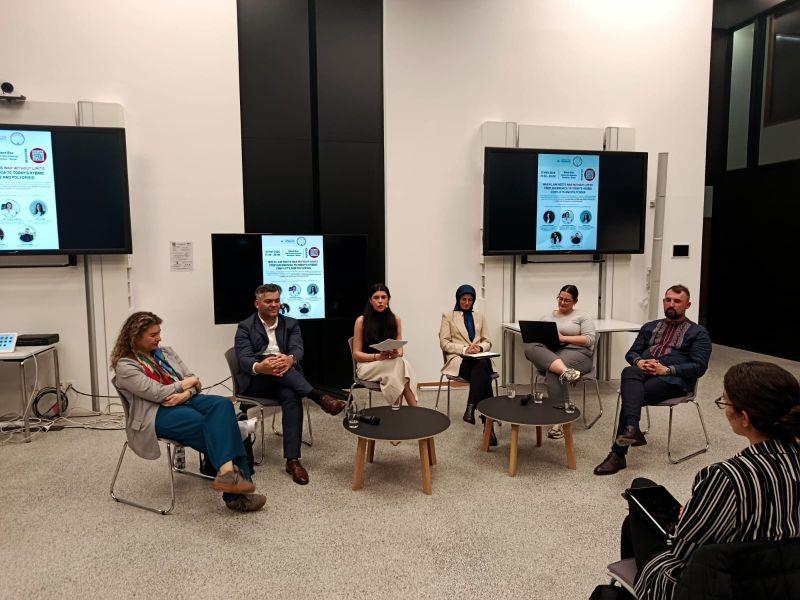
Reflecting on this dynamic, Dr Muharemović argued that the central problem today is not a lack of information. Modern societies are exceptionally effective at documenting violence, war crimes, and humanitarian crises in real time. What is increasingly absent, however, is political responsibility. The widening gap between awareness and action risks normalizing selective enforcement and weakening the deterrent capacity of international law itself.
The panel also highlighted the importance of maintaining historical memory in the face of growing relativization and denial. More than three decades after the Srebrenica genocide and the war in Bosnia and Herzegovina, the legacy of those events continues to shape debates about accountability, reconciliation, and democratic resilience in Europe and beyond. By situating Srebrenica within broader discussions about today’s hybrid conflicts and global “polycrisis,” the event underscored that the questions raised by Bosnia are not confined to the Balkans alone. They speak directly to the future of international order itself.
The conference formed part of a broader series of initiatives organized by the Uni.lu Diplomacy Lab and the Srebrenica Committee Luxembourg dedicated to examining nationalism, transitional justice, memory politics, and the future of European and international security. For ESILUX, participation in such debates reflects the Institute’s wider commitment to evidence-based analysis of Europe’s strategic, institutional, and democratic challenges, particularly at a time when the resilience of international norms can no longer be taken for granted.
As contemporary conflicts continue to test the credibility of international institutions, the discussion in Belval served as a reminder that the central challenge facing international law today is not simply legal or technical. It is fundamentally political: whether democratic societies and international actors remain willing to defend the principles they claim to uphold when doing so becomes costly, difficult, or strategically inconvenient.
Photo credit: Srebrenica Committee Luxembourg.